

Bambu Lab X2D 2026
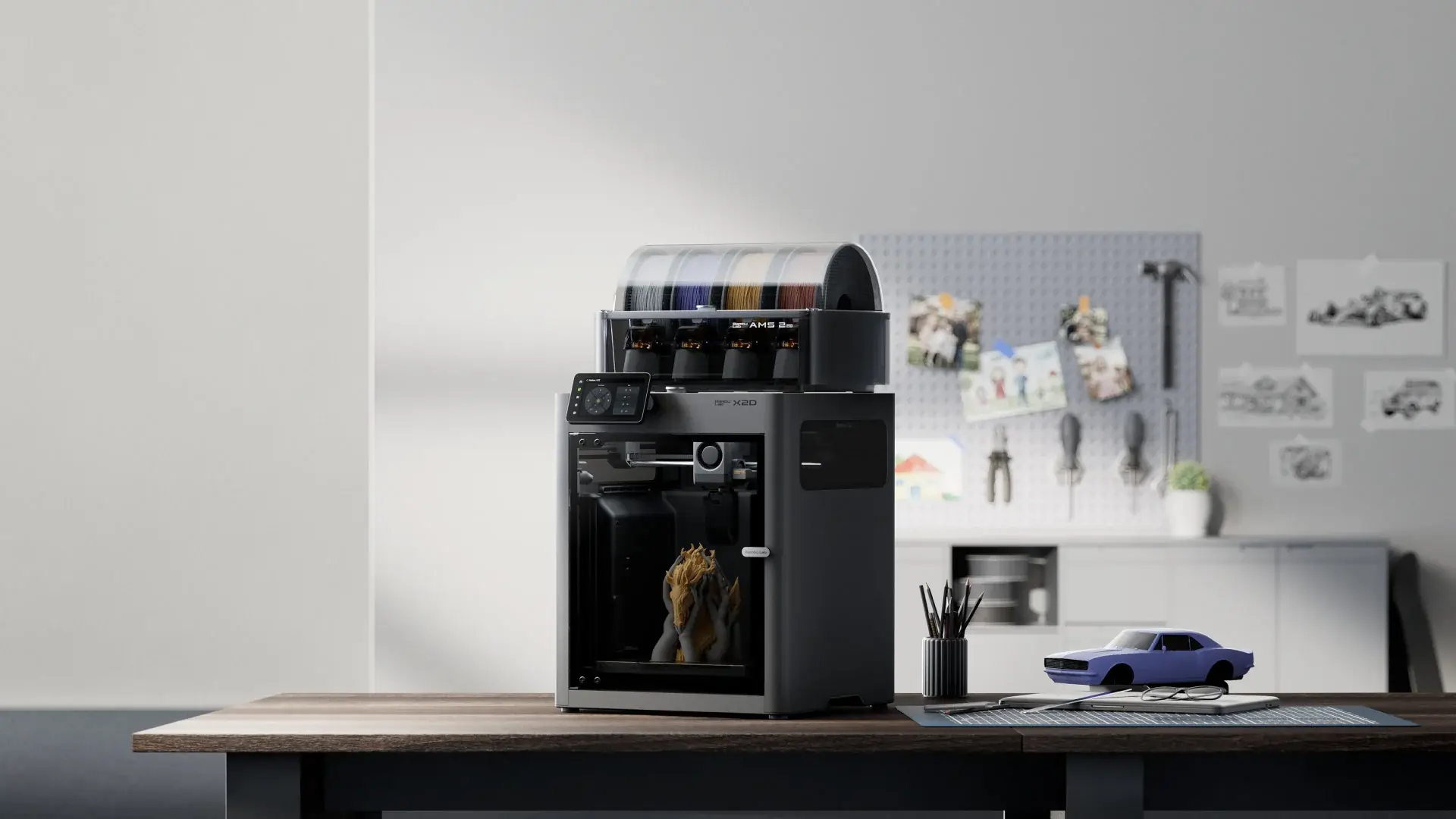
Bambu Lab officially unveiled the X2D today, April 14, 2026, at 10 AM EDT — the direct successor to the X1 Carbon, which the company quietly discontinued last month. The X2D brings dual-nozzle printing to Bambu’s compact X-series form factor for the first time, positioned between the single-extrusion P2S and the large-format H2D. Pre-leak community estimates put the base price at approximately $1,049 (without AMS) and $1,299 for the Combo configuration including the Automatic Material System. Those figures are unverified by the official spec sheet at time of writing — check Bambu Lab’s X2D product page for confirmed pricing as it updates. TechRadar published an early hands-on review within hours of launch, calling the dual-nozzle system and print quality “exceptional.”
This article will update as official specifications are confirmed. Specs marked ✅ are confirmed by Bambu Lab or pre-production hardware sightings. Specs marked ⚠️ come from community analysts and pre-launch leaks.
Table of Contents
What the X2D is, and where it sits in the lineup
The X1 Carbon launched on Kickstarter in May 2022, raised over $7 million, and became the benchmark for serious desktop FDM for three years running. When Bambu Lab officially declared the entire X1 series end-of-life in early April 2026 — firmware support until May 2027, security patches until May 2029, spare parts until March 2031 — it left a specific gap in the lineup.
The P2S ($549) already existed as the practical mid-range option. The H2D ($1,749–$1,999) covers large-format dual-extrusion with optional laser and blade cutting. Neither fills the “serious prosumer desktop printer with dual extrusion at under $1,100” space the X1C previously occupied for high-end single-nozzle work. VoxelMatters’ coverage of the launch describes the X2D as filling exactly that professional desktop dual-extrusion segment.
The X2D is that machine. Or more precisely: it’s the X1C’s replacement, with a dual-nozzle system grafted onto a body that community photos suggest shares the same compact enclosed form factor as its predecessor. For a full ranking of where it sits against the competition outside Bambu’s lineup, we’ll update our best 3D printers 2026 guide once first-wave reviews confirm real-world print quality.
Bambu’s current 2026 lineup, for context:
| Model | Price | Key differentiator |
|---|---|---|
| A1 Mini Combo | $449 | Entry-level, open-frame |
| P2S | $549 | Best single-nozzle compact; X1C killer for most use cases |
| X2D | ~$1,049 / $1,299 Combo | Dual extrusion, X-size body, LiDAR ⚠️ |
| H2S | $1,249 | Double build volume, single nozzle, high-speed |
| H2D | $1,749–$1,999 | Dual nozzle, large format, optional laser |
| H2C | $2,399+ | Vortek 6-hotend tool changer, near-zero purge waste |
Confirmed and leaked specs
| Spec | Value | Status |
|---|---|---|
| Build volume (single nozzle) | 256×256×256 mm | ⚠️ Leak |
| Build volume (dual nozzle) | ~235×235×250 mm | ⚠️ Estimate |
| Extruder configuration | One direct-drive + one Bowden | ⚠️ Leak |
| Nozzle system | Nozzle lifter with wiper | ✅ Teaser imagery |
| Nozzle type | 2-series (shared with H2D/H2S) | ⚠️ Leak |
| Max nozzle temperature | 350°C | ⚠️ Leak |
| Max build plate temperature | 120°C | ⚠️ Leak |
| Heated chamber | 65°C | ⚠️ Leak |
| LiDAR module | Yes (similar to X1C) | ✅ Teaser imagery |
| BirdsEye top-down camera | Yes | ✅ Teaser imagery |
| Dedicated TPU feeder | Reported | ⚠️ Community reports |
| Supported filaments | PLA, PETG, ABS, ASA, Nylon, TPU, PA-CF | ⚠️ Inferred from chamber temp |
All ⚠️ specs are pre-launch community estimates. Verify against Bambu Lab’s official spec sheet before purchase.
The dual extrusion architecture: what it actually means
The X2D’s dual-nozzle system works differently from the H2D’s. Where the H2D uses two direct-drive extruders on a single printhead with a sophisticated switching mechanism, the X2D combines one direct-drive extruder with a second Bowden-fed extruder. A nozzle lifter raises and lowers the inactive nozzle out of the print path, with a wiper to clean it on transition.
This is a meaningful architectural choice. The direct-drive nozzle handles the primary print material — including flexible filaments like TPU, which Bowden setups handle poorly due to feed compression. The Bowden nozzle handles the secondary material, typically a support interface filament or a second rigid material. You don’t need flexible printing on your support material; you need reliable switching.
What dual extrusion actually enables:
- Soluble and breakaway supports — print HIPS or PVA supports that dissolve or snap clean off, with no post-processing sanding on complex internal geometries
- Two-material functional prints — rigid structural shell with a flexible TPU grip, printed in one job without manual filament swaps
- Color separation without AMS purge waste — on a two-color job, dual nozzles eliminate the AMS color-change purge cycle almost entirely. The AMS purge waste in single-nozzle multi-color printing can consume 5–15% of total filament on a complex job
What it doesn’t enable: The X2D is not an IDEX system (independent dual extrusion with two carriages, like some Creality models offer). Both nozzles share the same motion system. This means no duplicate/mirror mode — you cannot print two identical parts simultaneously on opposite halves of the build plate. That’s an H2D-class feature.
For the target use case — engineering-grade prints with proper support material and occasional flexible-rigid hybrid parts — the X2D’s architecture is precisely what’s needed without the complexity overhead of true IDEX.
The TPU feeder: the detail the community noticed first
Community pre-launch analysis compiled by All3DP flagged the X2D’s reported dedicated TPU feeding mechanism as one of its most significant practical improvements. Flexible filaments (TPU, TPE) have been a consistent frustration point in Bambu’s AMS ecosystem — they bind, slip, and clog in ways that rigid filaments don’t. Most users work around this by bypassing the AMS entirely and running TPU directly from an external spool.
A purpose-built TPU intake path at the hardware level would address the three main failure modes: slow feeding due to compression, jamming at the Bowden entry, and slipping under tension. If this functions as reported, it removes the most common manual intervention in a Bambu workflow.
The community speculation that this TPU feeder module might be sold as a separate accessory compatible with other Bambu printers hasn’t been confirmed — but if it is, that’s a more significant ecosystem development than the X2D itself for the existing user base.
Why now, and what took so long
The X1 Carbon launched in 2022 with a feature set that was genuinely ahead of its competition. By 2025, the P2S had absorbed most of what made the X1C compelling — CoreXY motion, full enclosure, AMS compatibility, LiDAR-assisted calibration — at a lower price point. Bambu publicly acknowledged the X1 series was end-of-life rather than quietly sunsetting it, which is unusual transparency from a hardware company.
The gap between X1C discontinuation and X2D announcement was approximately two to three weeks. The Bambu Lab community forum announcement — tagged “Ready. Set. neXt” with the April 14 launch date — was teased with enough lead time that review units reached US Microcenter warehouses before the official announcement. This is a standard Bambu launch cadence: the H2D and P2S both followed the same pre-seeding pattern.
The dual extrusion focus reflects where Bambu’s competitive pressure actually sits in 2026. Creality’s K2 Combo and Qidi’s models are closing the gap on single-nozzle speed and quality. The H2C’s Vortek tool-changing system made Bambu the only affordable multi-material option with near-zero purge waste for users who need 6+ materials. The X2D extends Bambu’s two-material story into the compact form factor that the majority of desktop users are actually buying.
Should you buy the X2D — or wait?
Buy the X2D if:
- You print engineering materials (ABS, ASA, Nylon-CF) that require a heated chamber and you currently own a P2S or X1C
- You do multi-material work where soluble or breakaway supports would meaningfully improve your output
- Your workflow is two-material — not 4–16 color (that’s what the AMS + P2S or H2C handle)
- You want the smallest dual-extrusion Bambu machine available
For detailed filament settings for engineering materials on heated-chamber printers, see our ABS and ASA filament guide.
Buy the P2S instead if:
- Your work is primarily PLA/PETG single-material at speed
- You don’t need a heated chamber
- Budget is the primary constraint — the P2S at $549 delivers excellent quality for most desktop use cases
Buy the H2D instead if:
- You need more than 256mm build volume
- The optional laser cutting module is relevant to your workflow
- You regularly work with advanced engineering filaments above what the X2D’s chamber temperature supports
Wait on the X2D if:
- You want to see first-wave owner reviews before committing at ~$1,049. Bambu’s launch track record is strong — the P2S and H2D shipped without major regressions — but the new nozzle lifter mechanism and TPU feeder are novel components that deserve real-world stress testing beyond pre-release units
Where to buy and what to expect at launch
Based on previous Bambu Lab launches, pre-orders typically open on the same day as the announcement. The Bambu Lab US store is the primary direct channel. Microcenter carries Bambu Lab hardware in-store across US locations; stock on launch day tends to sell through fast. Amazon typically lists within days of launch.
There are no announced international shipping timelines at time of writing. Previous Bambu launches have shipped EU/UK stock within 2–4 weeks of US availability.
For filament recommendations once you have the X2D in hand, see our best 3D printer filament guide — particularly the engineering materials section covering ABS, ASA, and Nylon-CF that the X2D’s heated chamber unlocks.
Frequently asked questions
What is the Bambu Lab X2D?
The Bambu Lab X2D is a dual-nozzle FDM 3D printer announced on April 14, 2026, positioned as the direct successor to the X1 Carbon. It combines one direct-drive and one Bowden extruder in a compact enclosed body with a nozzle-lifting switching mechanism. It targets makers who need dual extrusion for support material printing and multi-material work without the larger footprint of the H2D.
How much does the Bambu Lab X2D cost?
Pre-launch community estimates put the X2D at approximately $1,049 without AMS and $1,299 for the Combo configuration including the Automatic Material System. These figures should be verified against Bambu Lab’s official pricing page — they have not been confirmed by official documentation at time of writing.
What is the build volume of the Bambu Lab X2D?
The X2D’s build volume is estimated at 256×256×256mm in single-nozzle mode, reducing to approximately 235×235×250mm in dual-nozzle mode to accommodate the nozzle-switching mechanism. These figures are pre-launch estimates; confirm on Bambu Lab’s spec sheet.
How does the X2D differ from the P2S?
The P2S ($549) is a single-nozzle printer. The X2D adds dual extrusion, a heated chamber (65°C, enables ABS/ASA/Nylon printing — Bambu Lab’s filament compatibility wiki covers recommended settings), a higher max nozzle temperature (350°C), and the BirdsEye top-down camera. The P2S is the right choice for high-speed PLA/PETG work; the X2D is for engineering materials and two-material prints.
How does the X2D differ from the H2D?
The H2D ($1,749–$1,999) offers a larger build volume (350×320×325mm), an optional laser engraving and blade cutting module, and a more sophisticated extruder system. The X2D’s build volume stays at 256mm cube — the same compact footprint as the X1C. The X2D will be meaningfully cheaper and physically smaller; the H2D is for users who need the extra volume or the laser module.
Is the X2D compatible with existing Bambu AMS units?
Based on Bambu’s previous hardware compatibility patterns and the Combo configuration being sold with AMS, yes — but verify on the official spec page. The X2D’s Combo listing implies AMS 2 Pro or AMS Lite compatibility at minimum.