



Aerospace 3D Printing 2026
Introduction
Aerospace 3D printing achieved what seemed impossible in December 2025: fully functional rocket engines manufactured in under three weeks. LEAP 71, a computational engineering firm, designed, printed, and hot-fire tested two complete methane-fueled engines—each generating 20 kilonewtons of thrust—in a timeline that compresses traditional 6-18 month development cycles by over 90%. This breakthrough represents more than incremental progress; it signals a fundamental transformation in how humanity engineers propulsion systems for space access.
The global aerospace 3D printing market reached $4.04 billion in 2025 and projects growth to $14.53 billion by 2032, driven by a compound annual growth rate of 20.1%. Major aerospace manufacturers now achieve 40-60% weight reduction in rocket components through additive manufacturing, while companies like SpaceX reduce part counts by 30% through advanced metal printing techniques. LEAP 71’s dual-engine demonstration utilized CuCrZr copper alloy—a material engineered to withstand combustion temperatures exceeding 5,000°F—printed by Aconity3D’s specialized systems and validated through rigorous hot-fire testing that confirmed 93% combustion efficiency.
Material innovations extend beyond copper alloys. NASA’s Glenn Research Center developed GRCop-42, a copper-chromium-niobium formulation optimized specifically for additive manufacturing, enabling full-scale rocket components that previously required extensive casting and machining. SpaceX’s Raptor 3 engine integrates monolithic turbopump housings and injector plates with internal cooling channels—geometries impossible through conventional fabrication. Agnikul Cosmos pushed boundaries further in October 2025, successfully flight-testing the world’s first single-piece 3D-printed rocket engine, eliminating every weld, fastener, and joint that traditionally create failure points.
This transformation delivers tangible economic benefits: 50% cost reduction targets at NASA, 30% part count decreases at SpaceX, and production timelines shortened from months to weeks at companies like Ursa Major. The following analysis examines the engineering breakthroughs, material science advances, manufacturing technologies, and strategic implications reshaping rocket propulsion through additive manufacturing.
The Aerospace 3D Printing Revolution: Market Scale and Trajectory
The aerospace additive manufacturing sector occupies a critical position within the broader $18.3 billion industrial 3D printing market projected to reach $73.8 billion by 2035 at a 15.1% compound annual growth rate. Fortune Business Insights reports aerospace-specific applications grew from $3.53 billion in 2024 to $4.04 billion in 2025, maintaining accelerated expansion toward the $14.53 billion target by 2032. This 20.1% annual growth rate substantially exceeds traditional aerospace manufacturing sectors, driven by fundamental shifts in production economics and engineering capabilities.
North America commands 34.84% of the global aerospace 3D printing market share as of 2024, supported by established manufacturing infrastructure and concentrated aerospace expertise. The United States aerospace sector maintains the world’s largest production base for military aircraft, commercial transports, and launch vehicles—infrastructure that enables rapid adoption of advanced manufacturing techniques. Within the aerospace and defense segment specifically, additive manufacturing captured 20.6% market share in 2025, with engine components representing 52.54% of revenue within this category.
Metal alloys dominate material utilization at 60.50% market share, with specialty and refractory metals experiencing the fastest growth at 25.74% compound annual rates. This concentration reflects fundamental physics: rocket propulsion demands materials that simultaneously withstand extreme temperatures, maintain structural integrity under massive mechanical loads, and conduct heat efficiently for thermal management. Traditional materials like stainless steel and aluminum serve structural roles, but copper alloys, titanium formulations, and nickel superalloys enable the combustion chambers, turbopumps, and thermal management systems that define engine performance.
Boeing’s implementation of additive manufacturing across its aerospace programs demonstrates the economic transformation occurring industry-wide. The company achieved 80-90% reductions in tooling costs for complex components by eliminating custom fixtures, molds, and machining setups required for traditional fabrication. When Boeing manufactures a titanium structural bracket through conventional machining, the process begins with a 10-kilogram titanium billet, machines away 9 kilograms of material waste, and requires specialized cutting tools that wear rapidly against titanium’s hardness. The same bracket printed through powder bed fusion consumes 1.2 kilograms of titanium powder, generates minimal waste, and produces near-net-shape parts requiring limited finishing operations.
Global Market Insights analysis projects industrial 3D printing will capture increasing shares of aerospace production volume as equipment capabilities scale and certification processes mature. Weight reduction constitutes perhaps the most compelling immediate benefit: aerospace engineers quantify every gram of structure translating to payload capacity or propellant requirements. Industry data confirms 3D-printed aerospace components achieve up to 55% weight reduction compared to traditionally manufactured equivalents through topology optimization and internal lattice structures impossible to create through casting or machining.
Production speed advantages compound economic benefits. Ursa Major Technologies, an American rocket engine manufacturer, operates a metal additive manufacturing facility in Ohio producing copper combustion chambers in one-month cycles. Traditional fabrication timelines for equivalent combustion chambers span 6-12 months, accounting for casting lead times, precision machining operations, and brazing assembly of internal cooling channels. This six-fold acceleration enables Ursa Major to iterate engine designs rapidly, respond to customer requirements faster than competitors, and maintain lean inventory models by manufacturing components on-demand rather than stockpiling months of production.
Investment flows reflect market trajectory confidence. Germany allocated substantial government subsidies supporting aerospace additive manufacturing development through 2025, recognizing strategic importance to European industrial competitiveness. Relativity Space raised $1.3 billion in private funding through 2023, achieving a $4.5 billion valuation as the second-most valuable private space company globally. Venture capital and strategic aerospace investment concentrates on companies demonstrating additive manufacturing as core enabling technology rather than supplemental capability.
Market consolidation risks emerge as equipment manufacturers and material suppliers concentrate. A handful of industrial 3D printer manufacturers—Velo3D, EOS, AMCM, Nikon SLM Solutions—supply the majority of high-end metal powder bed fusion systems capable of aerospace-grade production. Metal powder suppliers similarly concentrate among established materials companies with aerospace certification capabilities. This supply chain centralization creates potential bottlenecks during rapid industry expansion and concentrates technological control among few entities.
Regulatory challenges present ongoing obstacles to accelerated adoption. The Federal Aviation Administration developed additive manufacturing-specific guidance through Advisory Circular AC 20-180 in 2023, establishing frameworks for certifying 3D-printed aircraft and rocket components. Certification processes remain substantially longer than development timelines—SpaceX’s Starship program faces recurring launch approval delays while engine hardware sits ready. Small launcher startups encounter years-long certification processes that consume capital and delay market entry, even as their 3D-printed engines demonstrate technical readiness through extensive testing.
Quality assurance complexity increases with additive manufacturing adoption. Traditional components undergo well-established inspection protocols—visual examination, dye penetrant testing, X-ray verification of welds. Additively manufactured parts require computed tomography scanning to detect internal porosity, acoustic tomography for large structures where X-ray penetration proves insufficient, and statistical process control monitoring build parameters throughout multi-day print operations. These inspection requirements demand $500,000-$2 million capital investments in metrology equipment, plus specialized personnel trained in interpreting complex scan data.
Economic barriers to entry remain substantial despite improving accessibility. Blue Origin invested $200 million constructing its Alabama rocket engine factory incorporating extensive additive manufacturing capabilities for BE-4 engine production. This facility-scale investment enables production of dozens of engines annually but remains accessible only to well-capitalized aerospace corporations or heavily funded startups. Smaller aerospace suppliers incrementally adopt additive manufacturing through service bureau partnerships, purchasing 3D-printed components rather than operating in-house equipment until production volumes justify capital expenditure.
Mordor Intelligence forecasts continued aerospace additive manufacturing expansion across both traditional manufacturers and new space companies through 2030, with inflection points occurring as certification processes streamline and equipment costs decline through competition and technological maturation. The market evolution parallels earlier aerospace technology adoption curves—initially concentrated among well-capitalized first-movers, gradually diffusing across the industry as capabilities prove out and economic advantages become undeniable.
The trajectory toward $14.53 billion by 2032 assumes continued resolution of technical challenges, regulatory framework maturation, and sustained aerospace sector growth driving demand for more efficient manufacturing approaches. Geopolitical factors including space commercialization acceleration, military modernization programs emphasizing rapid prototyping, and international competition in launch capabilities all contribute to market expansion momentum. Material science breakthroughs enabling new alloy formulations, printer technology advancing toward larger build volumes and faster deposition rates, and computational design tools optimizing geometries for additive manufacturing collectively support this growth projection.
Engineering Breakthroughs: Case Studies of 3D-Printed Rocket Engines
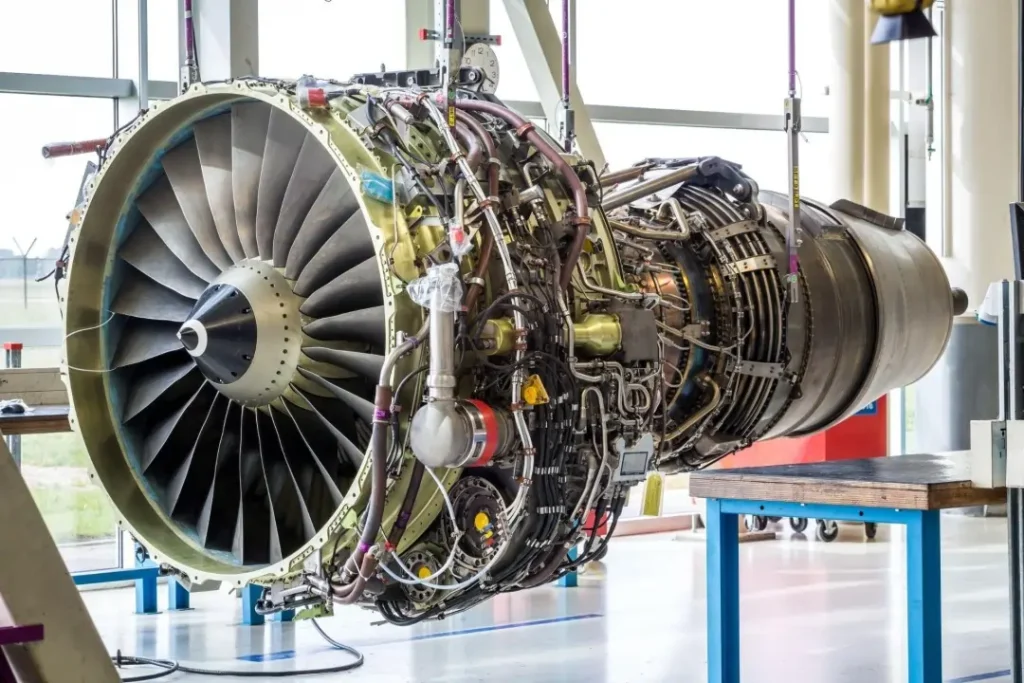
LEAP 71’s AI-Designed Methane Engines: 3 Weeks from Concept to Hot Fire
LEAP 71’s December 2025 achievement compresses rocket engine development timelines to scales previously considered impossible. The computational engineering firm designed, manufactured, and successfully hot-fire tested two complete methane-oxygen rocket engines in under three weeks—a timeline that traditional aerospace engineering approaches require 6-18 months to accomplish. Each engine generates 20 kilonewtons of thrust, equivalent to approximately two metric tons of force, burning methalox propellant combinations identical to those employed by SpaceX’s Starship and Blue Origin’s New Glenn launch vehicles.
The technical specifications demonstrate production-ready performance rather than laboratory demonstrations. LEAP 71’s bell nozzle configuration achieved 93% combustion efficiency during hot-fire testing, matching theoretical predictions and meeting target pressure and thrust parameters. This efficiency level indicates complete fuel combustion with minimal losses—critical for orbital-class propulsion where every percentage point of efficiency translates directly to payload capacity or mission range. The company simultaneously tested an aerospike nozzle design, an unconventional configuration featuring a central spike rather than traditional bell geometry, providing altitude compensation benefits that conventional nozzles cannot achieve.
Material selection proved central to rapid development success. 3DPrint.com reports LEAP 71 selected CuCrZr copper alloy for combustion chamber construction—a formulation combining copper’s exceptional thermal conductivity with chromium and zirconium additions providing high-temperature mechanical strength. Combustion temperatures in methane-oxygen engines reach 3,500 Kelvin (5,840°F), requiring materials that simultaneously conduct heat away from combustion surfaces while maintaining structural integrity under these thermal loads. German manufacturer Aconity3D printed the engine components using selective laser melting equipment optimized for copper alloy processing, which presents unique challenges compared to more commonly printed materials like titanium or stainless steel.
The artificial intelligence integration fundamentally differentiates LEAP 71’s approach from traditional aerospace engineering workflows. The company’s proprietary Noyron computational engineering system functions as a large language model trained specifically for engineering applications. Engineers input performance requirements—thrust target, propellant combination, operating pressure, thermal constraints—and Noyron autonomously generates complete three-dimensional engine geometries optimized for these parameters. This generative process evaluates thousands of design variations in hours, exploring configuration spaces far broader than human engineers could assess manually. The system integrates physics models for thermodynamics, fluid dynamics, structural mechanics, and additive manufacturing constraints, ensuring generated geometries both perform as required and remain manufacturable through available 3D printing processes.
LEAP 71’s roadmap demonstrates ambitions extending well beyond laboratory-scale demonstrations. The company announced plans for 200 kilonewton and 2,000 kilonewton engines in 2026, representing 10-fold and 100-fold thrust increases respectively from their initial 20 kilonewton demonstrators. A 2,000 kilonewton engine generates approximately 200 metric tons of thrust—approaching the scale of SpaceX’s Raptor 3 engine and substantially exceeding engines powering most existing commercial launch vehicles. Achieving this scale requires printer build chambers accommodating multi-meter components or advanced multi-piece printing strategies with high-strength joining techniques.
The commercial and strategic implications extend beyond LEAP 71’s immediate products. Multiple aerospace companies globally monitor and adopt similar computational design approaches, recognizing that algorithmic engineering enables design exploration impossible through conventional methods. The three-week development cycle allows LEAP 71 to serve multiple customers simultaneously, iterating engine designs rapidly in response to specific mission requirements. This responsiveness contrasts sharply with traditional aerospace suppliers operating on multi-month or multi-year development timelines with limited design iteration opportunities.
Critical assessment reveals important validation gaps despite impressive demonstrations. While LEAP 71’s engines performed successfully during initial hot-fire tests, long-term durability remains unproven. Orbital-class engines undergo hundreds or thousands of thermal cycles—repeated heating to combustion temperatures and cooling to ambient or cryogenic propellant temperatures. These thermal cycles impose fatigue stresses potentially revealing defects or failure modes not apparent in limited testing. SpaceX targets 1,000+ firings for Raptor 3 before refurbishment, establishing reliability benchmarks that new engine designs must eventually demonstrate.
Manufacturing validation challenges emerge when scaling to larger thrust classes. The 2,000 kilonewton engines planned for 2026 require build chambers and print parameters substantially beyond current demonstrated capabilities. Thermal management during printing becomes more complex with larger copper components, as thermal gradients can induce cracking or warping during the build process. Post-processing requirements similarly scale—hot isostatic pressing chambers large enough to accommodate multi-meter engine sections, heat treatment furnaces with sufficient capacity, and inspection equipment capable of scanning dense copper structures.
Supply chain implications warrant consideration as computational design and rapid manufacturing diffuse across the aerospace industry. Centralized metal 3D-print facilities serving multiple engine developers create efficiency through equipment utilization but introduce single-point failure risks and potential intellectual property concerns when competitors share manufacturing infrastructure. LEAP 71’s model of partnering with Aconity3D for production demonstrates one approach, though scaling to dozens or hundreds of engines may require distributed manufacturing capacity.
The validation of methalox propellant combinations through LEAP 71’s work provides confidence for broader industry adoption. Both SpaceX and Blue Origin selected methane-oxygen for their next-generation engines based on theoretical advantages—methane’s higher performance compared to traditional kerosene, lower coking compared to heavier hydrocarbons, and potential for in-situ production from Martian atmospheric CO2. LEAP 71’s rapid demonstration that 3D-printed copper alloy chambers successfully handle methalox combustion confirms viability and potentially accelerates development timelines for other organizations pursuing similar propellant combinations.
SpaceX Raptor 3: Part Consolidation Through Advanced Metal Printing
SpaceX unveiled Raptor 3 during August 2024 flight tests aboard Starship, revealing extensive additive manufacturing integration that achieves 30% part count reduction compared to Raptor 2. Metal AM Magazine analysis documents how the engine generates 21% more thrust than its predecessor while weighing 7% less—performance improvements enabled primarily through advanced metal printing techniques consolidating what previously required separate components and assembly operations.
The integrated turbopump housing represents perhaps the most significant single part consolidation achievement. Traditional rocket engine turbopumps assemble multiple machined components—inlet housing, bearing cartridge, shaft seal housing, outlet manifold—through precision welding or bolted joints with gasket seals. Each interface introduces potential leak paths, thermal expansion mismatches, and stress concentrations where fatigue cracks initiate. Raptor 3’s turbopump housing integrates these previously separate elements into a single 3D-printed geometry, eliminating dozens of welds and joint interfaces. This consolidation reduces part count, simplifies assembly, removes leak-prone connections, and enables internal flow passages optimized for fluid dynamics rather than constrained by assembly requirements.
The monolithic injector plate similarly demonstrates additive manufacturing’s capability to integrate complex functionality within single components. Rocket engine injectors mix propellants prior to combustion, traditionally accomplished through hand-stacked injector elements—hundreds of small tubes or posts arranged in precise patterns, then brazed into a structural plate. This assembly process requires extreme precision, generates numerous brazing joints potentially containing defects, and limits injector pattern optimization to manufacturable geometries. SpaceX’s 3D-printed injector integrates propellant passages, injector elements, and internal cooling channels within a single monolithic structure printed in one continuous build operation. This integration eliminates hundreds of potential failure points while enabling injector patterns optimized computationally rather than constrained by fabrication limitations.
Nozzle throat reinforcement through graded cellular cooling lattice structures exemplifies design capabilities unique to additive manufacturing. The nozzle throat experiences the highest heat flux in rocket engines—combustion gases at 3,500+ Kelvin flowing through the minimum cross-sectional area at sonic velocity. Traditional nozzle throats require thick copper alloy construction to survive these conditions, with regenerative cooling channels machined or cast into the structure. Raptor 3’s throat incorporates internal lattice structures with varying porosity and geometry creating enhanced heat transfer while maintaining structural strength. These graded lattices concentrate cooling capacity where thermal loads peak while minimizing mass in lower-stress regions—optimization impossible through traditional manufacturing approaches.
SpaceX’s technology stack centers on laser powder bed fusion, deploying more than twenty Velo3D Sapphire systems across manufacturing facilities in Boca Chica, Texas. Velo3D’s equipment distinguishes itself through capabilities printing geometries with minimal support structures—critical when manufacturing complex internal passages and overhanging features characteristic of optimized rocket engine components. The company announced an $8 million licensing agreement with Velo3D in September 2024, securing non-exclusive access to proprietary printing technologies and twelve-month rights to improvements Velo3D develops—insurance against competitive disadvantages if rivals gain superior additive manufacturing capabilities.
The design philosophy underlying Raptor 3 extends beyond simply consolidating existing parts. SpaceX engineers internalized secondary flow paths—coolant passages, turbopump drive gas feeds, pressurization lines—within primary structures rather than running them as external plumbing. This internalization eliminates brackets, clamps, and protective heat shielding required when lines route outside engine structures. Engineers similarly applied regenerative cooling to all exposed components operating in hot environments, eliminating separate heat shields and active fire suppression systems present in Raptor 2. These systematic optimizations compound weight savings and reliability improvements beyond simple part count reduction.
Elon Musk’s August 2024 claim that Raptor 3 represents “the most advanced 3D metal printing technology in the world” reflects SpaceX’s vertical integration strategy and substantial capital investment in additive manufacturing infrastructure. While comparisons prove difficult given limited public data from competitors, SpaceX’s deployment of 20+ high-end metal printers at a single facility represents manufacturing capacity rivaling or exceeding most aerospace companies globally. This capacity enables rapid iteration—design modifications implemented overnight through software changes, components printed within days, and validation testing completed within weeks rather than months or years required when outsourcing manufacturing or operating traditional production lines.
Cross-industry influence emerges as GE Aerospace and Siemens study Raptor’s cooling lattice concepts for gas turbine applications. Industrial turbines operate at lower temperatures than rocket engines but face similar thermal management challenges in optimizing efficiency while maintaining material durability. The graded cellular lattice approach demonstrated in Raptor 3 translates potentially to turbine blade cooling, combustor liner thermal management, and other applications where traditional cooling approaches constrain performance or require exotic materials.
Challenges persist despite demonstrated successes. Supply chain overreliance on a single manufacturing facility in Boca Chica creates potential vulnerabilities—natural disasters, industrial accidents, or regulatory shutdowns could halt Raptor production entirely. SpaceX reportedly operates backup capabilities, though details remain unpublicized for competitive and security reasons. Regulatory hurdles continue affecting Starship launch cadence, with Federal Aviation Administration certification processes extending timelines despite hardware readiness. Post-2026 regulatory framework evolution remains uncertain as FAA adapts policies for reusable launch vehicle operations including extensively 3D-printed propulsion systems.
Inspection complexity increases with internal lattice structures and consolidated geometries. Non-destructive evaluation techniques must verify internal features invisible to external examination—computed tomography scanning reveals porosity and internal defects, but scanning multi-ton assemblies with dense materials requires specialized equipment and substantial time. SpaceX likely employs acoustic tomography or other complementary techniques, though specific quality assurance processes remain proprietary. The inspection requirements add cost and time to production workflows, partially offsetting rapid printing advantages.
Single-Piece Revolution: Agnikul’s Agnilet and the Elimination of Assembly
Agnikul Cosmos achieved a fundamental manufacturing breakthrough in October 2025, successfully flight-testing the world’s first single-piece 3D-printed rocket engine. The Agnilet engine powers the company’s Agnibaan small satellite launch vehicle, manufactured entirely in one continuous additive manufacturing build operation without any subsequent assembly. This monolithic construction eliminates every joint, weld, fastener, and interface that traditional rocket engines require—removing hundreds of potential failure points simultaneously.
Thomas Net reports the United States Patent and Trademark Office awarded Agnikul a patent for this single-piece integration technology in October 2025, recognizing the novelty of manufacturing complete functional rocket engines without assembly operations. The patent covers specific approaches for managing thermal expansion in unified structures and techniques for printing complex internal geometries characteristic of combustion chambers, cooling channels, turbomachinery, and propellant feeds within a single build.
Traditional rocket engines comprise 100-1,000+ individual parts depending on complexity and thrust class. A medium-performance engine includes combustion chamber sections, injector assemblies with hundreds of individual elements, turbopump components including impellers and stators, propellant valves and actuators, cooling system manifolds, structural mounts and gimbal systems. Each component requires precision manufacturing, then assembly operations joining parts through welding, brazing, bolting, or other fastening methods. Every interface introduces tolerance stack-up—dimensional variations accumulating as parts join together. Gaskets and seals prevent propellant leakage but constitute potential failure modes under thermal cycling and vibration.
Agnilet’s monolithic construction fundamentally eliminates interface-related failure mechanisms. No welds exist to develop fatigue cracks or heat-affected zones with altered material properties. No bolted joints can loosen under vibration or create stress concentrations. No gaskets can degrade under thermal cycling or chemical exposure to propellants. No brazed joints can fail when thermal expansion coefficients mismatch between joined materials. This elimination of interfaces represents reliability improvement through subtraction—removing failure modes rather than strengthening against them.
The engineering principle underlying single-piece design centers on preventing failure initiation rather than containing failure propagation. Traditional multi-part engines employ safety factors and redundancy to manage inevitable interface imperfections. Welded joints receive X-ray inspection verifying full penetration; bolted assemblies employ lock-wiring preventing loosening; brazed cooling channels undergo pressure testing detecting leaks. These inspection and safety measures add cost, time, and weight while never eliminating risk entirely. Monolithic engines shift failure modes from interfaces to bulk material properties—porosity, inclusions, or manufacturing defects within the printed material itself rather than at joints between components.
Comparison with traditional assembly approaches quantifies the manufacturing transformation. A typical 20-kilonewton class engine comparable to Agnilet might contain 150-200 major components and 500+ fasteners, seals, and small parts. Assembly requires precision tooling ensuring components align within micron tolerances, welding operations demanding certified welders and post-weld heat treatment, and extensive testing verifying no leaks exist across dozens of sealed interfaces. Assembly timelines span weeks or months depending on engine complexity and production volume. Agnilet emerges from the 3D printer as a complete functional unit requiring only support structure removal, post-processing heat treatment, and final surface finishing on mounting interfaces.
Material complexity management presents the primary challenge in unified structures. Different engine sections experience vastly different operating conditions—combustion chamber walls reach temperatures exceeding 3,000 Kelvin, while exterior structural sections remain near ambient temperature or cool to cryogenic propellant temperatures. Thermal expansion coefficients determine how much material dimensions change with temperature. When separate components join together, engineers select materials optimized for each location and accommodate expansion differences through joint designs. Single-piece engines must employ materials with thermal expansion behavior tolerating the full temperature range experienced, or incorporate geometric features that accommodate expansion strains within the monolithic structure.
Weight versus reliability tradeoffs merit consideration. A monolithic engine potentially weighs more than an optimally designed multi-component equivalent because material selection must accommodate the most demanding conditions anywhere in the structure rather than optimizing locally. Traditional engines might use copper alloys only where extreme heat flux occurs, titanium in moderate-temperature structural sections, and aluminum or composites for low-temperature external structures. Single-piece printing currently requires consistent material throughout, though research explores gradient materials and multi-material printing for future applications.
Agnikul’s achievement carries particular significance as an IIT Madras spinoff company, demonstrating that breakthrough additive manufacturing capabilities extend beyond established aerospace corporations or heavily funded startups. The company developed its single-piece engine technology in India, accessing 3D printing equipment and material supplies available to academic and commercial organizations globally. This accessibility suggests additive manufacturing’s democratizing potential—reducing barriers to entry in rocket propulsion and enabling emerging space nations and commercial entities to develop indigenous launch capabilities without replicating the extensive supply chains and manufacturing infrastructure that traditional approaches require.
Flight validation in October 2025 confirmed Agnilet’s operational readiness, though long-term durability assessment awaits additional flight operations and engine inspections. The successful Agnibaan flight demonstrated that single-piece engines generate required thrust, withstand launch vibration and acceleration loads, and operate reliably in actual mission environments. These flight conditions impose stresses and thermal cycles difficult to replicate perfectly in ground testing, making flight validation critical for establishing confidence in new manufacturing approaches.
Defense Applications: New Frontier Aerospace Mjölnir for Hypersonics
New Frontier Aerospace completed critical hot-fire test series of its Mjölnir rocket engine in June 2025, validating a full-flow staged combustion cycle design optimized for both military hypersonic applications and commercial space propulsion. 3D Printing Industry reports the engine employs liquid natural gas fuel with potential for net carbon-negative operation when sourcing bio-waste-derived LNG, addressing environmental concerns increasingly relevant to aerospace operations.
Full-flow staged combustion represents the most thermodynamically efficient rocket engine cycle developed. Traditional engines operate as gas generators, burning a small portion of propellant to drive turbopumps that supply the main combustion chamber—wasting that gas generator exhaust overboard. Staged combustion cycles burn propellant in preburners driving turbopumps, then route the still-energetic exhaust into the main combustion chamber for complete expansion through the nozzle. Full-flow staged combustion extends this concept by running separate fuel-rich and oxygen-rich preburners, maximizing energy extraction while maintaining reasonable turbine operating temperatures. Only SpaceX’s Raptor, Russia’s RD-270, and a handful of other engines implement this complex but highly efficient cycle.
Mjölnir’s defense applications center on the Pathfinder hypersonic vertical takeoff and landing unmanned aerial system, currently in development with hover testing planned for 2026. Hypersonic flight—speeds exceeding Mach 5—presents extraordinary propulsion challenges. Air-breathing scramjet engines provide efficient hypersonic cruise but cannot operate below Mach 4, requiring rocket boosters for initial acceleration. Pathfinder integrates rocket propulsion enabling vertical takeoff, acceleration to scramjet operating speeds, and vertical landing for reusability. This combination demands compact, lightweight engines with rapid throttle response and reusability withstanding hundreds of flight cycles.
The Bifröst orbital transfer vehicle represents Mjölnir’s space application, targeted for 2027 operations. Orbital transfer vehicles maneuver satellites between orbits after initial launch—raising geostationary satellites from low Earth orbit parking locations, conducting plane changes requiring substantial velocity changes, or deorbiting satellites at end of life. These applications benefit from high specific impulse (fuel efficiency) that full-flow staged combustion provides, enabling mission performance with reduced propellant mass or extending operational lifetime through propellant conservation.
Funding sources illuminate defense sector interest in rapidly developed additive manufacturing-enabled propulsion. The Defense Innovation Unit provided seed capital for Mjölnir development, operating as a Department of Defense organization connecting military requirements with commercial technology development. DIU funding typically supports dual-use technologies relevant to both defense and commercial applications, avoiding traditional procurement processes that extend development timelines. NASA sustained testing support followed initial DIU investment, with test stands at NASA facilities providing environments for engine hot-fire validation under conditions simulating flight operations.
The “most advanced compact pump-fed rocket engine” claim reflects size optimization critical for both hypersonic vehicles and small spacecraft. Traditional rocket engines often demonstrate excellent performance characteristics but occupy substantial volume and mass—acceptable for large launch vehicles but problematic when engine size constrains vehicle design. New Frontier specifically designed Mjölnir for installation volume and mass efficiency while maintaining performance comparable to physically larger engines. Additive manufacturing enables this optimization through part consolidation and internal packaging density impossible with traditional assembly-based approaches.
Hypersonic context explains why the United States military prioritizes technologies like Mjölnir. Hypersonic weapons present detection and interception challenges for existing missile defense systems due to their speed and maneuverability. China demonstrated hypersonic vehicle capabilities including orbital fractional bombardment approaches, while Russia deployed Kinzhal and Avangard hypersonic systems. The United States pursues multiple hypersonic programs—Army Long-Range Hypersonic Weapon, Air Force AGM-183 ARRW, Navy Conventional Prompt Strike—all requiring propulsion systems enabling rapid development cycles to maintain pace with adversary capabilities.
3D printing specifically advantages classified military programs through multiple mechanisms. Rapid prototyping allows iterating engine designs in months rather than years, critical when intelligence reveals adversary advances requiring countermeasure development. Additive manufacturing’s digital nature enables geographically distributed production with identical build files, supporting resilient manufacturing infrastructure resistant to targeted strikes. The relatively small manufacturing footprint compared to traditional casting and machining operations allows establishing production capacity within secure facilities or hardened structures.
Reusability emphasis reflects both economic and operational advantages. Hypersonic test vehicles conducting dozens or hundreds of flight tests require engines withstanding repeated thermal cycles and mechanical loads without extensive refurbishment. Commercial space applications similarly benefit from reusable propulsion reducing operational costs—satellite servicing missions require multiple orbital transfer burns but can be operated more economically if engines require minimal maintenance between burns. New Frontier designed Mjölnir explicitly for rapid refurbishment, with additive manufacturing enabling on-demand replacement part production rather than maintaining extensive spare part inventories.
Material Science Enabling Extreme Performance
Copper Alloys: Conquering 5,000°F+ Combustion Chambers
Copper alloys represent the most critical material breakthrough enabling 3D-printed rocket engines to survive extreme combustion environments. NASA’s Glenn Research Center developed the GRCop family of alloys specifically optimized for additive manufacturing while maintaining performance characteristics required for rocket propulsion applications. The GRCop-42 formulation combines copper with chromium and niobium additions, creating material properties that resolve the fundamental contradiction between copper’s high thermal conductivity and the mechanical strength required at elevated temperatures.
Traditional copper presents significant challenges for rocket engine applications despite ideal thermal properties. Pure copper conducts heat exceptionally well—critical for combustion chamber liners where regenerative cooling removes heat by circulating cryogenic propellant through chamber walls. However, pure copper loses mechanical strength rapidly as temperature increases, creeping and deforming under the mechanical loads imposed by combustion pressure and thermal gradients. Copper also proves notoriously difficult for additive manufacturing: its high reflectivity causes laser beams to bounce rather than absorb energy melting powder, and rapid solidification generates internal stresses causing cracking.
NASA’s metallurgical innovations solved these fundamental limitations. The chromium additions in GRCop-42 form fine precipitates throughout the copper matrix, pinning grain boundaries and preventing dislocation movement that causes high-temperature creep. Niobium further strengthens the alloy while maintaining thermal conductivity at approximately 70% of pure copper—substantially higher than steel or nickel alloys. Modified powder metallurgy techniques produced copper alloy powder particles with controlled size distributions and surface characteristics enabling reliable laser powder bed fusion processing.
NASA documented Relativity Space’s Terran 1 rocket employing nine Aeon engines manufactured with GRCop-42 combustion chambers during its March 2023 orbital launch attempt. The vehicle reached space, validating that 3D-printed copper alloy engines survive actual launch environments with combustion gas temperatures exceeding 6,000°F. This flight demonstration confirmed years of ground testing and provided flight heritage data supporting broader industry adoption of additively manufactured copper propulsion components.
CuCrZr represents an alternative copper alloy formulation employed by companies including LEAP 71 for their rapid-development methane engines. The copper-chromium-zirconium composition provides high-temperature stability through precipitation hardening mechanisms while maintaining thermal conductivity sufficient for regenerative cooling applications. Aconity3D and other printer manufacturers developed processing parameters specifically for CuCrZr, including laser power settings, scan strategies, and build chamber atmosphere controls that prevent oxidation and achieve dense, crack-free parts.
Technical specifications illuminate why copper alloys enable performance impossible with other materials. Creep resistance at 900°F+ operating temperatures prevents dimensional changes that would alter combustion chamber geometry or cooling channel cross-sections during extended engine operation. Low cycle fatigue properties determine how many thermal cycles engines withstand—heating from ambient to combustion temperatures during firing, cooling back to ambient or cryogenic between firings. Copper alloys demonstrate fatigue life sufficient for hundreds or thousands of cycles depending on thermal gradient severity and mechanical loads.
Thermal conductivity enabling thin-wall cooling channel designs provides mass savings critical to rocket performance. Traditional combustion chambers employ thick copper walls containing milled cooling channels, then structural jackets surrounding the cooling passages. The thick walls ensure adequate strength but add mass. Additively manufactured chambers integrate cooling channels as part of wall structure, with lattice reinforcements or complex geometries maintaining strength while minimizing material volume. LEAP 71’s bell nozzle demonstrated these principles, achieving 93% combustion efficiency while minimizing engine mass through optimized wall thicknesses impossible to machine conventionally.
Manufacturing advantages extend beyond part consolidation to design exploration and rapid iteration. Engineers computationally model thermal management approaches, then print test articles validating predictions within days or weeks. Traditional fabrication requires months producing tooling and fixtures for even simple cooling channel modifications. This rapid iteration enabled LEAP 71’s three-week development timeline—multiple design variations tested quickly, with successful approaches incorporated and unsuccessful ones abandoned without significant time or cost penalties.
Economic impact quantifies additive manufacturing’s value proposition for copper components. NASA targets 10x faster production timelines through additive manufacturing compared to traditional casting, brazing, and machining approaches. Cost reductions exceeding 50% appear achievable when accounting for eliminated tooling, reduced material waste, and compressed development schedules. Ursa Major Technologies documented one-month production cycles for copper combustion chambers versus six-plus months traditionally, enabling the company to serve multiple customers simultaneously and respond rapidly to changing requirements.
Complex internal geometries impossible with casting or machining represent additive manufacturing’s most significant technical advantage. Regenerative cooling channels can follow optimal thermal management paths rather than straight lines dictated by drill bit limitations. Injector elements integrate within combustion chamber walls rather than requiring separate assemblies. Structural reinforcements locate precisely where stress analysis indicates requirements rather than uniform thicknesses necessitated by conventional fabrication. These design freedoms translate directly to performance improvements—lighter engines, higher efficiency, improved reliability through elimination of brazed joints and welded interfaces.
Titanium and Nickel Superalloys for Structural Components
Titanium alloys serve as aerospace industry workhorses, combining high strength-to-weight ratios with excellent corrosion resistance across temperature ranges from cryogenic propellant storage to moderate combustion gas exposure. Ti-6Al-4V, the most widely used titanium formulation, contains 6% aluminum and 4% vanadium by weight, providing mechanical properties suitable for rocket engine structural elements including bulkheads, thrust structures, and propellant tank domes. Wiley’s Advanced Engineering Materials journal documents titanium’s dominance in aerospace additive manufacturing applications, driven by the material’s favorable strength-to-density ratio and mature processing knowledge.
SpaceX’s Raptor engines employ titanium extensively for components experiencing mechanical loads without direct combustion gas exposure. Propellant feed systems, valve bodies, mounting flanges, and structural rings utilize titanium’s combination of cryogenic temperature toughness—important when handling liquid oxygen and liquid methane at temperatures below -150°C—and ambient temperature strength sufficient for launch acceleration loads. Titanium’s density approximately half that of steel enables mass savings that compound through vehicle structures, as every kilogram saved in propulsion reduces required propellant mass and tankage for given payload capabilities.
Inconel 718 nickel-chromium superalloy addresses applications where titanium’s temperature limitations become restrictive. While titanium maintains strength to approximately 400°C, Inconel 718 retains tensile strength exceeding 1,000 MPa at temperatures reaching 700°C. This high-temperature capability proves essential for turbopump housings, turbine blade rings, and other components exposed to hot gases driving turbomachinery. SpaceX employs Inconel for Raptor’s turbopump assemblies, where hot gas from preburners drives turbines at tens of thousands of RPM while temperatures exceed titanium’s operational limits.
Electron Beam Additive Manufacturing provides alternative processing for large-format titanium structures. EBAM systems employ electron beams in vacuum environments rather than lasers in inert gas atmospheres, enabling higher deposition rates—kilograms per hour versus hundreds of grams for laser powder bed fusion. NASA and aerospace contractors investigated EBAM for manufacturing multi-meter propellant tank domes and rocket body sections, though powder bed fusion remains dominant for complex rocket engine components requiring fine feature resolution.
Material selection criteria for rocket propulsion applications balance multiple competing requirements. Operating temperature range spans from liquid hydrogen storage at -253°C to combustion gases exceeding 3,500°C, with different components experiencing vastly different thermal environments. Mechanical stresses during launch acceleration, vibration, and acoustic loads demand materials maintaining strength across relevant temperature ranges. Reusability requirements for engines like SpaceX’s Raptor necessitate materials withstanding hundreds of thermal cycles without fatigue failure. Weight constraints drive aerospace engineers toward minimum material volume achieving required performance.
Processing challenges distinguish titanium and nickel alloy additive manufacturing from conventional fabrication. Titanium’s reactivity with oxygen requires inert atmosphere or vacuum processing, as surface oxidation degrades mechanical properties and prevents proper powder layer fusion. Specialized powder handling systems prevent contamination, with moisture and oxygen levels monitored continuously. Nickel alloys present different challenges: their high melting temperatures and thermal conductivity require substantial laser power, and solidification cracking risks necessitate careful parameter optimization. Post-processing heat treatments relieve residual stresses and optimize microstructures for mechanical performance.
Powder metallurgy supply chains influence material costs and availability. Titanium powder for aerospace applications costs $80-150 per kilogram depending on purity specifications and order volumes. Inconel 718 powder ranges $60-120 per kilogram. These material costs compare to titanium billet pricing of $30-60 per kilogram and Inconel billet at $40-80 per kilogram. However, additive manufacturing’s near-net-shape production means 95% of powder becomes part material versus traditional machining removing 80-90% as chips. This material efficiency substantially reduces effective material costs despite higher powder pricing.
Post-processing requirements add time and cost to additively manufactured titanium and nickel components. Heat treatment cycles relieve residual stresses induced by rapid heating and cooling during printing, preventing distortion or cracking during subsequent handling. Hot isostatic pressing applies high temperature and pressure simultaneously, closing internal porosity and improving fatigue properties. Surface finishing operations remove support structures, machine critical interface surfaces to tight tolerances, and may apply coatings enhancing environmental resistance. These post-processing steps add 1-3 weeks to production timelines and $5,000-$15,000 per component depending on size and complexity.
Cost-benefit analysis for titanium and nickel additive manufacturing reveals breakeven points varying with production volume and part complexity. Low-volume production—dozens to hundreds of parts annually—strongly favors additive manufacturing by eliminating tooling investments. Traditional titanium forging requires custom dies costing $50,000-$500,000 depending on part size, economically viable only when amortized across thousands of parts. Complex geometries with extensive machining similarly favor additive approaches: parts requiring hundreds of machining hours benefit from printing near-net-shape then finish machining only critical surfaces.
Aluminum Breakthroughs: NASA’s Lightweight Engine Revolution
Aluminum historically presented insurmountable challenges for rocket engine applications despite its attractive low density. The material’s low melting point—660°C compared to 1,670°C for titanium—rendered it unsuitable for combustion environments. Aluminum alloys also proved notoriously difficult for additive manufacturing: high thermal conductivity and reflectivity prevented reliable laser melting, while solidification cracking plagued attempts to print large structures. NASA’s 2023 achievement successfully 3D-printing and hot-fire testing a full-scale aluminum rocket nozzle represents a fundamental materials science breakthrough.
The collaboration between NASA Marshall Space Flight Center and Elementum 3D combined materials innovation with process development. Elementum 3D’s A6061 RAM2 alloy incorporates reactive additive manufacturing technology—proprietary modifications to aluminum powder enabling reliable laser powder bed fusion of large-scale components. The RAM process addresses fundamental challenges: aluminum’s high thermal conductivity normally conducts laser energy away from the melt pool faster than powder can fuse, while the material’s thermal expansion coefficient causes stresses leading to cracking during cooling.
NASA’s Broadsword engine demonstration proved concept viability under actual operating conditions. The aluminum nozzle extension survived hot fire testing, validating that appropriately designed aluminum components withstand rocket engine thermal and mechanical environments in non-combustion sections. Nozzle extensions operate cooler than combustion chambers or nozzle throats—combustion gases expand and cool as they accelerate through the nozzle, with exit temperatures potentially hundreds of degrees below peak combustion temperatures. This thermal environment permits aluminum usage where combustion chamber applications would fail.
Weight savings potential drives interest despite aluminum’s temperature limitations. Aluminum’s density of 2.7 g/cm³ compares to copper at 8.9 g/cm³, titanium at 4.5 g/cm³, and steel at 7.8 g/cm³. A nozzle extension weighing 50 kilograms in copper or steel might weigh 15-20 kilograms in aluminum for equivalent structural performance in suitable thermal environments. Rocket performance scales directly with mass ratios—every kilogram removed from engine mass increases payload capacity or reduces required propellant for given missions.
Applications extend beyond nozzle extensions to non-combustion structural elements throughout rocket engines. Mounting flanges, cable routing brackets, sensor housings, and external protective covers experience moderate temperatures where aluminum’s properties prove adequate. These numerous small components collectively represent significant mass. Replacing traditionally machined or cast aluminum parts with 3D-printed versions enables part consolidation and topology optimization reducing mass 20-40% while maintaining structural performance.
Technical barriers overcome demonstrate NASA’s materials science expertise. Laser interaction with aluminum powder required modified optics and beam delivery systems compensating for aluminum’s high reflectivity in infrared wavelengths typical of industrial fiber lasers. Process parameters including laser power, scan speed, layer thickness, and build chamber atmosphere underwent extensive optimization. Powder characteristics including particle size distribution, surface oxide characteristics, and flowability received careful control preventing defects.
Manufacturing capabilities scale beyond laboratory demonstrations toward production applications. NASA’s development efforts target transferring aluminum rocket engine additive manufacturing technology to aerospace industry partners. Companies including Elementum 3D commercialize materials and processes enabling broader adoption. As equipment manufacturers incorporate aluminum-optimized capabilities, the technology becomes accessible to space companies globally rather than remaining exclusive to NASA facilities.
Economic implications extend across aerospace manufacturing. Aluminum’s lower material costs—$5-15 per kilogram for powder versus $60-150 for titanium or copper alloys—reduce raw material expenses. Faster print speeds possible with aluminum compared to higher-melting-point materials decrease equipment time per part. Reduced post-processing requirements for many aluminum applications further compress production timelines and costs. These advantages accumulate, potentially enabling 50-70% cost reductions for suitable components compared to traditional titanium alternatives.
Future potential encompasses aluminum matrix composites—aluminum reinforced with ceramic particles or fibers providing enhanced high-temperature capability. Research programs investigate incorporating silicon carbide, aluminum oxide, or carbon nanotubes within aluminum matrices, potentially extending operational temperature ranges 100-200°C higher than unreinforced aluminum. These composite materials might enable aluminum usage in more demanding applications currently requiring titanium or nickel alloys.
Additive Manufacturing Technologies Reshaping Rocket Production
Selective Laser Melting: The Dominant Engine Manufacturing Process
Selective laser melting captured 48.6% of aerospace additive manufacturing revenue in 2023, establishing dominance through proven reliability, mature process control, and extensive material qualification databases. EOS documentation details SLM’s fundamental operating principle: focused laser beams selectively melt metal powder spread in thin layers across a build platform, with successive layers fusing to create three-dimensional geometries as the platform incrementally lowers.
Resolution capabilities fundamentally distinguish SLM from other additive processes. Industrial SLM systems achieve 30-60 micron layer thicknesses—substantially finer than directed energy deposition processes operating at 200-500 micron layers. LEAP 71’s methane engines employed 30 micron layers, enabling fine feature resolution for complex cooling passages and injector elements. This resolution permits designers to incorporate geometric details approaching machined component quality while maintaining additive manufacturing’s design freedom for internal features and consolidated assemblies.
Build chamber sizes span from small research systems accommodating 100mm cubes to large-format industrial machines with 800mm x 800mm x 1,000mm build volumes. AMCM’s M4K platform—employed by NASA contractors and aerospace companies—produced the world’s largest single-piece copper alloy combustion chamber at 860mm tall, demonstrating scale capabilities rivaling traditional casting or forging for many rocket engine components. This scale progression over the past decade transformed additive manufacturing from prototyping technology suitable only for small demonstration parts to production capability for flight-qualified engine components.
Material versatility enables engineers to select optimal alloys for specific applications. Copper and copper alloys including CuCrZr and GRCop-42 for combustion chambers and regenerative cooling components. Titanium alloys including Ti-6Al-4V and Ti-6Al-2Sn-4Zr-2Mo for structural elements requiring high strength-to-weight ratios. Inconel 718 and other nickel superalloys for high-temperature turbomachinery applications. Aluminum alloys increasingly available as processing challenges resolve. Specialty materials including tungsten, molybdenum, and refractory alloys for extreme environments. Each material requires specific processing parameters, though SLM’s laser-based approach adapts more readily to diverse materials than some competing processes.
SpaceX, LEAP 71, and Agnikul employ SLM as their primary manufacturing technology, with SpaceX operating more than twenty Velo3D Sapphire systems representing substantial capital investment but enabling unprecedented manufacturing throughput. Velo3D’s technology differentiates through support-free printing capabilities—geometric features typically requiring support structures can print reliably without supports, reducing post-processing time removing support material and improving surface finish on internal features. This capability particularly benefits rocket engine components with complex internal passages and overhanging features characteristic of optimized thermal management designs.
Technical advantages compound through multiple mechanisms. Complex internal geometries including lattice structures, conformal cooling channels, and integrated fluid passages prove straightforward to incorporate—geometry defined in CAD software translates directly to manufactured reality without tooling or fixturing considerations. Near-net-shape production minimizes post-machining, with many features requiring no secondary operations. Material efficiency achieves 95%+ utilization as unfused powder gets recycled for subsequent builds, contrasting sharply with subtractive manufacturing where 80-90% of starting material becomes waste chips. Design freedom enables topology optimization algorithms generating geometries minimizing mass while maintaining structural performance—organic shapes resembling biological structures that traditional manufacturing approaches cannot produce economically.
Quality control mechanisms integrated throughout SLM processes ensure aerospace-grade reliability. In-process monitoring systems employ cameras observing melt pools during printing, detecting anomalies including incomplete fusion, excessive porosity, or delamination between layers. Thermal imaging tracks temperature distributions identifying regions experiencing thermal gradients potentially inducing residual stresses. Layer-by-layer verification compares actual built geometry against intended CAD models, detecting dimensional deviations that might compromise part performance. Automated defect detection algorithms analyze monitoring data in real-time, flagging builds exhibiting concerning characteristics for human review or automatic build termination.
Post-build inspection requirements ensure delivered components meet aerospace quality standards. Computed tomography scanning non-destructively examines internal structures, revealing porosity, lack of fusion defects, or cracks invisible to external inspection. X-ray radiography provides alternative inspection for components where CT scanning proves impractical due to size or geometry. Ultrasonic testing validates material density and detects delamination between layers. Mechanical property validation through destructive testing of witness coupons—small test specimens built alongside actual parts—confirms printed material achieves specified strength, ductility, and fatigue resistance.
Material certification processes extend validation beyond individual components to entire powder lots and processing parameters. Aerospace specifications require demonstrating that material properties remain consistent across multiple builds using powder from the same production batch. Statistical process control monitors key parameters including powder particle size distribution, flowability, oxygen content, and chemical composition. Equipment qualification verifies that specific SLM machines produce parts meeting requirements when operated within defined parameter windows. These extensive qualification requirements add significant cost and time to initially certifying new materials or processes but provide confidence supporting flight certification.
Limitations constrain SLM’s universal applicability despite extensive advantages. Build time scales with part volume and complexity—large combustion chambers require 3-5 days continuous printing, with equipment occupied and unavailable for other production during this period. Support structures remain necessary for many geometries despite recent advances, requiring manual removal through grinding or machining that adds labor time and introduces potential damage risks. Surface finish as-built typically achieves Ra 10-20 microns—adequate for many applications but requiring post-machining for sealing surfaces or close-tolerance fits. Equipment costs ranging $500,000-$3,000,000 per industrial system limit accessibility, though service bureaus provide contract manufacturing options for organizations lacking capital for equipment ownership.
Leading systems deployed across aerospace industry include EOS M400-4 platforms featuring four lasers simultaneously scanning to accelerate build rates, Velo3D Sapphire XC systems enabling support-free printing of complex geometries, Nikon SLM 280 machines providing high-resolution capabilities, and AMCM M4K large-format systems producing meter-scale components. Each platform offers distinct advantages—EOS emphasizes production throughput, Velo3D targets design freedom, Nikon focuses on precision, AMCM enables scale—allowing manufacturers to select equipment matching specific application requirements.
Directed Energy Deposition for Large-Format Aerospace Structures
Directed energy deposition experienced 24.20% compound annual growth rates between 2025-2030, positioning as the fastest-expanding additive manufacturing technology segment driven by unique capabilities producing large-format structures impossible through powder bed approaches. DED processes feed wire or powder through nozzles, simultaneously melting material with lasers or electron beams to build components through successive deposition passes—conceptually similar to automated welding but with precise computer control enabling complex three-dimensional geometries.
Scale advantages distinguish DED from powder bed fusion fundamentally. Multi-axis robotic arms traverse large workpieces, depositing material across areas measured in meters rather than millimeters. Relativity Space’s proprietary Stargate printer systems employed DED concepts producing 7-foot diameter fuel tanks and 14-foot tall rocket body sections for Terran 1—components far exceeding powder bed fusion build chamber sizes. This scale capability eliminates segmentation and welding operations required when assembling large structures from smaller 3D-printed or traditionally manufactured sections.
Speed benefits compound DED’s scale advantages. Deposition rates achieving 5-10 kilograms per hour substantially exceed powder bed fusion’s 0.1-0.5 kg/hr typical rates. Large nozzle extensions or structural rings that might require week-long powder bed builds complete in days through DED. This throughput advantage becomes critical when producing numerous large components—Relativity Space’s vision for 60-day rocket production timelines depends heavily on DED’s rapid material deposition capabilities.
NASA applications extend beyond Relativity Space to broader research programs investigating DED for propulsion components, habitat structures, and in-space manufacturing demonstrations. The agency’s Marshall Space Flight Center operates large-format DED systems exploring rocket tank manufacturing, nozzle extensions, and structural elements. Research programs examine hybrid manufacturing—combining DED for bulk material deposition with machining operations for critical surfaces requiring tight tolerances. This integration leverages DED’s speed for rough form generation and conventional machining’s precision for functional surfaces.
Use cases span diverse component types within rocket engines and launch vehicles. Rocket body sections including cylindrical fuselage structures, interstage adapters connecting propulsion stages, and payload fairings protecting satellites during ascent benefit from DED’s large-scale capabilities. Nozzle extensions—the bell-shaped sections downstream of combustion chambers where exhaust gases expand—require large diameters but relatively simple geometries well-suited to DED production. Aerospike geometries with their central spike configurations similarly suit DED approaches. Repair and refurbishment applications add material to worn turbine blades or damaged structural components, extending service life through selective rebuilding rather than complete part replacement.
Technical characteristics differentiate DED from powder bed fusion in performance-critical aspects. Lower resolution with 200-500 micron layer thicknesses limits fine feature detail compared to SLM’s 30-60 micron capabilities. This coarser resolution proves acceptable for large structural components but unsuitable for intricate cooling passages or injector elements requiring sub-millimeter features. Higher porosity risks emerge from DED’s faster deposition rates potentially trapping gas during solidification. Careful parameter control and post-build hot isostatic pressing mitigate porosity, though DED parts typically require more extensive post-processing than powder bed fusion equivalents.
Multi-material capability represents a unique DED advantage enabling gradient structures. The process can switch between material feeds mid-build, creating components with copper interiors for thermal management transitioning to steel exteriors for structural strength. Functionally graded materials optimize properties spatially—soft, tough materials absorbing impact in expected load locations transitioning to harder, stronger materials where stiffness predominates. These gradient approaches remain largely experimental but demonstrate potential for future rocket engines optimizing material selection beyond uniform composition constraints.
Build envelope theoretically extends infinitely as robotic systems traverse workpieces of arbitrary size. Practical limitations emerge from part handling, thermal management during deposition, and inspection accessibility, but DED fundamentally eliminates the fixed build chamber size constraining powder bed systems. This unbounded capability enables manufacturing components limited only by facility dimensions and material handling equipment—critical for next-generation heavy-lift rockets with propellant tanks exceeding 10 meters diameter.
Norsk Titanium commercialized Rapid Plasma Deposition, a DED variant achieving near-net-shape titanium parts at substantial cost savings compared to traditional forging for aerospace structural components. While not primarily rocket engine focused, the technology demonstrates DED’s production viability and economic competitiveness for suitable applications. Boeing, Lockheed Martin, and other aerospace primes qualified RPD components for aircraft and launch vehicle structures, providing confidence in DED reliability for flight-critical applications.
Powder Bed Fusion vs Traditional Manufacturing: The Economic Case
Part count reduction quantifies additive manufacturing’s most tangible immediate benefit. Traditional rocket engines comprise 100-1,000 components depending on thrust class and complexity. SpaceX’s Raptor 2 required approximately 200 major parts in turbopump assemblies alone—individual housings, bearing cartridges, seal assemblies, inlet and outlet manifolds, each precisely machined and then joined through welding or bolting. Raptor 3’s consolidated turbopump housing integrates these previously separate elements into 1-10 components total, representing 90-95% part count reduction in this subsystem. Extending this consolidation across complete engines yields 30% total part reductions as SpaceX documented, with further optimization potentially achieving 50-70% reductions as design-for-additive-manufacturing matures.
Assembly elimination removes entire categories of manufacturing operations. Zero welds eliminate welding equipment costs, certified welder labor, post-weld inspection requirements, and heat treatment operations stress-relieving weld zones. Zero bolted joints remove fastener procurement, torque specification verification, lock-wiring operations preventing loosening, and periodic inspection intervals checking security. Zero brazed joints eliminate brazing furnaces, fixture tooling precisely positioning components, braze alloy material costs, and leak testing verifying joint integrity. These eliminated operations compound savings—each removed step decreases not only direct costs but also quality control overhead, supply chain complexity, and schedule risk from potential rework.
Timeline compression transforms development economics fundamentally. Traditional engine development follows serial processes: conceptual design, detailed engineering, tooling fabrication, component manufacturing, subassembly, final assembly, integration testing. Each phase requires weeks or months, with iterations cycling back through multiple steps. LEAP 71’s three-week development demonstrates additive manufacturing’s timeline disruption—design modifications implemented overnight through CAD file changes, components reprinted within days, validation testing completed within the same week. Even less aggressive manufacturers like Ursa Major document 1-2 month production cycles versus 6-18 months traditionally, enabling dramatically faster response to customer requirements or market changes.
Cost breakdown reveals savings accumulating through multiple mechanisms rather than single dominant factors. Tooling savings provide immediate one-time benefits: traditional combustion chamber fabrication requires casting dies, machining fixtures, brazing assembly tools, inspection gauges—collectively costing $100,000-$500,000 per part design depending on complexity. Boeing’s documented $100,000+ per-part tooling savings become company-wide millions when aggregated across aerospace programs. Additive manufacturing eliminates these tooling investments entirely, with design changes requiring only CAD modifications rather than physical tooling rework.
Labor reduction delivers ongoing operational savings. Automated printing requires operator oversight monitoring builds, changing powder, and removing completed parts—perhaps 10 person-hours over a 3-day combustion chamber print. Traditional manufacturing demands 200+ person-hours: machinists operating equipment for hundreds of hours machining cooling channels and complex features, welders joining sections, assembly technicians fitting components together, inspectors verifying dimensional conformance at each step. This 20:1 labor reduction translates directly to decreased labor costs and compressed schedules eliminating schedule-driven labor inefficiencies.
Material waste reaching 5% in additive manufacturing versus 90% in subtractive machining prevents both material cost waste and disposal expenses. A titanium combustion chamber starting from a 50-kilogram billet and machining to 5-kilogram final mass generates 45 kilograms of titanium chips requiring recycling. Titanium’s high value maintains recycling economics viability, but recycling introduces delays, quality variability, and additional handling costs. Printing the same combustion chamber consumes perhaps 6 kilograms of titanium powder—5kg part mass plus 1kg support structures and waste—with unfused powder immediately recycled into subsequent builds without intermediate reprocessing.
Inventory optimization enables capital efficiency improvements beyond direct manufacturing costs. Print-on-demand eliminates warehousing finished goods inventory—components manufactured as orders arrive rather than stockpiled anticipating demand. Spare parts inventories similarly shrink when replacement components print in days or weeks rather than requiring 6-12 month lead times justifying large safety stocks. Digital inventory of CAD files replaces physical inventory of legacy parts, with component designs refreshed to latest revisions rather than manufacturing obsolete specifications to exhaust existing stock.
Ursa Major Technologies provides detailed case study data documenting these economic benefits in production rocket engine manufacturing. The company’s Ohio facility equipped with EOS large-format printers produces copper combustion chambers for multiple customers in 1-month cycles from order to delivery. Traditional suppliers quote 6+ month lead times for equivalent components. This six-fold acceleration enables Ursa Major to serve more customers with less working capital tied up in work-in-process inventory. Customers benefit from compressed development timelines permitting more design iterations and faster responses to changing mission requirements or competitive pressures.
ROI calculations must account for substantial upfront investments partially offsetting operational savings. A $200 million facility like Blue Origin’s Alabama factory represents orders-of-magnitude larger capital requirement than traditional machine shops, though substantially less than $500 million+ integrated aerospace manufacturing facilities combining casting foundries, forging operations, machining centers, and assembly areas. Per-engine economics depend heavily on production volume: development programs manufacturing 10-100 engines see dramatic savings, while high-rate production exceeding 10,000 engines annually potentially favors traditional approaches after tooling amortization. Most rocket engine applications fall in low-to-medium volume ranges where additive manufacturing demonstrates clear economic advantages.
Aerojet Rocketdyne’s 30% cost reduction achievement on RS-25 engines for NASA’s Space Launch System demonstrates savings achievable when retrofitting additive manufacturing into legacy programs. The RS-25 traces lineage to Space Shuttle main engines—40+ years of flight heritage and extensively optimized through traditional manufacturing. Identifying 30% savings even in this mature program through selective component replacement with 3D-printed alternatives confirms broad applicability. NASA’s 50% cost reduction targets represent aggressive but potentially achievable goals for engines designed from inception for additive manufacturing rather than adapting legacy designs.
Hidden costs require acknowledgment in comprehensive economic analysis. Post-processing including heat treatment, hot isostatic pressing, and surface finishing adds $10,000-$20,000 per large engine component depending on requirements. Quality assurance through computed tomography scanning, material certification testing, and process validation introduces costs partially offsetting eliminated inspection expenses from traditional manufacturing. Skilled workforce availability constrains rapid scaling—additive manufacturing engineers and technicians command premium salaries in competitive labor markets, and training programs lag industry growth rates creating talent shortages.
Break-even analysis suggests additive manufacturing becomes cost-competitive at production volumes below 10,000 units annually for complex aerospace components. This threshold encompasses essentially all rocket engine applications: even SpaceX’s ambitious Starship program targets 1,000-2,000 Raptor engines annually at full Mars architecture deployment. Small launchers produce dozens to hundreds of engines per year. Military and government programs rarely exceed thousands of units over entire program lifecycles. These volume characteristics explain additive manufacturing’s rapid aerospace adoption compared to automotive or consumer goods where production volumes reaching millions of units favor highly automated traditional manufacturing approaches.
Design Philosophy Transformation: From Constraints to Capabilities
Part Consolidation: Eliminating Interfaces and Failure Points
Traditional engine assembly confronts engineers with 100+ individual parts requiring precision joining operations. Injector assemblies contain hundreds of individual elements—small tubes or posts arranged in precise patterns that mix propellants before combustion. Cooling channels machined or cast into combustion chamber walls connect to manifolds distributing cryogenic propellant. Structural supports mount components while accommodating thermal expansion differences. Each part requires manufacturing tolerances, inspection protocols, and assembly procedures—complexity accumulating as component counts increase.
Interface challenges multiply with part counts. Welded joints create heat-affected zones where material properties change from melting and rapid solidification, often becoming stress concentration sites where fatigue cracks initiate during thermal or vibration cycling. Bolted joints require precise torque specifications—too loose risks vibration-induced loosening, too tight introduces excessive preload potentially damaging components. Lock-wiring through bolt heads prevents loosening but adds assembly labor and inspection requirements. Gaskets and seals between pressurized components prevent propellant leakage but constitute failure modes under thermal cycling, chemical exposure to reactive propellants, or mechanical abrasion during vibration.
Brazing copper combustion chambers to steel structural jackets presents particular challenges from dissimilar metal joining. Copper and steel exhibit different thermal expansion coefficients—heating causes dimensional changes at different rates, inducing stresses at brazed interfaces. Braze alloys must wet both materials reliably while maintaining strength across operating temperature ranges. Brazing fixtures precisely position components during furnace heating cycles, adding tooling costs and process time. Inspection after brazing requires helium leak testing, X-ray examination, and pressure testing verifying joint integrity—quality control adding days to production schedules.
Consolidated design benefits emerge from eliminating these interface challenges. Monolithic parts demonstrate structural integrity throughout—no thermal expansion mismatches occur when material composition remains uniform. Leak prevention becomes inherent rather than requiring seals—propellant passages integral to component structure cannot leak at non-existent joints. Weight reduction accumulates from eliminating overlap zones where parts join, fastener mass, and sealant or gasket materials. Simplified inspection examines bulk material properties and surface conditions rather than verifying dozens or hundreds of joints meeting specification requirements.
SpaceX’s DfAM approach to Raptor 3 exemplifies systematic consolidation thinking. The turbopump assembly evolved from Raptor 1’s 200+ parts to Raptor 3’s integrated housing as single geometry—90-95% part count reduction in this critical subsystem. Engineers questioned every interface: does this joint serve essential purposes, or does it exist solely because traditional manufacturing cannot produce the component as single piece? This critical examination revealed numerous consolidation opportunities, with 30% total engine part reduction resulting from comprehensive application across all subsystems.
GE LEAP fuel nozzle precedent from commercial aviation demonstrates consolidation benefits quantifiably. The nozzle evolved from 20 brazed parts to single 3D-printed component, achieving 25% weight reduction and 5x durability improvement. Commercial aviation’s rigorous certification requirements and extensive operational data validate additive manufacturing reliability—tens of thousands of flight hours accumulated proving technology maturation. This validation in adjacent aerospace sectors provides confidence for rocket propulsion applications facing similar performance requirements but shorter certification timelines from lower production volumes.
Design for Additive Manufacturing principles reorient engineering thinking fundamentally. Traditional design begins with assembly: how will we join these parts together reliably? DfAM begins with monolithic thinking: what assemblies can we eliminate? Engineers conceive internal features—cooling channels, fluid passages, structural reinforcements—integrated during manufacturing rather than added through secondary operations. Biomimetic structures emerge naturally: lattice infills mimicking bone structure providing strength with minimal mass, organic geometries following stress flow paths revealed through finite element analysis, branching networks distributing fluids efficiently through minimal volume.
Multi-functional designs compound consolidation benefits. A combustion chamber wall simultaneously provides structural strength containing combustion pressure, thermal management through integrated cooling channels, and propellant distribution via internal passages feeding injector elements. This functional integration eliminates separate cooling jackets, propellant manifolds, and structural reinforcements—components that traditional manufacturing requires as discrete elements. The multi-functionality reduces mass, complexity, and failure modes while improving performance through optimization impossible when functions divide across multiple parts.
Engineering culture shifts toward “how many parts can we eliminate” rather than “how do we assemble these parts.” This reorientation challenges decades of aerospace practice where modular designs enabling component replacement and incremental testing represented best practice. While modularity retains value for systems requiring in-flight serviceability or incremental upgrades, fixed configurations like rocket engines benefit enormously from minimalist part counts. The cultural transition requires retraining engineers, updating design standards, and revising certification approaches—organizational changes potentially more challenging than technical implementation.
Regenerative Cooling and Complex Internal Geometries
Thermal management challenges dominate rocket engine design. Combustion temperatures reaching 5,000-6,000°F far exceed material melting points even for refractory metals. Copper maintains structural integrity to approximately 1,800°F, while nickel superalloys withstand 2,000-2,500°F maximum. This disparity between combustion temperatures and material capabilities necessitates active cooling—removing heat continuously during engine operation to maintain material temperatures within survivable ranges.
Regenerative cooling circulates cryogenic propellant through combustion chamber walls before injection and combustion. Liquid oxygen at -297°F or liquid methane at -260°F absorbs heat while flowing through channels in chamber walls, warming toward ambient temperatures or above depending on cooling requirements. This recovered heat doesn’t waste overboard; propellant enters combustion chambers preheated, improving combustion efficiency. The approach achieves multiple benefits simultaneously: cooling hot structures, preheating propellants, and recovering waste heat that would otherwise radiate uselessly into engine surroundings.
Traditional regenerative cooling methods mill cooling channels into metal combustion chamber liners, then braze outer jackets sealing channels and providing structural strength. Milled channels follow straight or gently curved paths dictated by cutting tool access—drill bits and end mills cannot create tortuous paths or variable cross-sections without extraordinary complexity. This geometric limitation constrains optimization: engineers cannot place cooling capacity precisely where thermal analysis indicates requirements, instead distributing cooling somewhat uniformly or in simple patterns matching machining capabilities.
Additive manufacturing enables internal conformal cooling channels printed as integral wall structure. Nikon SLM Solutions documentation details channel geometry optimization impossible through traditional manufacturing. Variable cross-sections widen at hot spots experiencing peak heat flux, increasing coolant flow and heat transfer capacity. Channels narrow in cooler zones where less cooling suffices, conserving coolant flow and maintaining adequate velocity preventing local boiling. Tortuous paths increase coolant residence time in critical zones, maximizing heat extraction. Lattice structures enhance internal surface area for convective heat transfer without proportional weight penalties.
LEAP 71’s bell nozzle demonstrates these principles achieving 93% combustion efficiency. The regenerative cooling system maintained material temperatures within design limits while combustion gases exceeded 6,000°F, validating computational models predicting thermal performance. This efficiency level confirms that 3D-printed cooling channels match or exceed traditional approaches while enabling design optimization impossible conventionally. The validation provides confidence for broader industry adoption of additively manufactured thermal management systems.
SpaceX Raptor 3 internalized secondary flow paths and applied regenerative cooling to exposed components, eliminating external plumbing and heat shields characterizing Raptor 2. This internalization reduces part count, simplifies assembly, and improves reliability by eliminating external connections vulnerable to vibration damage or propellant leaks. Engineers route turbopump drive gas, valve actuation fluids, and sensor purge flows through internal passages within structural components rather than external tubing requiring brackets and fittings. The approach demonstrates additive manufacturing enabling architectural changes beyond simple part consolidation.
Design freedom examples illustrate capabilities unavailable through conventional fabrication. Spiral cooling passages following helical paths around combustion chambers optimize heat transfer while maintaining uniform wall temperatures—impossible to drill with straight cutting tools. Honeycomb lattice walls combine structural strength with thermal management, with lattice parameters varying spatially to match local stress and thermal requirements. Integrated injector elements within chamber liner eliminate separate injector plates, consolidating propellant mixing and combustion functions. Graded porosity near nozzle throats enables film cooling—small coolant flows through porous material creating protective boundary layers—without requiring discrete cooling ports.
Computational fluid dynamics integration proves essential for optimizing these complex geometries. Engineers simulate thousands of cooling channel configurations, evaluating heat transfer effectiveness, pressure drop characteristics, and structural performance. Topology optimization algorithms generate geometries minimizing chamber mass while maintaining thermal margins and structural strength across operating conditions. Generative design explores configuration spaces far broader than human engineers examine manually, occasionally discovering unintuitive solutions outperforming conventional approaches.
Material-geometry synergy maximizes performance through matched optimization. Copper’s exceptional thermal conductivity enables thin-wall designs when combined with effective cooling channel geometries—walls perhaps 2-3mm thick versus 5-10mm for traditional designs, saving substantial mass. Complex channel networks distribute cooling uniformly, preventing hot spots that would require conservative design margins. Structural reinforcements locate precisely where finite element analysis indicates stress concentrations, adding material only where necessary rather than maintaining uniform thickness for manufacturing simplicity.
Testing validation confirms computational predictions and establishes confidence in novel designs. Hot fire testing exposes engines to actual thermal loads, combustion gas environments, and mechanical stresses simulating operational conditions. Instrumentation measures temperatures throughout structures, pressures in cooling passages, and propellant flow rates validating that hardware performs as models predict. LEAP 71’s 93% efficiency achievement demonstrates accurate physics modeling—computational design producing hardware meeting performance predictions without extensive empirical tuning typical of traditional development.
AI-Driven Computational Engineering: LEAP 71’s Noyron System
Paradigm shifts in engineering methodology emerge when artificial intelligence generates rocket engine designs autonomously. LEAP 71’s Noyron Large Computational Engineering Model functions as a specialized AI trained specifically for propulsion engineering rather than general-purpose applications. The system accepts performance requirements as inputs—thrust target, propellant combination, combustion chamber pressure, thermal constraints, manufacturing limitations—and generates complete three-dimensional engine geometries optimized for these specifications.
The process operates within hours rather than weeks or months required for human engineering teams. Engineers specify that an engine must generate 20 kilonewtons thrust burning methalox propellants at 100 bar chamber pressure while maintaining material temperatures below copper alloy limits and accommodating powder bed fusion manufacturing constraints. Noyron evaluates thousands of geometric configurations simultaneously, analyzing thermodynamic performance, fluid dynamics, structural mechanics, and manufacturability for each candidate design. The system ranks solutions by predicted performance metrics, presenting top configurations for human review and selection.
Design exploration breadth exceeds human capabilities fundamentally. Human engineers typically evaluate 5-10 major design variations during development programs, with minor parametric adjustments exploring local optimization spaces around chosen concepts. Each design variation requires weeks developing detailed geometry, weeks performing analysis, and weeks interpreting results before proceeding to next iteration. Noyron examines thousands of variations in the same timeframe, exploring configuration spaces impossible for human teams to assess comprehensively. This exhaustive search occasionally identifies unintuitive solutions—configurations that contradict conventional wisdom but demonstrate superior performance when analyzed rigorously.
Physics models integrated throughout computational design ensure generated geometries remain physically realizable and performant. Thermodynamic calculations predict combustion efficiency, specific impulse, and energy conversion based on propellant chemistry and engine cycle. Computational fluid dynamics simulates gas flows through combustion chambers, nozzles, and cooling passages, identifying pressure drops, heat transfer rates, and flow separation risks. Structural mechanics finite element analysis evaluates stress distributions, thermal expansion, and vibration modes ensuring designs maintain integrity under operational loads. Manufacturing constraints verify that geometries remain printable through available additive manufacturing processes without requiring supports in inaccessible locations or creating features below printer resolution limits.
Validation processes confirm computational predictions through physical testing. LEAP 71 manufactured Noyron-designed engines and conducted hot fire testing measuring actual performance against predictions. The 93% combustion efficiency achieved confirms thermodynamic modeling accuracy. Temperature measurements throughout engine structures validate thermal analysis. Thrust stand data quantifies performance meeting requirements. These validation exercises build confidence in computational design while generating data improving future Noyron predictions—a feedback loop progressively refining AI performance.
Industry implications extend beyond LEAP 71 as aerospace companies globally adopt similar approaches. Reduced reliance on legacy engine designs enables companies to optimize propulsion systems for specific mission requirements rather than adapting existing engines designed for different applications. Small launcher startups potentially access world-class engineering capabilities through computational design tools, democratizing advanced propulsion development previously requiring decades of accumulated institutional knowledge. Rapid iteration permits exploring unconventional cycles, propellant combinations, or geometric configurations without committing extensive resources to concepts proving unworkable.
Human role evolution shifts toward algorithm supervision and validation rather than direct design execution. Engineers specify requirements, interpret AI-generated solutions, and validate physical hardware behavior against predictions. The transition resembles evolutionary patterns in other industries where automation and AI handled routine tasks while humans focused on creative problem-solving, strategic decisions, and exception handling. Some aerospace engineers initially resisted this transition, viewing computational design as threatening professional identity—resistance potentially delaying adoption despite demonstrated performance advantages.
Skepticism regarding long-term durability remains warranted absent extensive operational experience. LEAP 71’s engines demonstrated successful hot fire testing, but hundreds or thousands of thermal cycles required for production engines remain undemonstrated. Computational models predict durability based on materials data and fatigue calculations, yet unknown failure modes potentially emerge only after extended operation. Flight heritage accumulates slowly—years or decades for statistically significant reliability data—creating temporal gaps between computational design capabilities and full confidence in long-term performance.
Regulatory acceptance presents challenges as certification authorities evaluate AI-generated designs. Federal Aviation Administration engineers traditionally review detailed design rationale, analysis documentation, and test data demonstrating compliance with safety standards. Black-box AI systems that generate designs through inscrutable internal processes complicate this review. LEAP 71 and similar companies must develop explainable AI approaches documenting design decisions in formats satisfying regulatory requirements—transparency potentially constraining the optimization freedom that makes computational design powerful.
Industry Leaders and Their Additive Manufacturing Strategies
SpaceX: Vertical Integration and In-House Innovation
Elon Musk’s August 2024 claim that SpaceX operates “the most advanced 3D metal printing technology in the world” reflects substantial capital investment and strategic commitment to manufacturing innovation. Applying AI’s analysis documents SpaceX deploying 20+ Velo3D Sapphire powder bed fusion systems valued at approximately $2 million each—representing $40+ million in additive manufacturing equipment at Boca Chica, Texas facilities alone. This equipment concentration creates manufacturing capacity rivaling or exceeding most aerospace companies globally, enabling production rates and iteration speeds competitors struggle matching.
The September 2024 $8 million licensing agreement with Velo3D secures non-exclusive technology access and twelve-month improvement rights. This arrangement provides SpaceX access to Velo3D’s proprietary support-free printing capabilities while guaranteeing access to technology improvements Velo3D develops over subsequent twelve months. The agreement structure reflects typical SpaceX strategy: deploying best available commercial technology while negotiating favorable terms protecting competitive position. For Velo3D, SpaceX’s endorsement validates technology while generating revenue and market visibility offsetting relationship risks when single customers command substantial leverage.
Starship program dependency on Raptor 3 engines emphasizes additive manufacturing’s mission-critical role. Starship aims reducing launch costs 10-100X compared to existing vehicles, enabling Mars colonization economics Musk consistently cites as SpaceX’s ultimate objective. This cost reduction requires reusability at levels exceeding Falcon 9—potentially 1,000+ flights per vehicle before retirement. Additive manufacturing proves essential achieving these targets: consolidated components improve reliability through eliminated failure points, reduced part counts simplify refurbishment, and rapid production enables manufacturing replacement engines economically when refurbishment proves impractical.
Vertical integration philosophy distinguishes SpaceX from traditional aerospace primes extensively relying on supplier networks. SpaceX manufactures engines, tanks, avionics, landing legs, and structures in-house rather than outsourcing to tier-1 suppliers. This vertical integration enables rapid iteration—design modifications implemented immediately without negotiating change orders through supplier contracts—and intellectual property control preventing proprietary processes leaking to competitors. Additive manufacturing amplifies vertical integration advantages: SpaceX controls entire process from CAD geometry through finished components without external dependencies introducing delays or compromising trade secrets.
Strategic advantages compound through organizational integration. SpaceX collocates design engineers and manufacturing personnel, enabling immediate feedback loops when production reveals design improvements. Rapid iteration measures design-to-test cycles in weeks: engineers modify CAD geometries Monday, components print by Wednesday, hot fire testing completes Friday, results inform next iteration following Monday. This tempo proves impossible when outsourcing manufacturing introduces multi-week lead times or when traditional manufacturing requires tooling changes before implementing design modifications.
Raptor production scale demonstrates manufacturing capacity approaching heavy industrial operations. Raptor 2 production exceeded 100 engines supporting Starship test flight programs. Raptor 3 production ramps target 1,000+ engines annually to support SpaceX’s Mars architecture requiring dozens of Starships launching during favorable Earth-Mars transfer windows every 26 months. This production scale requires not merely 3D printing equipment but complete supply chains: metal powder suppliers providing tons annually, post-processing equipment handling dozens of components weekly, quality assurance systems inspecting hundreds of parts monthly.
Cross-industry influence emerges as other sectors study SpaceX’s manufacturing innovations. Automotive manufacturers explore cooling lattice concepts for electric vehicle battery thermal management and engine cooling where traditional approaches constrain performance. Gas turbine manufacturers evaluate turbine blade cooling inspired by Raptor’s regenerative cooling and lattice structures. Defense contractors examine rapid iteration methodologies for hypersonic vehicles and next-generation fighter propulsion. SpaceX’s openness about general capabilities while protecting specific details—characteristic of Musk’s approach across Tesla and SpaceX—accelerates broader industry adoption of additive manufacturing techniques.
Risks persist despite demonstrated successes. Single-facility dependence creates vulnerabilities to natural disasters, industrial accidents, or regulatory actions—hurricane damage, factory fires, or environmental compliance issues could halt Raptor production entirely. Workforce concentration in Boca Chica, Texas creates labor market constraints—recruiting sufficient additive manufacturing engineers and technicians to support production scaling may prove challenging given limited local talent pools. Regulatory bottlenecks continue affecting Starship launch cadence despite hardware readiness, illustrating that manufacturing advances alone prove insufficient without supportive regulatory frameworks.
Relativity Space: The Fully 3D-Printed Rocket Vision
Tim Ellis and Jordan Noone founded Relativity Space in 2015 with audacious vision: manufacturing entire rockets through additive manufacturing to enable Mars industrial base development. Space Tech Times documents both founders brought aerospace 3D printing experience—Ellis from Blue Origin, Noone from SpaceX—recognizing additive manufacturing’s transformative potential extending beyond individual components to complete vehicles and ultimately off-Earth manufacturing infrastructure.
Terran 1’s March 2023 launch demonstrated feasibility of majority-3D-printed rockets. The vehicle achieved 85% printed mass fraction—far exceeding any previous orbital launcher—and successfully reached space altitude though not achieving orbit due to second-stage anomaly. Nine Aeon engines employed NASA GRCop-42 copper alloy combustion chambers, validating materials research through actual launch environment exposure. The flight provided critical validation that 3D-printed rockets survive launch stresses including aerodynamic loads, vibration, acoustic environments, and staging separation events.
Stargate technology represents Relativity’s proprietary large-format metal 3D printing approach. Assembly Magazine analysis describes Stargate systems as world’s largest metal additive manufacturing equipment, producing 7-foot diameter fuel tanks and 14-foot tall upper stage structures impossible on conventional powder bed fusion systems with 800mm build volumes. The technology combines directed energy deposition for bulk material deposition with additional processes Relativity maintains as proprietary, potentially including hybrid approaches integrating additive and subtractive operations within common build envelopes.
Terran R pivot following Terran 1’s partial success demonstrates adaptive strategy responding to market realities and technical lessons. The company increased 3D-printed mass fraction target from 85% to 95%, pursuing even greater additive manufacturing integration. Reusability became central design principle with Terran R explicitly competing against SpaceX’s Falcon 9 rather than smaller launchers like Rocket Lab’s Electron. The 44,000-pound to low Earth orbit payload capacity positions Terran R for commercial satellite deployment and government contracts requiring medium-lift capability. Hybrid manufacturing acknowledges practical limitations—some components benefit from traditional welding or machining rather than exclusively additive approaches.
Funding trajectory illustrates investor confidence despite technical challenges. Relativity raised $1.3 billion cumulative through Series E funding in June 2021, with $650 million in that single round. Investors including Fidelity, BlackRock, Mark Cuban, and Jared Leto supported valuations reaching $4.5 billion by late 2023—positioning Relativity as second-most valuable private space company globally after SpaceX. This valuation reflects not merely current technology but potential: autonomous Mars factories, 60-day rocket production timelines, launch cost reductions enabling entirely new space applications.
Leadership transition in March 2025 brought Eric Schmidt, former Google CEO, as new CEO with Tim Ellis moving to board role. This transition suggests strategic pivot toward commercializing Relativity’s manufacturing technology beyond internal rocket production—potentially licensing Stargate systems to aerospace contractors, governments, or other launch companies. Schmidt’s technology industry background may accelerate software integration, automation, and scaling strategies distinct from Ellis’s aerospace engineering focus.
Long-term vision encompasses autonomous off-Earth manufacturing. Stargate systems designed for eventual Mars deployment would enable in-situ rocket production using Martian materials, supporting sustainable Mars presence without continuous Earth resupply. While highly speculative, this vision drives design decisions favoring autonomous operation and minimal human intervention—characteristics beneficial for terrestrial manufacturing efficiency regardless of Mars application timing.
Challenges faced include technical validation of 95% printed mass fraction claims for Terran R. Terran 1’s second-stage anomaly, while not definitively linked to additive manufacturing, raises questions about reliability at extreme integration levels. Market competition intensifies as SpaceX reduces Falcon 9 launch prices through reusability while numerous small launcher startups attack different market segments. Technical validation requires successful Terran R orbital flights proving reliability comparable to traditionally manufactured competitors before commercial and government customers commit large satellite deployments.
Blue Origin, Aerojet Rocketdyne, and Established Aerospace
Blue Origin’s BE-4 engine incorporates 200+ 3D-printed parts within a $200 million Alabama factory opened in 2020, demonstrating established aerospace’s substantial capital deployment supporting additive manufacturing adoption. The liquid natural gas-fueled engine claims “most powerful LNG rocket engine” status, generating approximately 2,400 kilonewtons thrust—substantially larger than most competing engines and validating LNG as viable orbital-class propellant. 3DPrint.com reports dozens of engines per year production capacity supports United Launch Alliance’s Vulcan Centaur rocket program, providing commercial and government launch services.
NASA collaboration through Announcement of Collaboration Opportunity programs brings Blue Origin and Aerojet Rocketdyne together investigating liquid oxygen-liquid hydrogen engine demonstrations. These cryogenic propellants offer higher specific impulse than methalox or kerosene combinations but present additional technical challenges from hydrogen’s extremely low temperature (-423°F) and small molecular size enabling leakage through microscopic gaps. Friction Stir Additive Manufacturing exploration represents alternative to powder bed fusion and directed energy deposition, potentially offering advantages for specific geometries or materials.
Aerojet Rocketdyne’s RS-25 engines power NASA’s Space Launch System for Artemis lunar missions, carrying 40+ years flight heritage from Space Shuttle program. The company’s 30% cost reduction target through additive manufacturing components represents substantial achievement given RS-25’s maturity and extensive optimization through decades of production and operation. The pogo accumulator—a 3D-printed shock absorber integrated within engine structure damping pressure oscillations—demonstrates selective component replacement where additive manufacturing provides clear advantages without redesigning entire systems.
Copper thrust chamber hot fire tests validate Aerojet’s materials and manufacturing process development, confirming that additively manufactured copper components withstand RS-25’s demanding operating conditions. RL10 engine additive manufacturing components similarly demonstrate technology insertion into another heritage design, with RL10 providing upper stage propulsion for Atlas and Delta rockets since 1960s. These incremental improvements prove less dramatic than startup approaches redesigning engines from scratch but demonstrate risk mitigation through gradual adoption.
Established player advantages include decades of flight data informing additive manufacturing design decisions. Traditional aerospace companies possess institutional knowledge from thousands of engine firings, flight operations, and post-flight inspections—understanding failure modes, stress distributions, and design margins accumulated through extensive operational experience. This knowledge enables confident additive manufacturing insertion by replacing components where failure modes understood and monitored rather than speculative redesigns lacking empirical validation.
Existing certification pathways provide regulatory advantages when established aerospace companies pursue additive manufacturing. NASA and Department of Defense maintain relationships with traditional contractors spanning decades, with mutual understanding of requirements, inspection protocols, and acceptable risk levels. Startups establish these relationships from zero, requiring years building credibility and demonstrating compliance with military and space agency standards. Blue Origin and Aerojet leverage existing relationships accelerating certification of 3D-printed components compared to new entrants lacking regulatory track records.
Conservative adoption critique argues established aerospace adopts additive manufacturing too slowly, maintaining legacy processes and designs when clean-sheet approaches might achieve greater performance or cost improvements. Company cultures emphasizing risk reduction and incremental change resist radical redesigns absent compelling business cases. Fixed overhead costs from existing factories, equipment, and workforces create switching costs when new manufacturing approaches obsolete capital investments. These organizational inertias explain why startups like Relativity and LEAP 71 pursue more aggressive additive manufacturing integration despite less experienced teams and smaller capital bases.
Hybrid approaches combining additive and traditional manufacturing may represent optimal strategies for many applications. Critical path components with extensive flight heritage and known reliability continue conventional manufacturing, while less critical or frequently redesigned components transition to additive approaches. Turbopump housings, injector plates, and combustion chambers—components where additive provides clear consolidation advantages—convert to 3D printing. Turbine blades, bearings, and other components where traditional metallurgy and machining prove highly optimized remain conventional. This selective integration captures additive benefits while managing transition risks.
Supply Chain Transformation and Economic Impact
From Global Supply Chains to Distributed Manufacturing
Traditional aerospace supply chains span global networks connecting specialized suppliers. Tier 1 engine manufacturers including Aerojet Rocketdyne, Pratt & Whitney, and GE Aerospace integrate components from dozens of tier 2 suppliers providing castings, forgings, and precision machined parts. Tier 2 suppliers source from tier 3 foundries, specialty materials producers, and processing service providers. Lead times accumulate: 12-24 months typify complex propulsion components when accounting for casting solidification times, heat treatment cycles, precision machining operations, inspection hold points, and transportation between facilities often located across continents.
Additive manufacturing disruption enables supply chain compression eliminating intermediate tiers. Ursa Major Technologies’ one-month production cycle from order to copper combustion chamber delivery demonstrates transformation: metal powder arrives from tier 2 supplier, components print and post-process within company facilities, finished parts ship to customers. No foundries, no forging operations, no extensive machining subcontractors—vertical integration concentrating previously distributed operations within single organizations or facilities.
Print-on-demand manufacturing eliminates warehouse inventory capital requirements. Traditional aerospace maintains finished goods inventory buffering against supply disruptions and enabling rapid customer delivery despite long manufacturing lead times. Capital tied up in inventory—potentially millions of dollars for engine manufacturers—earns no return while incurring storage, handling, and obsolescence risks. Additive manufacturing shifts to build-to-order: customers place orders, components print during subsequent weeks, delivery occurs without intervening inventory storage. This model dramatically reduces working capital requirements while improving responsiveness to customer specification changes.
Regional manufacturing places production capacity near consumption rather than centralizing in specialized facilities. Launch service providers potentially operate additive manufacturing cells at launch sites, producing spare parts or custom components on-demand rather than shipping from distant factories. This distributed approach reduces transportation costs, compresses delivery timelines from weeks to days, and provides redundancy insulating against localized disruptions affecting centralized production. Military applications particularly value distributed manufacturing resilience—hardened facilities at multiple locations prevent single-point vulnerabilities from adversary attacks or natural disasters.
Digital inventory of CAD files replaces physical inventory of manufactured parts. Cloud-based design repositories enable worldwide access to current component specifications, with version control ensuring latest improvements propagate immediately across all production locations. This approach eliminates obsolescence: no warehouses contain superseded designs manufactured months or years prior. Engineering changes implement through software updates rather than scrapping physical inventory and remanufacturing entire stock to revised specifications.
Economic implications extend throughout aerospace value chains. Working capital reduction frees cash for research and development, facility improvements, or return to investors rather than tying capital in inventory. Boeing’s documented $100,000+ per-part tooling savings aggregate to company-wide hundreds of millions when applied across aerospace programs. Obsolescence elimination removes write-off risks when design changes make inventoried parts unsalable. Supplier consolidation reduces procurement overhead managing fewer vendor relationships while potentially increasing dependence risks on remaining suppliers.
Geopolitical considerations influence supply chain strategies as governments prioritize domestic manufacturing capabilities. United States International Traffic in Arms Regulations restrict exporting defense-related technology including advanced rocket engines regardless of manufacturing method. Additive manufacturing enables domestic production of components previously sourced internationally, supporting strategic independence goals. Technology transfer concerns intensify with additive manufacturing: CAD files and print parameters constitute complete manufacturing instructions potentially stolen through cyber attacks or insider threats more easily than reverse-engineering physical parts.
SpaceX licensing speculation suggests potential futures where intellectual property licensing replaces physical product supply chains. SpaceX might distribute Raptor print parameters to authorized manufacturers globally, enabling local production under standardized specifications while retaining design control and quality oversight. This model resembles software licensing more than traditional hardware manufacturing—SpaceX provides “source code” (CAD files and parameters) while licensees provide production capacity and market access. Whether such approaches emerge depends on SpaceX’s strategic decisions balancing vertical integration control against market expansion opportunities.
Risks and dependencies include metal powder supply concentration. Limited global suppliers including AP&C, Carpenter Technology, and Praxair dominate aerospace-grade metal powder production. Supply shortages, quality issues, or market concentration enabling price increases could constrain entire additive manufacturing industries. Powder specifications—particle size distributions, chemical composition, flowability characteristics—directly impact part quality, making supplier qualification processes lengthy and switching costs substantial.
Equipment concentration among Velo3D, EOS, AMCM, and Nikon SLM Solutions creates dependencies on few printer manufacturers. Capacity constraints during industry growth spurts, service and support limitations, or technology obsolescence represent risks. Printer manufacturers themselves depend on laser suppliers, motion control system providers, and software developers—dependencies cascading through supply chains creating compound vulnerabilities when any link experiences disruptions.
Quality variability from powder batch-to-batch differences affects manufacturing consistency. Powder produced in different batches, even from the same supplier meeting identical specifications, sometimes prints differently—requiring process parameter adjustments or potentially causing defect rate increases. Aerospace quality systems require extensive documentation tracing every component to specific powder lots, with mechanical property testing validating each batch meets requirements. These quality assurance measures add costs and complexity while never entirely eliminating variability.
Cybersecurity concerns escalate as digital manufacturing files represent complete manufacturing instructions vulnerable to theft. Nation-state actors or corporate espionage potentially target CAD repositories stealing engine designs, print parameters, and quality control procedures—intellectual property enabling competitors or adversaries to manufacture equivalent components. Traditional manufacturing physical security provided some protection through difficulty reverse-engineering complex assemblies. Digital manufacturing concentrates manufacturing knowledge in files requiring robust information security measures protecting proprietary technology.
COVID-19 pandemic lessons accelerated aerospace additive manufacturing adoption by exposing supply chain fragility. International shipping disruptions, factory closures, and border restrictions interrupted traditional supply chains causing months-long delays. Companies with additive manufacturing capabilities pivoted production rapidly, printing components domestically when international suppliers became inaccessible. This demonstrated resilience proved valuable independently of normal economic advantages, with some organizations maintaining distributed additive manufacturing capacity explicitly for supply chain risk mitigation rather than cost optimization.
Washington Post analysis of rocket engine supply chain transformation highlights how small companies leverage additive manufacturing competing against established aerospace primes. Traditional barriers including capital intensity establishing manufacturing facilities, supply chain relationship development, and regulatory certification created moats protecting incumbent positions. Additive manufacturing lowers these barriers substantially: $2-10 million initial investments establish production capacity, limited supplier relationships needed, and certification processes potentially accelerate through technology demonstration programs. This democratization enables entrepreneurial entry challenging established positions.
Challenges, Limitations, and Future Developments
Quality Assurance and Certification Hurdles
Non-destructive testing complexities increase substantially with additively manufactured aerospace components containing internal features invisible to external examination. Computed tomography scanning employs X-ray imaging from multiple angles reconstructing three-dimensional representations revealing internal porosity, cracks, or lack-of-fusion defects. Industrial CT systems capable of scanning dense metal rocket engine components cost $500,000-$2,000,000 depending on capabilities, representing substantial capital investment required before manufacturing single part. Scanning times range from hours to days for large components depending on required resolution and material density.
Acoustic tomography provides alternatives for components exceeding CT scanner capacity or containing materials too dense for X-ray penetration at practical energies. Ultrasonic transducers emit sound waves through components, with reflected signals analyzed to identify internal discontinuities. The technique requires substantial expertise interpreting complex acoustic signatures, with training periods extending months or years developing competency. SpaceX likely employs acoustic tomography for large Raptor components, though specific methods remain proprietary.
X-ray inspection remains standard for verifying joint quality in partially printed assemblies or welds joining printed sections. Radiography technicians position X-ray sources and film or digital detectors to image suspect regions, with trained interpreters identifying defect signatures. Automated defect recognition algorithms assist interpretation but cannot fully replace human expertise for ambiguous indications. Inspection requirements add days or weeks to production schedules depending on component complexity and defect investigation requirements when anomalies appear.
Ultrasonic testing validates material density and detects delamination between layers potentially invisible to radiography. Technicians position transducers contacting component surfaces, transmitting sound pulses and analyzing return signals for anomalies indicating discontinuities. Technique effectiveness depends on surface finish, geometry, and material properties—rough surfaces or complex shapes complicate interpretation. Qualification testing establishes detection thresholds: minimum defect sizes reliably identified under specific inspection conditions.
Defect types requiring detection include porosity from gas entrainment during melting, lack of fusion when adjacent powder layers fail bonding completely, residual stresses from thermal gradients causing part warping or cracking, powder contamination introducing foreign particles degrading properties, and surface roughness exceeding specifications for sealing surfaces. Each defect type exhibits characteristic signatures in inspection modalities, requiring technicians recognize subtle indications differentiating acceptable manufacturing artifacts from rejectable flaws.
Federal Aviation Administration certification pathways evolved through Advisory Circular AC 20-180 issued 2023 providing additive manufacturing-specific guidance. Part 21 Production Approval processes extend to AM operations, requiring demonstrated process control, material qualification, and quality systems meeting aerospace standards. The guidance represents progress compared to earlier periods lacking AM-specific regulations, though certification timelines still extend 2-4 years for novel applications lacking precedent.
Material qualification demonstrates AM parts meet specifications equivalent to traditionally manufactured components. Tensile testing measures ultimate strength, yield strength, and elongation-to-failure. Fatigue testing applies cyclic loads simulating operational stresses, determining fatigue life and endurance limits. Creep testing subjects materials to sustained high-temperature loads quantifying deformation rates. Microstructure analysis via microscopy characterizes grain structure, phase composition, and defect populations. Traceability systems document every powder lot, build parameter set, and post-processing treatment enabling investigation when quality issues emerge.
Department of Defense NADCAP accreditation establishes industry-recognized quality standards for aerospace manufacturing including additive processes. Accreditation requires demonstrated compliance with specifications covering personnel training, equipment calibration and maintenance, process parameter control, inspection procedures, and documentation practices. Qualification costs range $500,000-$2,000,000 per material-process combination depending on complexity and testing requirements. First article inspections verify 100% part conformance initially before transitioning to sampling inspections for production quantities.
Industry standards development progresses through ASTM International and SAE International. ASTM F3413 establishes standard guide for additive manufacturing qualification principles for aerospace applications. AMS 7003 specifies powder bed fusion processes for metallic parts. NASA STD-6030 provides agency-specific additive manufacturing requirements. These evolving standards codify best practices while leaving technology flexibility avoiding obsolescence as capabilities advance.
Regulatory bottleneck concerns persist despite standards progress. SpaceX’s Starship experienced launch delays attributed partially to engine certification questions even while hardware demonstrated readiness through extensive ground testing. Small launcher startups face years-long approval processes consuming capital and delaying revenue generation. Military hypersonic programs potentially stall pending AM component qualification even when technology demonstrations prove capability. Regulatory system capacity expanding more slowly than technology advancement creates systemic constraints.
Relativity Space’s orbital failure raises questions about AM reliability despite limited evidence linking failure specifically to additive manufacturing. Second-stage anomaly during Terran 1’s March 2023 launch prevented orbit achievement though vehicle reached space successfully. Subsequent investigation findings remain unpublicized, leaving uncertainty whether AM contributed to failure or if unrelated systems caused anomaly. This uncertainty illustrates challenges establishing technology credibility—single failures potentially attributed to novel manufacturing approaches even when root causes lie elsewhere.
Digital twins offer pathways reducing physical validation requirements through high-fidelity virtual testing. Computational models simulate component behavior under operational loads, thermal environments, and fatigue cycling—predicting performance and identifying potential failures before physical hardware exists. Validated digital twins potentially reduce expensive physical testing programs while providing insights informing design optimization. However, model validation requires extensive physical test data initially, creating circular dependencies between computational and experimental programs.
In-process monitoring enables real-time defect detection during builds rather than post-production inspection. Melt pool cameras observe laser-powder interaction continuously, with automated algorithms identifying anomalies including incomplete melting, excessive spatter, or thermal gradient irregularities. Detected anomalies trigger alarms enabling operator intervention or automatic adjustments to printing parameters compensating for deviations. Thermal imaging maps temperature distributions throughout builds identifying regions experiencing excessive or insufficient heating potentially causing residual stresses or incomplete fusion.
AI inspection leverages machine learning trained on thousands of components identifying defect signatures faster and more consistently than human inspectors. Neural networks analyze CT scan data, X-ray images, or ultrasonic signals recognizing subtle patterns indicative of specific defect types. These systems improve continuously as additional inspection data trains algorithms. However, AI systems require extensive validation demonstrating reliable detection without excessive false positives flagging acceptable parts as defective or false negatives missing actual flaws.
Accelerated testing protocols compress qualification timelines by testing under extreme conditions inducing failures more rapidly than operational use. Thermal cycling between temperature extremes, vibration at frequencies and amplitudes exceeding flight environments, and sustained high-temperature creep tests all accelerate damage accumulation enabling shorter test programs. Results extrapolate to operational lifetimes through damage accumulation models validated against components operated under actual conditions. Regulatory acceptance of accelerated testing varies with application criticality and supporting data quality.
Material Property Variability and Long-Term Durability
Batch-to-batch powder variation affects manufacturing consistency despite powder suppliers meeting specifications. Particle size distribution influences flowability determining how uniformly powder spreads across build platforms—variations cause local density fluctuations affecting melting behavior. Chemical composition tolerances permit variation within specification ranges: oxygen content in titanium powder particularly critical as elevated oxygen embrittles material. Powder age and reuse cycles gradually degrade properties through oxidation and particle agglomeration. Manufacturer differences mean identical alloy specifications from different suppliers produce powder printing differently despite meeting chemical composition requirements.
Mechanical property anisotropy—direction-dependent strength—emerges from additive manufacturing’s layer-by-layer build approach. Vertical build direction (Z-axis) typically exhibits 10-20% lower tensile strength and ductility compared to horizontal directions (XY-plane) within build layers. Layer boundaries act as weak points where delamination or crack propagation initiates preferentially compared to bulk material. Rocket engines experience primarily axial loads along thrust direction, enabling design orientation aligning high-stress directions with stronger horizontal print orientations when geometry permits. This anisotropy necessitates considering build orientation during design phases—decisions affecting both performance and manufacturing efficiency.
Hot isostatic pressing homogenizes microstructures reducing anisotropy to acceptable levels for many applications. HIP subjects components to high temperature (typically 900-1200°C) and pressure (100-200 MPa) simultaneously for several hours. The combined thermal and mechanical loading closes internal porosity, recrystallizes grain structure reducing preferred orientations, and relaxes residual stresses. Post-HIP properties approach wrought material equivalents: 95-100% of forged or rolled material strength depending on alloy and processing specifics. However, HIP adds $5,000-$15,000 per component depending on size and complexity.
Thermal cycling durability remains incompletely characterized for most additively manufactured rocket engines. Reusability targets like SpaceX’s 1,000+ Raptor firings before refurbishment require surviving equivalent thermal cycles—heating from ambient or cryogenic to combustion temperatures during firing, cooling back down between firings. Each cycle induces thermal stresses from differential expansion potentially initiating fatigue cracks. Flight heritage data accumulates slowly: proving 1,000-cycle durability requires operating engines through 1,000 cycles consuming months or years even with aggressive testing schedules.
Creep behavior—time-dependent deformation under sustained high-temperature loads—requires long-term testing programs simulating years of operational exposure. Copper alloys in combustion chambers experience sustained heating during firings lasting seconds to minutes, cooling briefly between firings, with accumulated exposure over hundreds of cycles. Creep testing typically extends thousands of hours at relevant temperatures and stresses, requiring specialized furnaces maintaining precise conditions. Extrapolation from accelerated tests to operational lifetimes introduces uncertainties when actual operating profiles differ from test conditions.
Fatigue life predictions rely on computational models validated against experimental data from representative specimens. Paris law and similar fatigue crack growth relationships predict cycles-to-failure based on stress ranges, mean stresses, and material properties including fracture toughness. However, additively manufactured materials sometimes exhibit different fatigue behavior compared to wrought equivalents due to microstructure differences, residual stresses, and internal defects. Conservative safety factors account for uncertainties but potentially over-design components adding unnecessary mass.
Microstructure concerns include grain structure, precipitate distributions, and defect populations affecting mechanical properties. Columnar grains—long crystals aligned with build direction—result from directional solidification during printing. These grains may demonstrate different crack propagation behavior compared to equiaxed grains typical in castings. Defect nucleation at pores, inclusions, or lack-of-fusion regions initiates fatigue or creep failures at lower stresses than defect-free material. Post-processing including HIP and heat treatment optimizes microstructures approaching properties of traditionally manufactured components.
Testing protocols established through industry consensus and regulatory requirements guide validation programs. Hot fire campaigns conducting 100+ cycles minimum establish baseline durability for commercial certification. Destructive testing sections engines post-firing, examining internal surfaces and microstructures via microscopy identifying damage accumulation patterns. Accelerated life testing applies extreme conditions—higher temperatures, pressures, or cycle rates—inducing failures more rapidly than operational use. Statistical sampling across build batches ensures properties remain consistent, detecting process drift before delivering nonconforming hardware.
Known failures provide learning opportunities though detailed information often remains proprietary. Relativity Space’s Terran 1 second-stage anomaly represents the most visible potential AM-related failure, though root cause confirmation remains unavailable publicly. Multiple startup companies experienced engine test failures during development—expected normal development process but raising questions about technology maturity when AM receives scrutiny. Iterative learning refines print parameters, post-processing procedures, and inspection criteria progressively improving reliability.
Risk mitigation strategies balance innovation against reliability requirements. Engine redundancy—multiple engines per rocket—provides fault tolerance where single engine failures don’t compromise mission success. Conservative design margins over-engineer initial designs until flight heritage accumulates providing confidence enabling margin reduction. Hybrid critical parts employs traditional manufacturing for highest-stress components where consequences of failure prove catastrophic, restricting AM to lower-risk applications until technology matures. Gradual adoption starts with secondary structures validating manufacturing quality before transitioning to propulsion applications.
The Future Trajectory: 2026-2030 and Beyond
Scaling to Super-Heavy Lift: 2,000 kN Engines and Starship-Class Propulsion
LEAP 71’s 2026 roadmap targeting 200 kilonewton and 2,000 kilonewton engines represents 10-fold and 100-fold thrust scale-ups from initial 20 kN demonstrators. A 2,000 kN engine generates approximately 200 metric tons of thrust—comparable to SpaceX’s Raptor 3 and substantially exceeding most operational rocket engines. This scaling presents multiple manufacturing challenges beyond simply enlarging geometries proportionally.
Print chamber size requirements escalate dramatically with larger engines. Current large-format systems like AMCM’s M4K provide 800mm x 800mm x 1,000mm build volumes—adequate for components under one meter in any dimension. Super-heavy lift engine combustion chambers potentially exceeding 2-3 meter diameters overwhelm these capacities. Solutions include multi-piece printing with subsequent welding or brazing, though joints reintroduce failure modes consolidated designs eliminate. Alternative approaches might employ modular printer designs scaling build volume through additional motion stages or mobile printer heads traversing stationary workpieces.
Material challenges intensify at larger scales. Thermal gradients in massive copper parts risk cracking as exterior surfaces cool faster than interior regions during printing. Managing these gradients requires sophisticated heating strategies: preheating substrates, controlling build chamber temperatures, adjusting print strategies depositing material permitting periodic cooling. Powder volume requirements reach tons per engine—supply chain strains emerge when multiple organizations simultaneously pursue super-heavy lift development. Build time economics extend unfavorably: week-long print operations occupy expensive equipment potentially more profitably employed producing multiple smaller components.
New Glenn, Starship, and heavy-lift market development drives demand for super-heavy engines. Blue Origin’s New Glenn employs seven BE-4 engines each generating approximately 2,400 kN thrust—demonstrating market viability for this thrust class. SpaceX’s Raptor 3 at approximately 2,600 kN enables Starship’s ambitious payload capacity and reusability targets. Chinese Long March 9 development and Russian Angara modernization programs similarly target heavy-lift capabilities. International competition motivates rapid development as nations pursue strategic advantage in space access capabilities.
Future Mars rockets potentially require 5,000+ kN engines when mission architectures demand payload capacities exceeding current vehicles by factors of 10 or more. Elon Musk’s Mars colonization vision necessitates transporting massive cargo masses—habitats, life support systems, power generation equipment, manufacturing infrastructure—justifying development of engines substantially larger than current systems. Whether additive manufacturing scales economically to these thrust levels remains uncertain, though technology trajectory suggests capability arriving within 10-15 years if technical and market drivers align.
Distributed large-format printing enables multiple regional facilities producing super-heavy engines. United States, European, and Asian facilities equipped with identical or compatible equipment manufacture engines under license or for local markets. This geographic distribution reduces transportation challenges shipping oversized components internationally while providing redundancy against localized disruptions. However, distributed manufacturing requires technology transfer, quality assurance coordination, and potentially intellectual property concerns when geopolitical tensions affect technology sharing.
Strategic Implications for Aerospace and Global Space Economy
Democratization of Space Access: Small Launchers and Commercial Viability
Small satellite market explosion drives demand for dedicated launch services. Starlink deploys thousands of satellites requiring hundreds of launches annually. OneWeb, Planet Labs, and numerous emerging constellations similarly require frequent launch access. Traditional large launchers carrying dozens of satellites as rideshare payloads provide economical mass-to-orbit but force customers accepting suboptimal orbits and inflexible schedules. Dedicated small launchers offer customized orbits and on-demand scheduling at premium pricing.
Additive manufacturing enables small launcher economics by reducing development costs and capital requirements. Built In’s overview documents how Rocket Lab, Relativity Space, Virgin Orbit, and numerous startups leverage AM reducing traditional barriers to entry. Low capital investment—potentially $100 million startup funding versus $1+ billion for traditional aerospace programs—enables venture capital financing rather than requiring government backing or major corporate parentage. Rapid iteration compressed development timelines from 10+ years to 3-5 years getting rockets operational before capital exhaustion.
Launch cost trajectories show consistent downward trends. Small launchers charged $10,000-$20,000 per kilogram to low Earth orbit in 2020—expensive compared to SpaceX Falcon 9’s $2,000-3,000/kg but acceptable for customers requiring dedicated missions. By 2025, AM-enabled efficiency reduced costs to $5,000-$10,000/kg with some providers targeting $2,000-$5,000/kg by 2030. These reductions expand addressable markets making space access economical for applications previously unviable at higher prices.
Barriers lowered through additive manufacturing include capital requirements dropping 10-fold compared to traditional aerospace programs, development timelines compressing by 50-70%, manufacturing footprint shrinking from multi-million square foot factories to 100,000-200,000 sq ft facilities, and regulatory pathways streamlining through FAA Part 450 commercial space regulations introduced 2021. These reductions don’t eliminate challenges but transform space launch from government-dominated to commercially accessible industry.
Global launcher competition intensifies across all spacefaring regions. United States hosts 10+ small launcher startups including Relativity, Firefly, ABL Space Systems, with varying development status from operational to early testing. Europe’s Isar Aerospace, Orbex, and Skyrora pursue similar strategies leveraging AM. China’s Galactic Energy, iSpace, and LandSpace demonstrate rapid private space sector emergence. India’s Agnikul and Skyroot represent Asian startup activity. New space nations including UAE, South Korea, and Australia develop indigenous capabilities enabled partially by accessible additive manufacturing technology.
Geopolitical implications include sovereign launch capabilities becoming accessible to nations previously depending on foreign launch services. National security independence from launching reconnaissance satellites, communications infrastructure, and navigation constellations without relying on potentially adversarial nations motivates government support for domestic launch industries. Technology proliferation concerns emerge as rocket technology dual-use nature—identical systems launching satellites or delivering weapons—creates security dilemmas balancing commercial development against military risks.
Commercial space race intensifies toward winner-takes-most market dynamics. Network effects favor early market leaders: launch service providers with established reliability attract more customers, generating revenue funding additional launches improving reliability further. SpaceX’s Falcon 9 dominance illustrates these dynamics—proven reliability enables premium pricing while high flight rates reduce per-launch costs. Small launcher market may consolidate similarly with 3-5 providers capturing majority market share while numerous others struggle achieving sustainable operations.
Niche market opportunities provide pathways for smaller players avoiding direct SpaceX competition. On-demand launches within days of customer orders command premium pricing from government and commercial customers requiring responsive capabilities. Specialized orbits including sun-synchronous, polar, and high-inclination trajectories suit dedicated small launchers better than rideshare missions. Responsive space military applications launching replacement satellites within hours of on-orbit failures justify maintaining excess launch capacity. Lunar and interplanetary smallsats extend beyond low Earth orbit creating distinct market segments.
Shakeout predictions suggest 30+ organizations currently attempting small launcher market entry with perhaps 5-10 achieving sustained commercial operations by 2030. Market capacity limitations, capital requirements despite AM advantages, and customer preferences for proven reliability favor consolidation. Failed startups may provide acquisition targets for successful companies seeking technology, personnel, or market positions—industry maturation process typical across emerging sectors.
Conclusion: Engineering the Accessible Space Age
Aerospace 3D printing achieved transformative milestones compressing rocket engine development from 6+ month timelines to under three weeks through LEAP 71’s December 2025 methane engine demonstrations. Material science breakthroughs including NASA’s GRCop copper alloys, titanium additive manufacturing maturation, and aluminum propulsion component feasibility enable performance previously impossible while reducing costs 30-50%. Selective laser melting and powder bed fusion technologies provide resolution and reliability supporting flight-qualified propulsion components at production scale. Industry leaders including SpaceX’s Raptor 3 achieving 30% part count reduction, Relativity Space’s 85% 3D-printed Terran 1 rocket reaching space, and Agnikul’s single-piece engine eliminating assembly operations demonstrate technology maturation across diverse implementation strategies.
Market trajectory from $4.04 billion aerospace additive manufacturing revenue in 2025 toward $14.53 billion by 2032 reflects fundamental transformation rather than incremental improvement. This 20.1% annual growth substantially exceeds traditional aerospace manufacturing sectors, driven by compelling economic advantages, performance improvements, and strategic capabilities unavailable through conventional approaches.
Critical success factors determining whether aerospace AM realizes projected growth include material science continued advancement developing alloys specifically optimized for additive manufacturing rather than adapting existing formulations. Equipment scale-up enabling multi-meter component production economically remains essential for super-heavy lift engine development. Quality assurance maturation through automated inspection, digital twins, and accelerated testing protocols must compress certification timelines keeping pace with development speed. Workforce development producing thousands of AM engineers, technicians, and quality specialists requires educational program expansion and industry-academia collaboration. Supply chain stabilization ensuring reliable metal powder availability, equipment service and support, and complementary technologies like HIP and post-processing capacity must scale proportionally with production growth.
Remaining challenges include long-term durability validation requiring years accumulating operational experience before declaring 1,000+ cycle reusability proven. Regulatory bottlenecks persist as certification processes lag technological development—streamlining without compromising safety remains policy challenge. Material property variability from powder batch differences and process parameter sensitivity requires continuous quality improvement. Geopolitical tensions create technology control dilemmas balancing commercial proliferation benefits against dual-use concerns when rocket technology serves both civilian and military applications.
The 2026-2030 outlook anticipates 200-2,000 kN engines entering production validating LEAP 71’s development roadmap, fully reusable AM-enabled launchers achieving operational status through Relativity’s Terran R and SpaceX’s Starship programs, in-space manufacturing demonstrations aboard Orbital Reef and Artemis lunar base establishing off-Earth production feasibility, AI-autonomous design becoming industry standard as computational engineering tools mature and prove reliability, and small launcher market consolidation completing as 5-10 survivors establish sustainable businesses while others exit or consolidate.
Transformative potential extends beyond manufacturing efficiency to enabling entirely new space applications. Additive manufacturing reducing launch costs 10-100X enables mega-constellations deploying 100,000+ satellites providing global broadband, persistent Earth observation, and navigation services. Commercial lunar economy supporting mining operations, scientific research facilities, and tourism becomes economically viable when transportation costs decline sufficiently. Mars mission feasibility improves dramatically through Starship economics enabled by AM propulsion—transportation costs dropping from $100,000+/kg to potentially $1,000/kg make sustained Mars presence conceivable. Democratized launch capabilities enable dozens of nations developing indigenous space programs without replicating extensive aerospace industrial bases.
Aerospace 3D printing transcends mere manufacturing methodology representing foundational infrastructure enabling humanity’s multi-planetary future. The next decade determines whether this technological revolution delivers sustainable space economy benefiting global populations or fragments into unsustainable competition creating orbital debris, geopolitical tensions, and squandered opportunities. Success requires sustained investment in technology development, regulatory frameworks balancing safety with innovation, international cooperation managing dual-use technology concerns, and visionary leadership recognizing space access as strategic imperative rather than discretionary expense.
The convergence of additive manufacturing, computational design, advanced materials, and entrepreneurial drive creates unprecedented opportunities transforming space from exclusive domain of superpowers and major corporations to accessible frontier for innovators globally. Whether this potential realizes depends on choices made over coming years by engineers advancing technology, policymakers establishing regulatory frameworks, investors allocating capital, and leaders articulating compelling visions inspiring sustained commitment. The technical foundation exists; outcomes depend on human decisions leveraging these capabilities toward beneficial rather than merely possible futures.
FAQ:
How fast can 3D-printed rocket engines be manufactured?
LEAP 71 demonstrated rocket engines built in under 3 weeks (December 2025), compressing traditional 6-18 month timelines by 90%. SpaceX Raptor 3 components print in 3-5 days. Ursa Major’s copper combustion chambers require 1 month from design to delivery versus 6+ months traditionally. Speed depends on component size—small injectors print overnight, while large thrust chambers need days. Post-processing including heat treatment and inspection adds 1-3 weeks to total production timelines regardless of print speed.
What materials are used for 3D-printed rocket engines?
Primary materials include copper alloys (CuCrZr, NASA GRCop-42) for combustion chambers and regenerative cooling withstanding 5,000°F+ temperatures, titanium alloys (Ti-6Al-4V) for structural components requiring high strength-to-weight ratios at cryogenic to moderate temperatures, Inconel 718 nickel superalloy for turbopumps operating at 700°C+, and aluminum alloys for lightweight nozzle extensions and non-combustion structures. Material selection depends on operating temperatures, mechanical loads, and thermal management requirements specific to each component’s function within engine systems.
How much cost reduction does 3D printing provide for rocket engines?
Aerospace 3D printing achieves 30-50% cost reduction through multiple mechanisms: part consolidation eliminating assembly labor (SpaceX Raptor 3: 30% fewer parts reducing assembly time and inspection requirements), material waste reduction (5% versus 90% in subtractive machining saving both material costs and disposal expenses), tooling savings ($100,000+ per part for Boeing eliminating casting dies and machining fixtures), and compressed development timelines enabling faster market entry capturing revenue earlier. NASA targets 10X faster production with 50%+ cost savings through optimized AM processes. Ursa Major’s 1-month production cycle versus 6+ months traditionally enables 6X more customer iterations within equivalent timeframes.
Which companies are leading 3D-printed rocket engine development?
SpaceX leads with Raptor 3 achieving 30% part reduction through 20+ Velo3D printers and $8M technology licensing securing competitive advantages. LEAP 71 achieved 3-week AI-designed engines (December 2025) using Noyron computational engineering demonstrating fastest development cycles industry-wide. Relativity Space built 85% 3D-printed Terran 1 rocket achieving first orbital launch attempt March 2023 with proprietary Stargate large-format printing. Agnikul created world’s first single-piece engine (Agnilet) eliminating all assembly operations through monolithic printing. Blue Origin manufactures BE-4 with 200+ printed parts in $200M Alabama factory. Aerojet Rocketdyne reduces RS-25 costs 30% adding AM components to heritage Space Shuttle engines. New Frontier Aerospace’s Mjölnir targets hypersonic and defense applications.
What is the largest 3D-printed rocket engine component?
AMCM’s M4K printer produced an 860mm (34 inch) tall copper alloy combustion chamber—world’s largest single-piece component for liquid rocket engines validating large-format powder bed fusion capabilities. Relativity Space’s Stargate printers manufactured 7-foot diameter fuel tanks and 14-foot tall upper stage structures through directed energy deposition approaches. SpaceX’s systems create multi-meter Raptor 3 components though specific dimensions remain proprietary. LEAP 71 plans 200-2,000 kN engines for 2026 requiring even larger build chambers or multi-piece printing strategies with high-strength joining techniques enabling super-heavy lift propulsion.
How reliable are 3D-printed rocket engines compared to traditional engines?
Reliability improves through part consolidation eliminating failure-prone interfaces—SpaceX Raptor 3’s monolithic turbopump housing removes weld seams and leak paths that historically caused engine failures. GE’s 3D-printed LEAP fuel nozzle demonstrated 5X durability improvement versus traditional 20-part brazed assembly through eliminating brazing failure modes. However, long-term durability requires validation: most AM engines have under 100 firings versus traditional engines with 1,000+ flight heritage proving reliability. Relativity Terran 1’s March 2023 orbital failure (reached space but not orbit) highlighted certification challenges though root cause linkage to AM remains unconfirmed. Quality assurance via CT scanning, acoustic tomography ensures defect-free production meeting aerospace standards.
What are regenerative cooling channels in 3D-printed engines?
Regenerative cooling circulates cryogenic propellant through combustion chamber walls absorbing heat before combustion, maintaining material temperatures within survivable ranges despite 5,000-6,000°F combustion gases. Traditional engines mill straight cooling channels then braze jackets—labor-intensive with limited geometric optimization. 3D printing creates conformal cooling channels as integral wall structures: variable cross-sections widening at hot spots for increased heat transfer, narrowing in cooler zones conserving flow; tortuous paths increasing coolant residence time for maximum heat extraction; lattice structures enhancing surface area for convective heat transfer without proportional weight increases. LEAP 71’s bell nozzle achieved 93% combustion efficiency with printed regenerative cooling. SpaceX Raptor 3 internalized secondary flow paths eliminating external heat shields and plumbing through integrated cooling architecture.
Can 3D printing manufacture entire rockets?
Relativity Space’s Terran 1 achieved 85% 3D-printed mass including nine Aeon engines and structural components—first orbital-class launch March 2023 reaching space though not achieving orbit. Terran R targets 95% printed mass pursuing even greater additive manufacturing integration for reusable medium-lift operations. Complete printing faces challenges: large propellant tanks strain printer build volumes (Stargate technology addresses through large-format capabilities), quality assurance complexity for multi-meter structures requiring extensive inspection, and hybrid manufacturing (3D printing plus traditional welding) emerging as optimal approach balancing reliability against innovation. Most experts predict 90-95% printed mass representing practical upper limit with some components benefiting from traditional manufacturing approaches.
How does AI improve 3D-printed rocket engine design?
LEAP 71’s Noyron Large Computational Engineering Model autonomously generates engine geometry from performance requirements in hours versus weeks of human engineering. AI evaluates thousands of geometric variations simultaneously optimizing combustion efficiency, structural integrity, thermal management, and manufacturability—exploration breadth impossible for human teams. December 2025 achievement: 20 kN methalox engines designed, printed, and tested under 3 weeks with 93% combustion efficiency validating physics models. Enables unconventional designs like aerospike nozzles without human bias toward traditional solutions. SpaceX uses AI for topology optimization of Raptor 3’s cooling lattices. Industry-wide adoption accelerates as computational design tools mature, potentially enabling small companies accessing world-class engineering capabilities previously requiring decades of institutional knowledge accumulation.
What are the limitations of 3D-printed rocket engines?
Key limitations include material property variability (powder batch-to-batch differences affecting mechanical properties 5-10% requiring statistical process control), anisotropy (vertical build direction strength 10-20% lower than horizontal requiring design compensation), long-term durability unknowns (thermal cycling over 1,000+ flights unproven for most AM engines creating certification challenges), quality assurance complexity (CT scanning and acoustic tomography adding $500,000+ inspection equipment costs), regulatory certification delays (FAA/DoD qualification processes 2-4 years consuming capital and delaying revenue), equipment costs ($2M+ Velo3D systems limiting accessibility though service bureaus provide alternatives), and post-processing requirements (HIP, heat treatment, surface finishing adding weeks and $10,000-$15,000 per engine). Build time constraints for large components (3-5 days occupying expensive equipment) and support structure removal labor partially offset automation benefits.


