

Best Beginner Investing Apps 2026
Disclosure: This article compares investing apps as software products — fees, features, and regulatory protections. BitsFromBytes is not a registered investment adviser. Nothing here constitutes financial advice. Investing involves risk, including loss of principal. Verify all fees and features directly with the provider before opening an account.
Quick verdict: 8 apps, 8 use cases
| App | Best for | Minimum | Fee | PFOF? |
|---|---|---|---|---|
| Fidelity | Overall best — zero cost, education, IRAs | $0 | $0 | No |
| Public.com | Multi-asset (stocks, bonds, crypto) without three logins | $0 | $0 stocks/ETFs; $0.35/contract options | No |
| Betterment | Hands-off automated investing with tax optimization | $0 | 0.25%/year | No |
| Charles Schwab | Paper trading practice before real money | $0 | $0 | Yes |
| Acorns | Starting the habit with round-ups, no thinking required | $0 (invest at $5) | $3–$5/mo | N/A — no equity trades |
| Stash | Learning while investing with guided stock selection | $1 | $3–$9/mo | N/A — no direct trading |
| Robinhood | Experienced self-directed investors who want fast mobile UI | $0 | $0 (Gold: $5/mo) | Yes — significant |
| SoFi Invest | Banking + investing in one app with an IRA match | $0 | $0 | No |
PFOF = Payment for Order Flow. A “No” means the broker does not sell your order flow to market makers. See full explanation below.
Fidelity is the best beginner investing app in 2026 for most people: $0 commissions, $0 minimums, no payment for order flow, IRAs, and an education center that actually teaches you how markets work. If you already know that and you’re here to compare the rest, the table below covers all eight picks.
If you’re deciding between an automated micro-investing app (Acorns, Stash) and a full brokerage (Fidelity, Schwab), there is one calculation you need to run first — and most guides skip it entirely. It’s below, in the section titled “The fee that compounds against you before you invest a dollar.”
Table of Contents
The fee that compounds against you before you invest a dollar
This is the table that no competitor publishes, and it is the most important thing a beginner needs to see before choosing a subscription-based investing app.
Apps like Acorns and Stash charge a flat monthly fee. Flat monthly fees look small in isolation. As a percentage of your account balance — the number that actually matters — they can be enormous.
Effective annual fee rate by account balance:
| App | Monthly fee | Annual fee | $100 balance | $500 balance | $1,000 balance | $5,000 balance | $10,000 balance |
|---|---|---|---|---|---|---|---|
| Acorns Personal | $3 | $36 | 36.0% | 7.2% | 3.6% | 0.72% | 0.36% |
| Acorns Family | $5 | $60 | 60.0% | 12.0% | 6.0% | 1.20% | 0.60% |
| Stash Growth | $3 | $36 | 36.0% | 7.2% | 3.6% | 0.72% | 0.36% |
| Stash+ | $9 | $108 | 108.0% | 21.6% | 10.8% | 2.16% | 1.08% |
| Betterment | 0.25%/yr | 0.25%/yr | 0.25% | 0.25% | 0.25% | 0.25% | 0.25% |
| Fidelity | $0 | $0 | 0% | 0% | 0% | 0% | 0% |
| Public.com | $0 | $0 | 0% | 0% | 0% | 0% | 0% |
| Schwab | $0 | $0 | 0% | 0% | 0% | 0% | 0% |
Source: BitsFromBytes original calculation from published fee schedules at Acorns.com, Stash.com, Betterment.com, Fidelity.com as of May 2026. Fees verified from provider websites; confirm current rates before opening an account.
What this means in plain terms:
If you open an Acorns account and maintain an average balance of $500 while paying $3/month, the app is taking 7.2% of your money every year in subscription fees — before any market returns or losses. The S&P 500 has averaged roughly 10% annual returns over the long term. A 7.2% fee on that balance captures most of what the market gives you.
The break-even point between Acorns ($3/month = $36/year) and Fidelity ($0/year) is exactly $0. Fidelity is always cheaper. What Acorns charges you for is behavioral automation — the round-up feature, the hands-off portfolio management, the psychology of making investing invisible. That is worth real money to certain people. But you should know you’re paying for it.
The guideline from this table: If your investing account balance is below $5,000 and you are using a flat-fee app, calculate your effective annual fee rate. If it exceeds 1%, ask honestly whether the automation you’re paying for is genuinely preventing you from switching to a $0 platform.
The PFOF table: which apps sell your orders, which don’t
Payment for Order Flow (PFOF) is the practice of routing your trades to a market maker (Citadel Securities, Virtu Financial) in exchange for a payment. The market maker profits from the spread — the gap between the buy and sell price — and shares a portion with your broker. The trade-off: your broker earns revenue without charging you a commission, but your trade executes at a slightly worse price than if the broker competed purely for best execution.
PFOF was withdrawn from proposed SEC regulation in 2025 under SEC Chair Paul Atkins. The European Union banned PFOF for its MiFID II-regulated markets. In the U.S., it remains legal and widespread.
The 12 largest U.S. brokerages earned $3.8 billion in PFOF revenue in 2021 alone. Robinhood generated over $600 million in PFOF in 2025 (Q1 2026 transaction revenue: ~$180 million, sustained). A 2020 SEC enforcement action found that Robinhood customers received significantly worse execution prices in 2016–2019 compared to alternatives.
PFOF status by broker (2026):
| Broker | PFOF? | Key details |
|---|---|---|
| Fidelity | No | Routes orders for best execution; claims $10 savings per 1,000-share order vs. PFOF brokers |
| Public.com | No | Eliminated PFOF in 2021; revenue from Premium subscriptions and Bond Account spreads |
| Betterment | No | Automated portfolios; uses ETF market orders through best-execution routing |
| Vanguard | No | No PFOF by policy |
| Merrill Edge | No | Bank of America subsidiary; no PFOF |
| SoFi Invest | No | Confirmed non-PFOF by company disclosure |
| Charles Schwab | Yes | ~$350M in PFOF revenue in 2025; disclosed in quarterly regulatory filings |
| Robinhood | Yes | PFOF is primary revenue model; $600M+ in 2025; 77%+ of revenue in 2021 |
| Webull | Yes | PFOF disclosed; additionally owned by Fumi Holdings Inc. (Chinese holding company) |
| E*TRADE | Yes | Morgan Stanley subsidiary; PFOF disclosed |
Sources: Wikipedia — Payment for Order Flow; Congress.gov CRS Product IF12594; SEC DERA Working Paper 2025; individual broker quarterly 606 disclosures.
What this means for beginners: For long-term buy-and-hold investing in ETFs — which is what most beginner guides (including this one) recommend — PFOF’s practical impact on your returns is small. Fidelity’s claimed $10 savings per 1,000-share order matters most for active traders executing large orders frequently. If you’re buying $50 of a Fidelity index fund every month, the execution quality difference is fractions of a cent.
Where PFOF matters meaningfully: if you plan to trade options frequently, or execute large block orders regularly. At those volumes, routing quality compounds.
The apps: what each one is, who it’s for, and what the marketing doesn’t tell you
Fidelity — Best overall
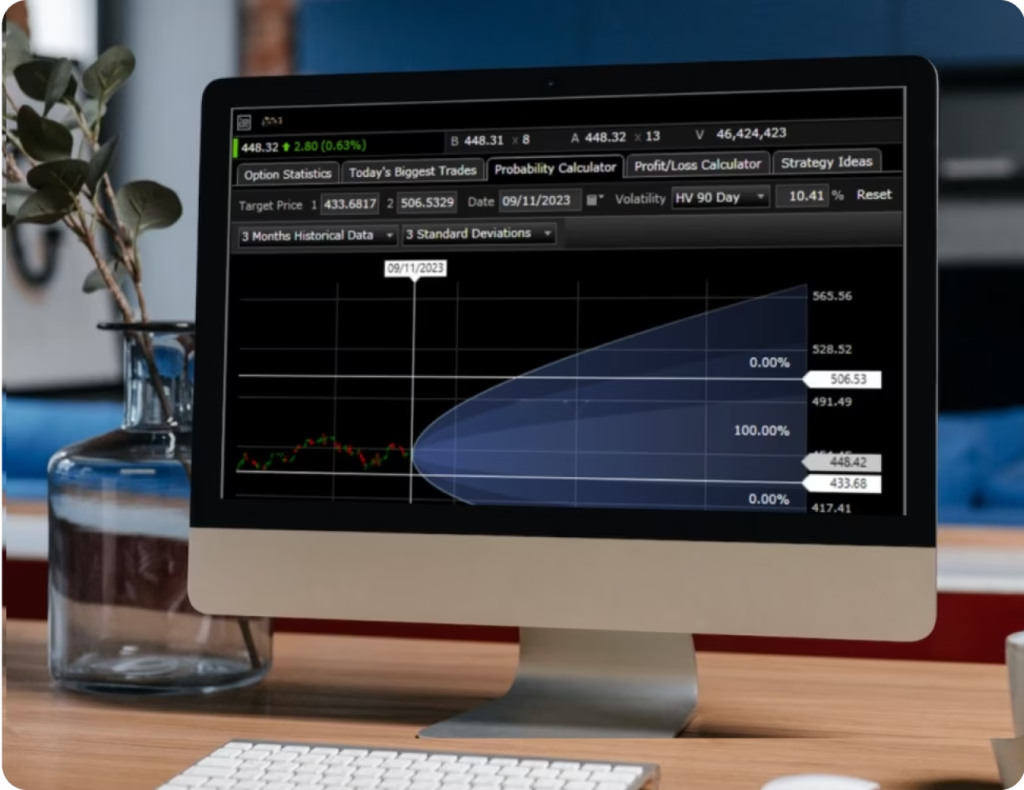
Fee: $0 commissions. No account minimum. No account fee. No PFOF. What you get: Stocks, ETFs, mutual funds (including expense-ratio-free Fidelity ZERO funds), Roth IRA, traditional IRA, 401(k) rollovers, options, international stocks. Cash earns through Fidelity’s money market sweep. Mobile app: Consistently rated 4.8/5 across iOS and Android. Full account management, research tools, and education accessible from the app.
Fidelity is the answer when a beginner investor asks “what should I use?” and is willing to learn a moderately full-featured interface. It doesn’t gamify investing. It doesn’t make you feel clever for placing a trade. It’s a serious brokerage that happens to be free, with better customer service than any app on this list and a research and education library that is genuinely useful rather than decorative.
NerdWallet named Fidelity its best investing app for beginning investors in 2026. What that assessment correctly identifies: Fidelity is the one platform a beginner can open today and never need to migrate away from. Every beginner app on this list is a stepping stone toward what Fidelity already is.
What Fidelity doesn’t do well: The interface can overwhelm someone who has never seen a stock quote before. There is no round-up automation, no behavioral nudging to build the habit, no themed portfolio collections. If you need the app to make the decision for you, Fidelity will wait patiently while you do nothing with your account.
The honest recommendation: Fidelity is the best first account for anyone who is ready to transfer money, pick a target-date fund or a simple three-fund portfolio, and leave it alone. If that describes you, open a Fidelity account before you finish reading this article.
Public.com — Best for multi-asset self-directed investors
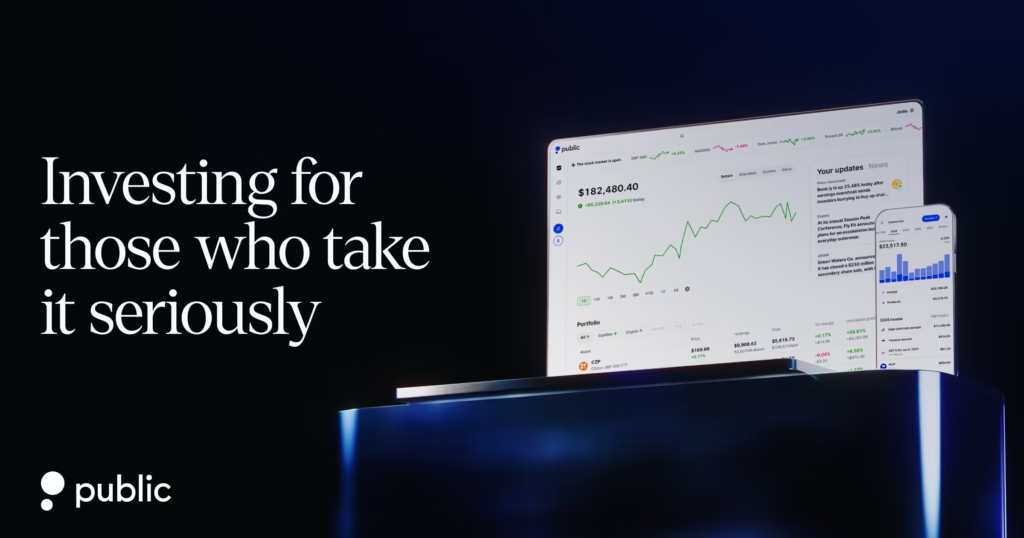
Fee: $0 commissions on stocks and ETFs. $0.35 per contract for complex multi-leg options. 1.25% spread on crypto. No PFOF. What you get: Stocks, ETFs, options, bonds (Bond Account, $1,000 minimum, targets 5%+ yield), 25+ cryptocurrencies, 3.3% APY on uninvested cash. No IRAs as of early 2026. Cash yield: 3.3% APY — significantly above the near-zero sweep rates at Fidelity and Schwab’s default accounts.
Public eliminated PFOF in 2021 and built its business model on Premium subscriptions and Bond Account spreads instead. That’s a meaningful trust signal: the revenue model doesn’t depend on routing your orders to the highest-paying market maker.
The Bond Account is genuinely differentiated. For beginners who aren’t ready to put everything into equities, Public’s Bond Account gives access to a diversified bond portfolio with a stated 5%+ yield target at a $1,000 minimum — a product most full-service brokerages bury behind complex fixed-income desks. Combined with 3.3% APY on cash, Public treats conservative money seriously.
What Public doesn’t do: No IRAs. If retirement accounts matter to you — and for most working-age investors they should, because of the tax advantages — Fidelity or SoFi are better primary accounts. Public works well as a second account alongside a retirement-focused brokerage.
The 1% portfolio transfer match: Public pays 1% in shares when you transfer an existing brokerage portfolio to them, with no cap on the transfer size. On a $20,000 transfer, that’s $200 in free shares. Factor this in if you’re weighing a platform switch.
Betterment — Best for hands-off automated investing
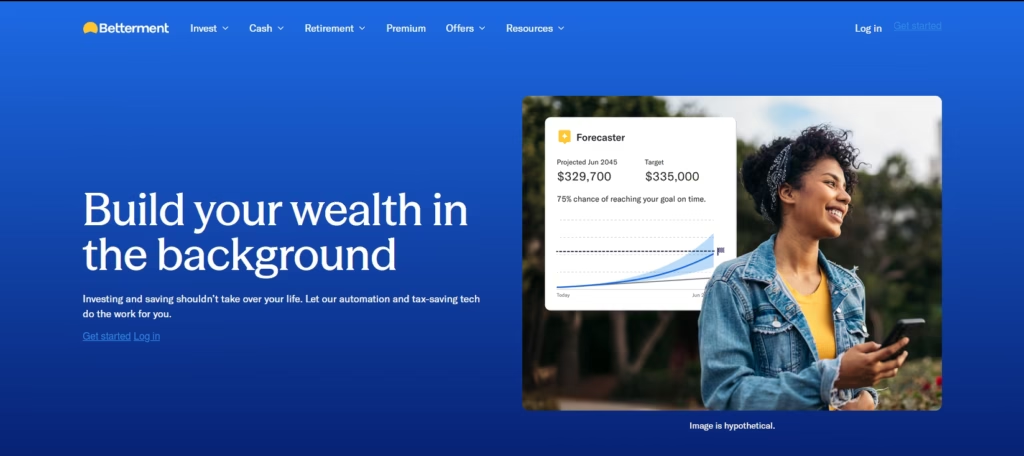
Fee: 0.25% of assets per year ($2.50 per year on a $1,000 account). Cash earns ~4.75% APY. What you get: Automatically built and rebalanced portfolios of low-cost ETFs, matched to your risk tolerance and time horizon. Tax-loss harvesting on taxable accounts. IRA accounts. No stock picking.
Betterment doesn’t let you pick individual stocks. You answer questions about your goal (retirement, home purchase, emergency fund), your timeline, and your risk tolerance. The app builds a portfolio and manages it automatically, including rebalancing when markets move your allocations away from targets.
The 0.25% annual fee is consistently fair across all balance sizes — the opposite of Acorns’ flat monthly fee. At $1,000, you pay $2.50/year. At $50,000, you pay $125/year. The fee is proportional to what the service is worth.
Tax-loss harvesting — selling investments that have declined to realize a loss for tax purposes, then reinvesting in similar holdings to maintain market exposure — is a feature that meaningfully reduces the tax drag on taxable accounts. At small balances, the benefit is minimal. Above $10,000 in a taxable account, it adds real value that Acorns, Stash, and most beginner apps don’t provide.
Who should not use Betterment: Anyone who wants to learn how to pick individual stocks or understand what’s in their portfolio at an individual company level. Betterment is not a financial education tool. You can’t see which companies are in your portfolio beyond broad ETF categories.
Charles Schwab — Best for paper trading practice
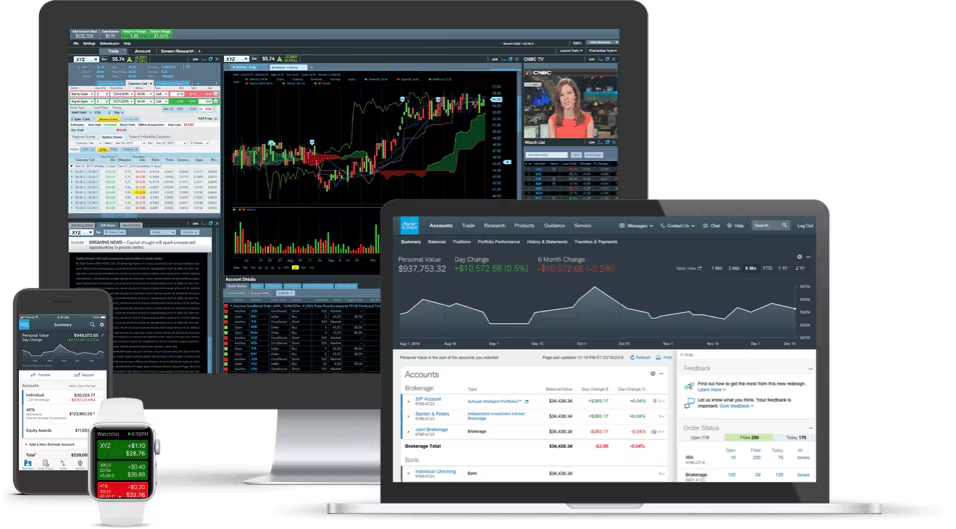
Fee: $0 commissions. No account minimum. PFOF disclosed. Differentiator: Schwab’s thinkorswim platform (previously TD Ameritrade’s platform, now Schwab-owned) includes a paper trading mode — a simulated account where you execute trades with fake money at real market prices.
Paper trading is undervalued by beginner guides. The single most common mistake new investors make is impulsive selling during a market downturn because they’ve never felt what it is like to watch $800 of an $1,000 portfolio temporarily vanish on paper. Paper trading builds that tolerance in a zero-risk environment.
Schwab’s mobile app is rated lower than Fidelity’s for beginner usability. Customer service is strong — 24/7 phone support, physical branches in most US cities, and a reputation for knowledgeable agents. For beginners who want to be able to walk into an office and talk to a human being, Schwab’s branch network is a meaningful differentiator.
PFOF disclosure: Schwab generated approximately $350 million in PFOF revenue in 2025, which is disclosed in quarterly regulatory filings. For long-term passive investors in ETFs, this is not a meaningful practical concern. For investors planning active trading, route execution quality is worth comparing.
Acorns — Best for building the investing habit automatically
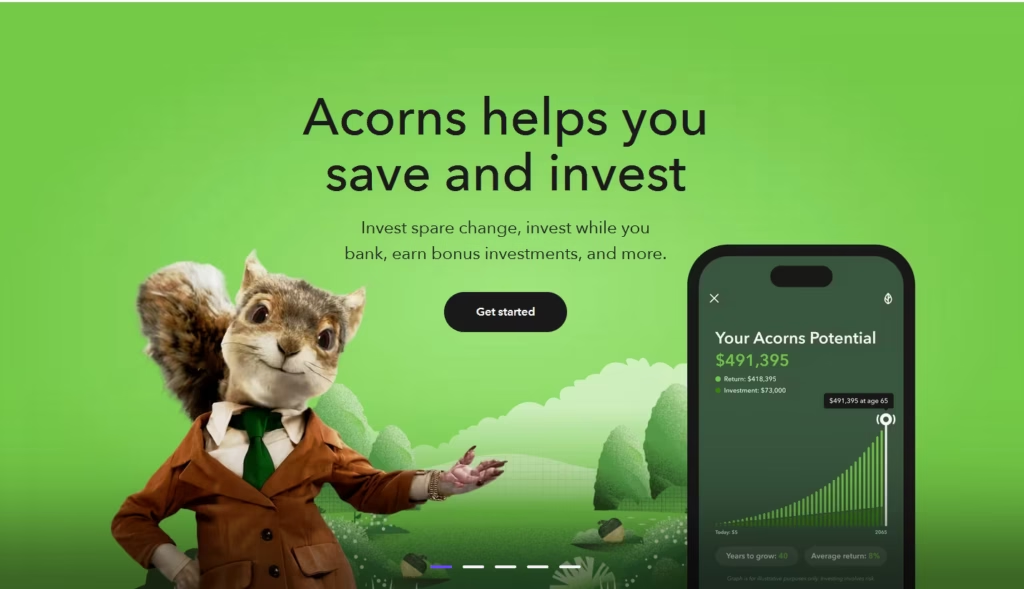
Fee: $3/month (Personal), $5/month (Family). Students and users under 24 can get fees waived. What you get: Round-up micro-investing, pre-built diversified ETF portfolios (no individual stock picking), IRA (Acorns Later), checking account (Acorns Checking), custodial accounts for children (Family tier). $0 account minimum; $5 required to begin investing.
Acorns is the best answer to a specific question: “Will I actually log in and invest manually?” If the honest answer is no — because you’re busy, because you keep forgetting, because you’ll spend the money on something else — Acorns makes consistent investing happen without any decision-making on your part.
The round-up mechanism works as described: every purchase is rounded to the nearest dollar, the spare change accumulates to $5, and it invests automatically into your pre-set ETF portfolio. A person who spends $800/month on everyday purchases and rounds up every transaction generates roughly $15–$25/month in spare change invested. That’s not life-changing, but it is the investing habit running on autopilot.
The limitation to state clearly: Acorns does not teach you to invest. You do not learn what an ETF is, what the market does, or why your portfolio is built the way it is. Acorns is a behavioral tool, not a financial education tool. When your balance grows to a point where the $3/month represents a fee below 0.5% of your portfolio, and you’ve built the habit of regular investing, the case for graduating to Fidelity (free) or Betterment (0.25%/year, more sophisticated) becomes strong.
Fee reality check: At a $500 balance, Acorns Personal charges an effective 7.2% annual fee. At a $5,000 balance, it’s 0.72% — still higher than Betterment’s 0.25% AUM fee or Fidelity’s 0%.
Stash — Best for beginners who want to choose their own investments
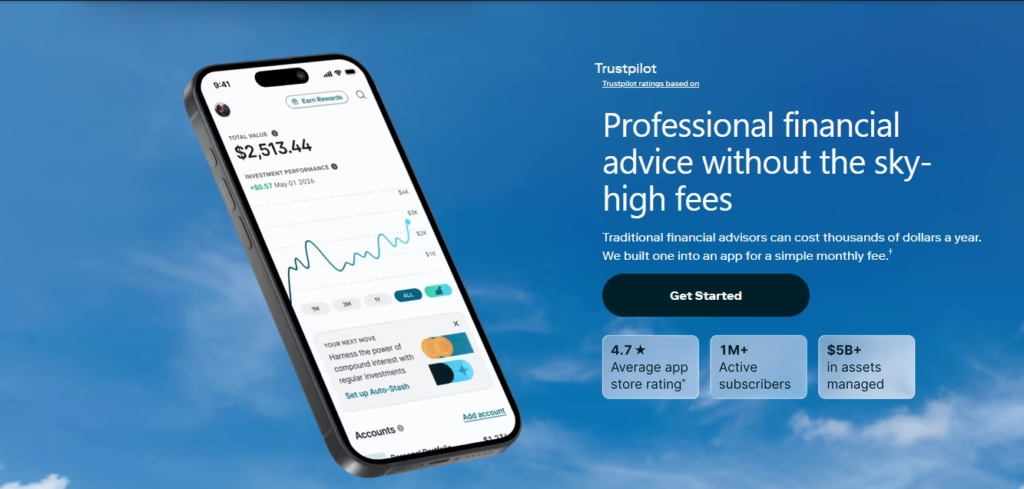
Fee: $3/month (Growth), $9/month (Stash+). No account minimum ($1 to start). What you get: 1,000+ individual stocks and ETFs to choose from, guided by themed portfolios (clean energy, tech, dividend income). Stock-Back debit card earns fractional shares instead of cash-back. IRA available. Banking included.
Stash sits between Acorns (fully automated, no choices) and Fidelity (full brokerage with no guidance). It gives you choices — more than 1,000 stocks and ETFs — but organizes them into accessible themes and provides risk tolerance assessment before you pick. The Stock-Back card is the standout feature: you earn fractional shares of the companies you shop at as a reward on eligible purchases.
At $3/month with a $1,000 account, the effective annual fee is 3.6% — high. At $10,000, it’s 0.36%. The fee structure is identical to Acorns; the differentiation is the investment menu (pick your own stocks vs. pre-built portfolios) and the Stock-Back card rewards program.
What Stash cannot do: It doesn’t offer tax-loss harvesting, sophisticated portfolio analysis, or the research tools of a full brokerage. Like Acorns, it’s training wheels — useful for learning the interface of investing, expensive to use long-term on small balances.
Robinhood — Best for self-directed mobile-first investors (with caveats)
Fee: $0 commissions on stocks, ETFs, and options. Robinhood Gold: $5/month (includes 4.5% APY on cash, Level 3 options, Morningstar research). PFOF is primary revenue model. What you get: Stocks, ETFs, options, crypto, fractional shares, IRA with 1–3% match (Gold members). Fast mobile-first interface with real-time quotes and simple order entry.
Robinhood built zero-commission trading — a genuine contribution to democratizing market access. The platform is fast, clean, and the easiest mobile trading interface available. These are real advantages.
The tradeoffs are documented in public record. PFOF generated over $600 million in Robinhood’s 2025 revenue. The 2020 SEC enforcement action found that Robinhood customers received significantly worse execution prices from 2016–2019. The January 2021 GameStop trading restriction — where Robinhood halted customer purchases during a volatile squeeze, protecting its market-maker relationships — remains the most visible example of whose interests the business model primarily serves.
None of this makes Robinhood unusable for a beginner building the long-term investing habit. A buy-and-hold investor who purchases a total stock market ETF once per month is unlikely to notice PFOF execution differences. The concerns become material for active traders, options traders, and anyone placing large orders.
What this article won’t tell you: Whether to buy any specific investment. What Robinhood’s stocks, ETFs, or options are worth. What the market will do.
SoFi Invest — Best for the banking + investing bundle
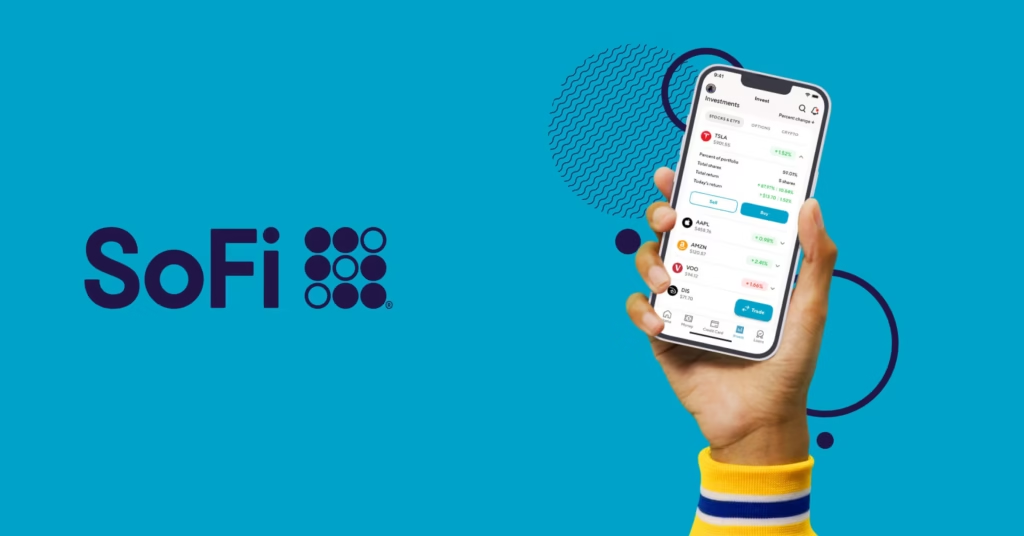
Fee: $0 commissions. No account minimum. No PFOF. What you get: Stocks, ETFs, fractional shares, IRA with 1% match, crypto (SoFi Invest). Plus banking (checking, savings, high-yield), loans (student, personal, mortgage), and credit card — all under one login if you want them.
SoFi’s pitch is integration. If you want one app that handles your checking account, savings, loan payments, and investment portfolio without switching between apps, SoFi is the most coherent execution of that idea in 2026. The 1% IRA match — SoFi contributes 1% of your annual IRA contribution, up to the contribution limit — is a genuine incentive for retirement savers.
The limitation: SoFi’s investment platform is less sophisticated than Fidelity’s. Research tools are lighter. The mutual fund selection is smaller. The platform optimizes for simplicity and integration, not for depth. Experienced investors will find Fidelity’s research tools significantly more useful; beginners who want simplicity may prefer SoFi’s single-app experience.
The graduation framework: when to leave your beginner app
The most useful thing a guide can tell a beginner who starts with Acorns or Stash:
| Account balance | Annual fee at Acorns/Stash ($3/mo) | Recommended action |
|---|---|---|
| $0–$1,000 | 3.6–36%/year | Consider whether the automation genuinely prevents you from saving at a free platform. If yes, the fee may be worth it. If no, open Fidelity now. |
| $1,000–$5,000 | 0.72–3.6%/year | Transition point. The automation has done its job. Your balance is large enough that a free platform’s $0 fee meaningfully outperforms. |
| $5,000–$10,000 | 0.36–0.72%/year | Still above Betterment’s 0.25% AUM fee. Consider migrating to Betterment (for automation) or Fidelity (for full control). |
| $10,000+ | 0.36%/year or less | The habit is built. The portfolio is real. Fidelity, Schwab, or Betterment are the right homes for this money. |
There is no “right” graduation date — only the question of whether you’re still getting value from the automation that justifies the fee premium over a free alternative.
The five criteria that actually matter for beginners
Every review rubric in this category weights the same things: fees, minimums, educational content, investment variety, user interface. Here’s what matters in practice for a beginner in the first year of investing:
1. Does the app make you do nothing by default? Acorns, Betterment, and Stash automate the behavior. Fidelity, Schwab, and Public require you to actively transfer and invest. Know yourself honestly.
2. What does the app actually charge on your real balance? Apply the effective annual fee rate table above to your anticipated average balance. Not the headline number — the actual number.
3. Can you open an IRA? For working adults with earned income, contributing to a Roth or traditional IRA is typically the first best investment decision, before taxable brokerage accounts. Fidelity, Schwab, Betterment, Acorns (Later), Stash, SoFi, and Robinhood all offer IRAs. Public does not, as of early 2026.
4. Is the broker FINRA-registered and SIPC-insured? All apps in this guide are. SIPC insurance protects brokerage accounts up to $500,000 ($250,000 for cash) in the event of broker failure — not against investment losses, but against institutional failure. This is the baseline safety standard.
5. Does the app route your orders for best execution or for PFOF revenue? See the PFOF table above. For passive long-term investors, this matters less than for active traders. Know which category you’re in.
Frequently asked questions
How much money do I need to start investing with an app?
All eight apps on this list allow you to open an account with $0. Acorns begins investing at $5. Betterment and Public invest with any dollar amount. Fidelity and Schwab have $0 minimums. The minimum amount that makes financial sense — where the fee structure doesn’t consume your returns — depends on which app you choose. On a free platform like Fidelity, any amount makes sense. On Acorns at $3/month, a balance below $500 means paying an effective annual fee above 7%.
Is Robinhood safe for beginners in 2026?
Robinhood is FINRA-registered, SIPC-insured, and regulated. Accounts are as safe from institutional failure as any other brokerage. The concerns are not about safety in the fraud or theft sense — they’re about the PFOF business model (execution quality), past regulatory actions (the 2020 SEC enforcement for failure to disclose PFOF and best execution violations), and the January 2021 trading restrictions. For a beginner buying index ETFs monthly, these concerns are less practically significant than for an active options trader.
What is the best investing app for someone starting with $500?
Fidelity or Public.com. Both are $0 cost at any balance. Public’s 3.3% APY on uninvested cash means your idle money earns while you decide what to invest in. Fidelity’s education center teaches you what to do with it. At $500, paying $3/month for Acorns or Stash consumes 7.2% of your balance annually before any market gains — too high for a balance that size.
Which investing apps offer IRAs?
Fidelity, Charles Schwab, Betterment, Acorns (Later), Stash, SoFi Invest, and Robinhood all offer traditional and Roth IRAs. Public.com does not offer retirement accounts as of early 2026. For most working adults, maximizing IRA contributions ($7,000 limit in 2026; $8,000 if 50+) in a tax-advantaged account before investing in taxable accounts is the standard starting advice — but consult a tax professional for your specific situation.
What is Payment for Order Flow and does it hurt me?
Payment for Order Flow (PFOF) is compensation a broker receives from a market maker for routing your trades to them. The market maker profits from executing your trade at a slightly worse price than the best available. For long-term passive investors buying and holding ETFs, the practical impact per trade is fractions of a cent per share — low enough to be negligible. For active traders placing large orders or trading options frequently, execution quality differences can compound materially. The 2020 SEC action against Robinhood quantified the historical execution loss at $5 per order above 100 shares and $15 per order above 500 shares.
Are investing apps regulated and insured?
All apps in this guide are registered with FINRA and covered by SIPC insurance up to $500,000 per account ($250,000 for cash claims). SIPC protects you if your brokerage firm fails — not against losing money because your investments declined in value. Gemini (crypto) operates under New York state digital currency licensing and SOC 2 certification. Crypto assets held at any platform are not SIPC-insured, as they are not securities.
Methodology and data sources
App fee data sourced directly from each provider’s current pricing page, verified May 2026. The effective annual fee rate calculations in the fee table are original computations by BitsFromBytes from published fee schedules; verify current fees at each provider before opening an account as pricing changes.
PFOF data sourced from: Wikipedia’s Payment for Order Flow article (citing FINRA and SEC sources); Congress.gov CRS Product IF12594; SEC DERA Working Paper on PFOF, January 2025; individual broker quarterly Rule 606 disclosures.
No app reviewed in this article has paid for placement or favorable coverage. BitsFromBytes may earn a commission if readers click affiliate links and open accounts; this does not influence rankings or the fee/PFOF analysis.