
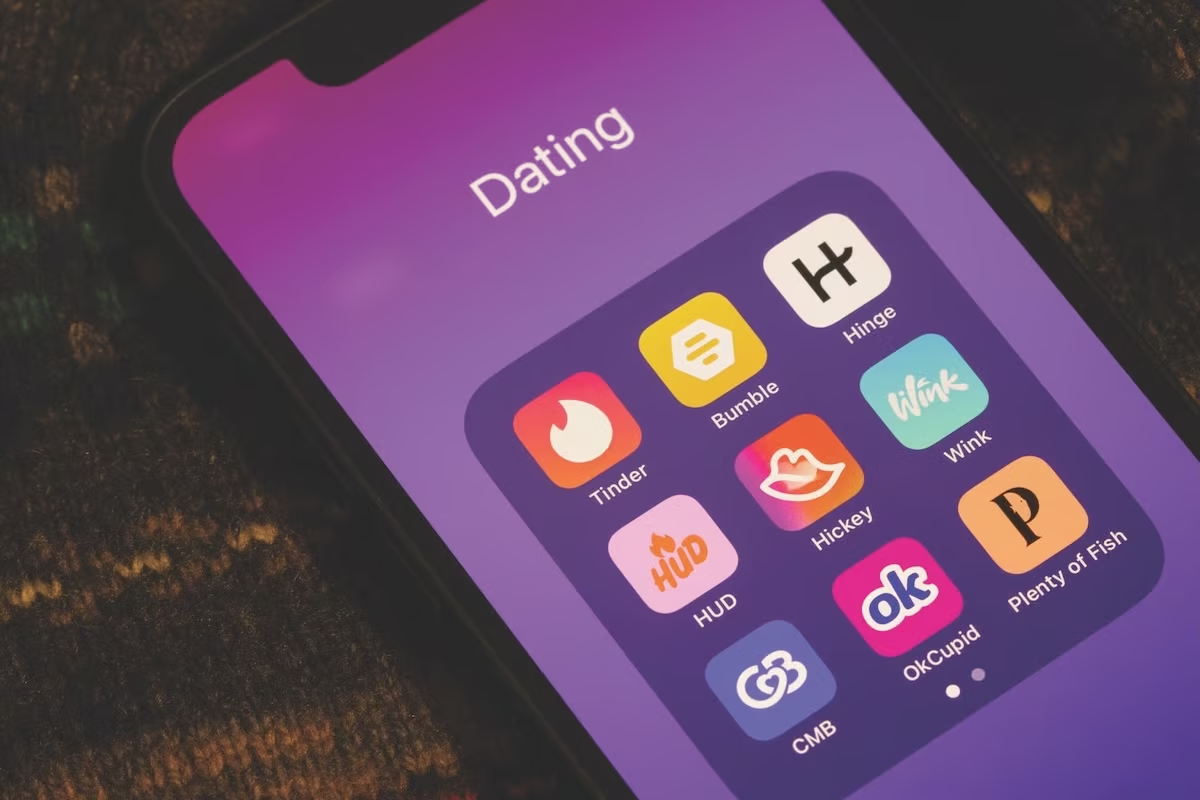
Best Dating Apps 2026
Quick verdict:
| App | Best for | Free tier usable? | Base premium | Top tier | Marriage share (The Knot, 2025) |
|---|---|---|---|---|---|
| Hinge | Serious relationships | ✅ Yes (8 likes/day) | $16.99/mo | $49.99/mo | 36% |
| Bumble | Women who want control | ✅ Yes (limited swipes) | $16.99/mo | $54.99/mo | 20% |
| Tinder | Maximum user pool / casual | ✅ Yes (limited) | ~$24.99/mo* | ~$49.99/mo* | 25% |
| OkCupid | LGBTQ+ / detailed matching | ✅ Yes (full messaging) | $7.95/mo | $34.99/mo | N/A |
| Match.com | Adults 35+ seeking commitment | ❌ No (messaging locked) | ~$40/mo | ~$45/mo | Included in “other” |
| eHarmony | Compatibility-led matching | ❌ No | $25.90/mo† | $65.90/mo† | Included in “other” |
| Grindr | Gay, bi, and queer men | ✅ Yes (limited) | $19.99/mo | $29.99/mo | N/A |
*Tinder pricing uses dynamic algorithmic pricing by age, location, and engagement. Prices for users aged 25–35 in major US metros as of March 2026. †eHarmony annual billing rate. Monthly billing is significantly higher.
Hinge holds 22% of the U.S. dating app market. It accounts for 36% of all dating-app-facilitated marriages in 2025, according to The Knot’s 2025 Real Weddings Study of nearly 17,000 couples. That 14-point gap between market share and marriage outcomes is the most important number in this category — and it tells you more about which dating app actually works than any feature list.
Most “best dating apps” roundups rank platforms by download counts and subscriber numbers. This one ranks by documented outcomes, verified pricing as of May 2026, and platform-specific match rate data that most users never see before they pay.
Table of Contents
The number every article skips: market share vs. actual outcomes
The global dating app market generated approximately $6.2 billion in revenue in 2025, with over 350 million users worldwide, according to Business of Apps’ 2026 Dating App Market report. Match Group — which owns Tinder, Hinge, OkCupid, Match.com, and Plenty of Fish — generated $3.5 billion of that total.
Downloads and subscriber counts tell you which app is popular. They don’t tell you which app works. Here’s the comparison that does:
| App | US market share (downloads) | Share of dating-app marriages (The Knot 2025) | Delta |
|---|---|---|---|
| Hinge | ~22% | 36% | +14 points |
| Tinder | ~25% | 25% | 0 points |
| Bumble | ~24–26% | 20% | -4 to -6 points |
Hinge massively outperforms its market share on outcomes. Tinder performs exactly in line with its share. Bumble underperforms relative to its user base. The delta between market share and marriage share is the clearest proxy for relationship intent and matching quality available in public data.
This pattern has a structural explanation: Hinge limits free users to 8 likes per day, uses prompted profiles (three written questions, not just photos), and runs a matching algorithm based on the Gale-Shapley stable matching model — the same mathematical system that earned a Nobel Prize in Economics in 2012. Scarcity and depth force intentionality. Intentionality filters for users who actually want relationships. The marriage rate data is the downstream result.
Match rate reality by gender and platform
The single most important piece of information most users discover too late: match rates on dating apps differ dramatically by gender, and by platform. These figures come from published research and platform-disclosed data:
| Platform | Men’s match rate (right-swipes that result in a match) | Women’s match rate |
|---|---|---|
| Tinder | 0.6% (1 match per 167 right-swipes) | ~40% |
| Bumble | ~3% | ~45% |
| Hinge | ~3% | ~35% |
Sources: SwipeStats analysis, PlayersTime March 2026 report, Bumble community data.
For men, these numbers change the calculus on which dating app to invest time in. Tinder’s enormous user pool — 75+ million monthly active users per Match Group’s Q4 2025 earnings — gives access to the widest selection, but at a 0.6% match rate, volume is the only strategy available. Hinge’s 3% match rate (5x higher than Tinder) comes from a more filtered pool of users who are reading profiles, not spam-swiping.
For women, all three platforms are functionally equal in match access — the scarcity constraint that dominates the male experience simply doesn’t apply. The relevant factor for women shifts to which platform’s user base has the intent that matches their own.
The annual cost of dating apps in 2026 — including how most people actually use them
Pricing comparisons that show one app at a time are incomplete because most active daters run multiple apps simultaneously. The industry standard is two to three apps at once. Here’s what that actually costs:
Single-app annual cost (base premium tier, annual billing):
| App | Monthly (annual billing) | Annual total |
|---|---|---|
| OkCupid Basic | $7.95 | $95 |
| Hinge+ | $16.99 | $204 |
| Bumble Boost | $16.99 | $204 |
| Tinder Plus | ~$24.99* | ~$300 |
| Grindr XTRA | $19.99 | $240 |
| Match.com | ~$40 | ~$480 |
| HingeX (top tier) | $49.99 | $600 |
| Bumble Premium (top tier) | $54.99 | $660 |
| eHarmony Premium Extra | $65.90† | $791 |
*Dynamic pricing; younger users and women typically pay less. †Annual billing rate for the highest eHarmony tier.
The portfolio cost — two or three apps at once:
| Scenario | Apps | Monthly cost | Annual cost |
|---|---|---|---|
| Conservative (free on all) | Hinge + Bumble + Tinder | $0 | $0 |
| Realistic (one premium) | Hinge+ + Bumble free + Tinder free | $16.99 | $204 |
| Common pattern | Hinge+ + Bumble Boost + Tinder Plus | $58.97 | $708 |
| Heavy user (mid tiers) | HingeX + Bumble Premium + Tinder Gold | ~$130 | ~$1,560 |
The heavy-user scenario — $1,560 per year — exceeds the average American’s annual spending on clothing. Most users arrive at this through gradual upgrade decisions over several months, not a single subscription choice. Each individual upgrade feels marginal; the cumulative total doesn’t.
Which premium subscriptions are worth it — and which are regret traps
The single most common complaint across 1-star reviews of dating app subscriptions is auto-renewal after cancellation. The second most common is paying for “see who liked you” and finding that most of the revealed likes came from accounts the platform had failed to moderate.
Based on review pattern analysis:
Worth considering:
- Hinge+ ($16.99/mo) — unlocks unlimited likes and shows who liked you. The like pool on Hinge is higher quality than Tinder or Bumble because the platform’s free tier already filters for intent. The “see who liked you” feature is less corrupted by bots than on Tinder because Hinge’s prompted-profile requirement creates a harder barrier to fake-account creation.
- Bumble Boost ($16.99/mo) — extends match expiration timers and enables rematching. For women, the Beeline (see who liked you) feature has a similar quality issue to Tinder Gold, but the overall scam/bot prevalence is lower on Bumble. Worth it for users in high-density metros where Bumble’s user pool is largest.
- OkCupid Basic ($7.95/mo) — the cheapest useful premium in the category. Removes ads and provides messaging priority. OkCupid’s free tier already allows full messaging (unlike Tinder or Match.com), so the value of the premium tier is incremental rather than essential.
Regret traps:
- HingeX ($49.99/mo) — Hinge’s top tier. At 3x the price of Hinge+, the additional features (priority visibility, advanced preference matching) are not documented to produce proportionally better outcomes. No independent research confirms that HingeX users get significantly more dates than Hinge+ users.
- Tinder Gold/Platinum (~$39.99–49.99/mo) — the “see who liked you” feature that justifies the price difference over Tinder Plus is the feature most heavily populated by bots and inactive accounts. Tinder’s subscriber count peaked at 10.9 million in mid-2023 and has declined every quarter since, per Match Group SEC filings. Users paying for premium visibility on a platform whose paying base is actively shrinking are getting worse value over time.
- eHarmony top tiers (up to $65.90/mo) — eHarmony’s compatibility matching is its genuine differentiator, but it’s available on the basic plan. The premium tiers primarily add messaging volume features on a platform where message volume is not the bottleneck to outcomes.
1. Hinge — Best dating app for serious relationships
Hinge generated $689 million in revenue in 2025, a 25% year-over-year increase, according to Match Group’s Q4 2025 earnings report. It is the only major dating app where users, paying subscribers, revenue, and revenue per paying subscriber all grew simultaneously — while Tinder’s subscriber count declined and Bumble’s revenue fell.
The structural reason for Hinge’s lead on relationship outcomes is its profile system. Every Hinge profile includes three written prompts from a curated list (“I go crazy for…”, “My most irrational fear is…”, “A life goal of mine…”) plus up to six photos. Matches happen by “liking” a specific photo or prompt and optionally adding a comment. This requires a minimum of effort that photo-only platforms don’t, which changes who uses the free tier and how they use it.
What Hinge does well: The free tier is genuinely usable: 8 likes per day, messaging after matching, and the ability to see one person who liked you per day without paying. Hinge’s “We Met” feedback system (which asks users how dates went) produces real outcome data the company uses to improve recommendations — Hinge’s own data shows 90% of users rate their first Hinge date positively, and 72% report wanting a second date. The AI Convo Starters feature (launched 2025) suggests opening messages based on the other person’s profile. Prompt Feedback tells you whether your profile prompts are working relative to others.
What Hinge doesn’t do well: 8 free likes per day feels restrictive in lower-density markets. The algorithm rewards users who send comments with likes and respond to matches quickly — passive use is penalized. Available in approximately 20 countries, compared to Tinder’s nearly global reach. HingeX at $49.99/month is expensive for incremental gains.
Who should NOT use Hinge: Users in rural areas or small cities where the user pool is thin. Users seeking casual connections (87% of Hinge users report seeking serious relationships — if that’s not your intent, you’re the mismatch, not the platform). Users who won’t engage with the prompted profile format — a blank-looking profile on Hinge performs significantly worse than one with thoughtful prompts.
2. Bumble — Best dating app for women
Bumble’s defining structural feature: in heterosexual matches, only women can send the first message within 24 hours, or the match expires. Men cannot initiate. This single rule produces measurably different behavior — Bumble’s internal data shows conversations on Bumble are 60% longer than those on Tinder, because both parties chose to engage rather than one side chasing.
Bumble reported $246 million in app revenue for Q3 2025, a 10% year-over-year decrease, per Bumble Inc.’s Q3 2025 earnings. The company has 50+ million monthly active users, with 4.1 million paying subscribers. Revenue challenges reflect broader market dynamics rather than a product collapse — the app remains the second-most-downloaded dating platform in the US.
What Bumble does well: Women’s experience on Bumble is structurally different from other apps: the 45% female match rate combined with full control over which matches open into conversations makes Bumble the clearest choice for women who find other apps exhausting. The Bumble BFF and Bumble Bizz modes expand the platform beyond dating into friendship and professional networking. Safety features are robust — photo verification is required, and Bumble’s safety documentation covers in-app blocking, reporting, and private detector (an AI-powered tool that blurs unsolicited explicit images).
What Bumble doesn’t do well: For men in heterosexual dating, Bumble’s model means zero control over conversation initiation. Matches expire if the woman doesn’t message within 24 hours — a significant frustration in practice, where many right-swipes happen casually and the match is valued when seen later. Bumble Premium at $54.99/month is the most expensive base-tier premium of any major app for features that are standard mid-tier elsewhere.
Who should NOT use Bumble: Men who find the 24-hour expiration window with zero initiation ability frustrating. Users outside the US, UK, Canada, and Australia — Bumble’s international penetration is thin compared to Tinder and Hinge. Users in lower-density areas where the women-must-message rule creates a bottleneck when the available match pool is already small.
3. Tinder — Best dating app for maximum user pool
Tinder made $1.94 billion in revenue in 2024, according to Match Group’s annual report, the highest gross of any dating app by a wide margin. It has 75+ million monthly active users and 9.8 million paying subscribers as of 2026. No other dating app has comparable reach — in smaller cities and international markets, Tinder is often the only app with a meaningful local user pool.
The tradeoff for scale is signal quality. Tinder’s photo-first, swipe-based model produces a 0.6% match rate for men (one match per 167 right-swipes), the lowest of any major platform. The free tier is functional for browsing; messaging is unlimited once matched. The premium tiers’ primary value proposition — seeing who liked you — is undermined by the platform’s bot and inactive account prevalence, which is higher than Hinge or Bumble’s.
What Tinder does well: Geographic reach is unmatched. In markets where other apps have sparse user pools — rural areas, international travel, smaller cities — Tinder is the only realistic option. The UI remains the fastest way to assess large numbers of profiles. For users with casual dating intent, the volume-based model aligns with the goal.
What Tinder doesn’t do well: The 75% male, 25% female gender split — the most imbalanced of any major app — creates structural competitive pressure for men that no subscription tier resolves. Subscriber count has declined for six consecutive quarters since peaking in Q2 2023. The platform’s algorithmic pricing has generated significant user distrust: users have documented paying different prices for the same plan based on age, location, and time of day.
Who should NOT use Tinder: Users specifically seeking long-term relationships who are not willing to filter aggressively — Tinder’s intent distribution is far more mixed than Hinge’s, and the signal-to-noise ratio requires more effort per viable match. Users who have found Tinder’s paid tiers to be poor value in their market should not continue paying — the free tier delivers most of the platform’s functional value.
4. OkCupid — Best dating app for LGBTQ+ users and detailed compatibility
OkCupid predates the swipe era and shows it — in a good way. Profiles support 22 gender identities and 20 sexual orientations, the most inclusive taxonomy of any mainstream dating platform. Match percentages are calculated from compatibility questions users answer voluntarily, with the option to weight specific questions as dealbreakers.
OkCupid’s free tier allows full messaging without paying — the only major platform that doesn’t lock messaging behind a subscription. This changes the user dynamic: serious users can engage without any financial commitment, while casual users have less reason to stay active. The result is a slower-paced app with more deliberate profiles.
Who should NOT use OkCupid: Users in markets outside the US and major international cities — OkCupid’s user pool is significantly smaller than Tinder or Bumble internationally. Users who find detailed question answering tedious — the compatibility system requires engagement to generate useful match percentages, and minimal-effort profiles defeat the algorithm.
5. Match.com — Best dating app for adults 35+
Match.com is the oldest platform in this roundup, launched in 1995. Its age skews older than any other app here, which is a feature for users seeking partners in the 35–55 range where other apps have thin user pools. Messaging requires a paid subscription — there is no functional free tier beyond browsing.
The platform’s integration with Match Group’s ecosystem means profile data can surface across properties. At approximately $40/month for a full subscription, Match.com is priced for users who treat dating with the same financial seriousness they bring to a gym membership. The user base reflects that: users on Match.com are statistically more likely to be seeking a committed relationship and less likely to be using the app casually.
6. eHarmony — Best dating app for structured compatibility matching
eHarmony does not let users browse freely. New registrations complete a 150-question personality assessment before receiving matches — a deliberate friction mechanism designed to filter for users with serious intent. The platform claims its matching system is based on relationship science, drawing on research it has published and cited through its internal research group.
The most honest assessment: eHarmony works well for people who value process and are willing to pay for it ($25.90–65.90/month annually), and is the wrong tool for anyone who finds the assessment tedious or wants to browse freely.
7. Grindr — Best dating app for gay, bi, and queer men
Grindr is the largest LGBTQ+ social and dating platform with approximately 13 million daily active users globally, per Grindr’s investor disclosures. The geolocation-based interface shows profiles sorted by physical proximity rather than algorithm — a design choice that reflects the app’s roots in facilitating in-person connection quickly.
Grindr’s revenue grew approximately 26% in 2025, making it the fastest-growing major dating platform by percentage, according to company guidance. The free tier is functional; the XTRA tier ($19.99/month) removes ads and adds unlimited browsing; the Unlimited tier ($29.99/month) adds features including profile view history and read receipts.
Decision guide: which dating app for which situation
If you want a serious relationship: → Start with Hinge free. The outcome data is unambiguous — 36% of 2025 dating-app marriages started there. Spend one month engaging seriously (thoughtful prompts, commented likes, fast responses to matches) before evaluating whether Hinge+ is worth adding.
If you’re a woman tired of men not putting in effort: → Bumble. The mandatory first-message rule filters for men who are willing to wait, and the 24-hour expiration prevents match pile accumulation. Bumble Boost ($16.99/month) is worth adding if you’re in a market with a large Bumble user pool.
If you’re in a small city or rural area: → Tinder free first. Volume is the only realistic strategy with a small pool, and Tinder’s reach is unmatched. Add Hinge simultaneously to capture serious-intent matches that may exist in smaller numbers.
If you want LGBTQ+-inclusive matching with detailed compatibility: → OkCupid free tier. Full messaging without paying, 22 gender identities and 20 sexual orientations supported, and match percentages from compatibility questions. The basic premium at $7.95/month is worth adding if the ads are disruptive.
If you’re a gay or bi man: → Grindr for proximity-based daily use. Add OkCupid or Hinge (available to same-sex users) for relationship-intent matching that Grindr’s casual-first model doesn’t optimize for.
If you’re 35+ and have tried apps before: → Match.com or eHarmony. Both filter for users with serious intent through their pricing model and profile requirements. eHarmony’s compatibility algorithm is the deepest available; Match.com’s user pool is larger.
The one thing most reviews won’t say
Premium features on every dating app follow the same design logic: they show you who already liked you (saving time), give you more daily likes (increasing volume), and boost your profile visibility (improving exposure). None of these guarantee better dates — they accelerate the matching process on whatever user pool the app already has.
The most effective investment for most users is not a premium subscription. It is better photos. A 2024 analysis of Hinge match rate data showed profile photo quality accounts for a substantially larger variance in match rates than any algorithm-accessible variable. Users who improve their primary photo before upgrading to a premium tier consistently report better outcomes than those who upgraded with the same photos.
Pay for premium after your free tier generates matches at a rate you can engage with. If the free tier generates zero matches, the problem is usually the profile — not the algorithm — and no subscription tier fixes that.
Frequently asked questions
Which dating app has the best success rate for relationships?
By outcome data, Hinge leads. The Knot’s 2025 Real Weddings Study of nearly 17,000 married couples found that 36% of those who met through a dating app met on Hinge — more than Tinder (25%) and Bumble (20%) combined relative to their market shares. Hinge’s design forces intentionality: prompted profiles, limited free likes, and a matching algorithm built on the Nobel Prize-winning Gale-Shapley model.
Are dating app premium subscriptions worth the money?
For most users: the base premium tier on one app is worth a one-month trial if the free tier generates matches. Top-tier subscriptions (HingeX, Bumble Premium, Tinder Platinum) represent poor value for most users. The primary feature sold at the top tier — seeing your full like list — is the feature most affected by bot accounts and inactive users on all platforms. Improve your profile before upgrading.
How much do people actually spend on dating apps per year?
The average paying user spends approximately $19/month per app, per PlayersTime’s March 2026 dating market analysis. Users running two apps at base premium spend approximately $408/year. Users at mid-tier on three apps — a common pattern among heavy users — spend approximately $700–1,560 per year, which exceeds the annual cost of most other subscription services in a typical household.
What percentage of people using dating apps actually find a relationship?
Approximately 30% of dating app users report finding a long-term relationship or marriage through apps, per Pew Research Center survey data. Among couples who married in 2025, 27% first connected through a dating app or site, per The Knot’s Real Weddings Study. Success rates vary significantly by platform intent — Hinge users (87% seeking serious relationships) convert at materially higher rates than Tinder’s mixed-intent user base.
Which dating app is safest?
All major apps have photo verification: Tinder, Bumble, Hinge, OkCupid, and Match.com use AI-based photo check systems. Bumble’s private detector proactively blurs unsolicited explicit images before the recipient sees them — the most proactive safety feature of any mainstream app. The FTC’s 2024 romance scam data shows Americans lost $1.14 billion to romance scams in 2023; the FTC advises never sending money to someone you haven’t met in person, regardless of how long you’ve been talking online.
Is Tinder still worth using in 2026?
For most serious-relationship-seekers in markets with a viable Hinge or Bumble user pool: Tinder is a secondary tool, not a primary one. Its 0.6% male match rate and declining subscriber count signal a platform trending toward casual use. For users in smaller markets or international locations where other apps have thin pools, Tinder’s unmatched geographic reach makes it the only realistic option.
How do match rates differ between men and women on dating apps?
Significantly. Men on Tinder match approximately 0.6% of their right-swipes (one match per 167). On Hinge and Bumble, the male match rate rises to approximately 3%. Women across all three platforms match at rates of 35–45% of their right-swipes. This gender asymmetry shapes every strategic decision about which app to use and whether premium tiers are worth the cost — for women, match access is rarely the bottleneck; for men, it frequently is.
Methodology
Statistics in this article draw from Match Group’s Q4 2025 earnings report, Bumble Inc.’s Q3 2025 earnings report, Grindr’s 2025 investor disclosures, The Knot’s 2025 Real Weddings Study (n = ~17,000 couples), Pew Research Center online dating survey data, Business of Apps’ 2026 Dating App Market report, SwipeStats platform analysis, and PlayersTime’s March 2026 dating app cost report. Pricing was verified in the iOS App Store in May 2026 using accounts in the 25–35 age demographic in a major US metro.
Match rate data for men reflects reported figures from SwipeStats, Bumble community data, and platform-disclosed statistics. These figures represent averages across the user base and vary substantially based on profile quality, location, and time of activity.
BitsFromBytes has no commercial relationship with any dating app reviewed in this article.