

DJI Osmo Pocket 4 2026
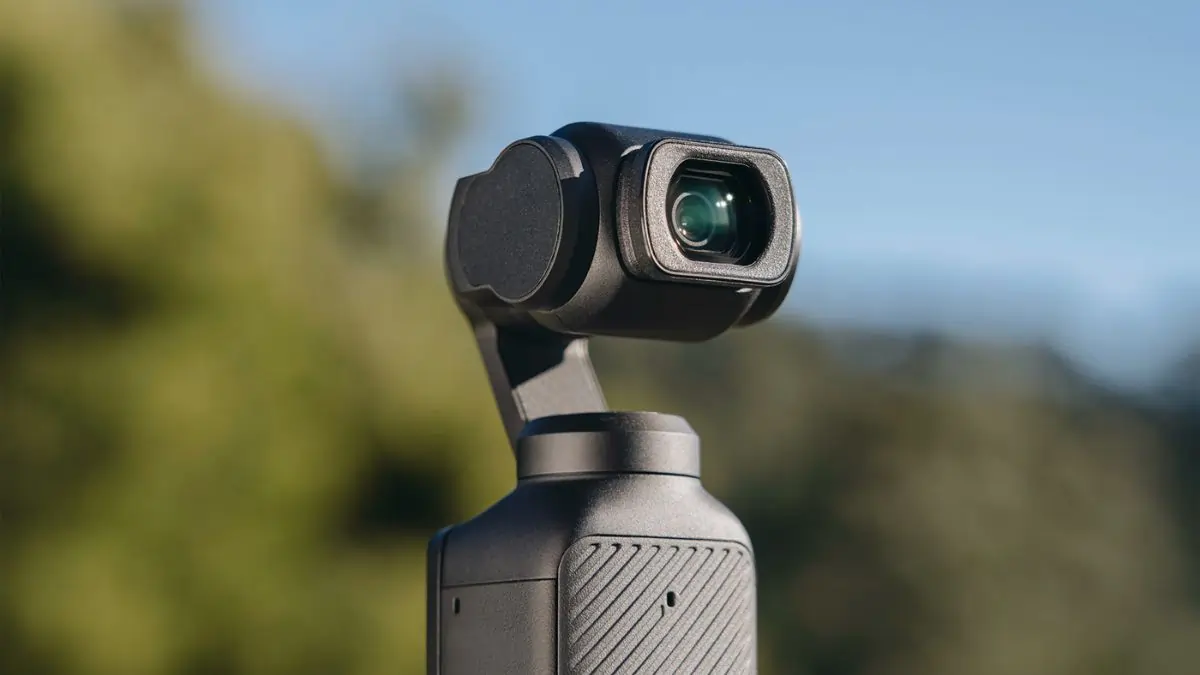
DJI announced the Osmo Pocket 4 today, April 16, 2026. It starts at $499, shoots 4K at 240fps, records 10-bit D-Log M footage, packs 107GB of built-in storage at 800MB/s, and drops 35% lighter than the Pocket 3 — all in the same pocketable gimbal form factor. If you own a Pocket 3 and shoot under mixed or challenging light, this is a meaningful upgrade. If you shoot mostly in good daylight and are happy with your footage, waiting for hands-on reviews makes more sense. Global availability is expected around April 20, 2026.
Table of Contents
Confirmed specs at launch
The following comes from the retail packaging leak, FCC filings, and DJI’s official pre-launch materials. These are confirmed, not rumored.
| Spec | Pocket 4 | Pocket 3 |
|---|---|---|
| Sensor | 1-inch CMOS | 1-inch CMOS |
| Dynamic range | 14 stops | 11 stops |
| 4K max frame rate | 240fps | 120fps |
| Slow-motion (1080p) | Up to 480fps ⚠️ | 240fps |
| Color profile | 10-bit D-Log M | 10-bit D-Log M |
| Built-in storage | 107GB @ 800MB/s | None |
| microSD card slot | ❌ Removed | ✅ Included |
| Zoom | 2x lossless / 4x digital | 2x lossless |
| Audio channels | 4-channel | 2-channel stereo |
| Weight | ~116g | 179g |
| Battery | 1,545 mAh | 1,300 mAh |
| Autofocus | PDAF + eye tracking | Phase detection AF |
| Connectivity | Wi-Fi 6, USB 3.1 | Wi-Fi 5, USB 2.0 |
| Built-in fill light | ✅ | ❌ |
| New physical buttons | Zoom rocker + C shortcut | None |
| Starting price | $499 | $519 (at launch) |
⚠️ The 1080p/480fps mode appears on the packaging and pre-launch materials but has not been independently verified in recorded footage as of this writing. Treat this spec as confirmed-on-paper until reviews drop.
The upgrades that actually move the needle
4K at 240fps — what it means in practice
The Pocket 3 topped out at 4K/120fps. Doubling the frame rate to 240fps at the same resolution means footage can be slowed to 10x speed in a 24fps timeline without any loss of detail. Commercially, cameras that can hit this target in a handheld package have typically cost several thousand dollars — the Sony FX3, for instance, doesn’t reach 4K/240fps. The GoPro Hero 12 maxes out at 2.7K/240fps without a physical gimbal.
The real-world caveat: sustained 4K/240fps recording generates significant heat in a small body. Recording time limits at this frame rate — whether DJI imposes a 5-minute, 10-minute, or unlimited cap — will be one of the first things reviewers test. Don’t assume unlimited recording until that’s confirmed in hands-on footage.
14 stops of dynamic range
The Pocket 3’s sensor was rated at 11 stops of dynamic range. The Pocket 4’s 14-stop figure represents a 3-stop improvement — which, in practical terms, means significantly better highlight and shadow retention in high-contrast scenes. Shooting at golden hour, into windows, or in mixed indoor/outdoor conditions all benefit from extra stops. This is the upgrade that will make the biggest daily difference for most users, more so than the frame rate increase.
For comparison, Sony’s A7 IV — a full-frame mirrorless camera at $2,500 — is rated at 15 stops. The Pocket 4 is approaching full-frame dynamic range performance in a body that fits in a jeans pocket.
107GB internal storage at 800MB/s
The lack of built-in storage has been a consistent complaint across the Pocket 2 and Pocket 3. A day of heavy 4K shooting fills a 64GB card fast, and microSD cards capable of handling sustained 4K/120fps — V60 or V90 rated cards — were already expensive before the current memory card shortage pushed prices higher.
107GB at 800MB/s transfer speed means files move from camera to computer fast. Approximate transfer time for a full 107GB at 800MB/s: about 2 minutes and 15 seconds, compared to roughly 18–25 minutes on a typical UHS-I microSD card at real-world speeds. That’s a genuine workflow improvement for anyone editing daily.
The flip side — and it matters — is that 107GB is a fixed ceiling. A day of heavy 4K/120fps shooting can consume 50–70GB. At 4K/240fps, storage will fill faster. There’s no expandability option.
The microSD removal controversy
When unboxing images appeared online on April 11, one detail lit up the creator community: no visible microSD card slot on the Pocket 4’s chassis.
DJI appears to have removed the microSD slot entirely, committing fully to the internal 107GB system. The reasoning is defensible — microSD cards introduce a bottleneck at the exact moment they matter most, and V90 cards that can handle the Pocket 4’s potential bitrate cost $50–$80 for 64GB as of April 2026. Internal storage at the Pocket 4’s rated write speeds bypasses all of that.
The practical consequence: 107GB is your total capacity. No swapping cards in the field, no “bring four cards for a wedding shoot” flexibility. Users who currently work multi-day shoots without access to a computer will need to evaluate whether the internal storage ceiling works for their workflow. For vloggers, travelers, and day-trip shooters, 107GB is fine. For event shooters working full days without a laptop on site, it’s a constraint worth noting before purchasing.
FCC clearance and what it means for US buyers
The standard DJI Osmo Pocket 4 received FCC certification before DJI was added to the FCC’s Covered List in December 2025. That clearance covers US retail sale through normal channels — Amazon, B&H, Best Buy, and DJI’s own store. US buyers can purchase the standard Pocket 4 without any uncertainty.
The Pocket 4 Pro is a different situation. The Pro variant — a separate device with a dual-lens setup, expected in May or June 2026 — carries no FCC registration on record as of today. Without FCC certification, the Pro cannot be sold through US retail in any official capacity. DJI may attempt to bring the Pro to the US market under a waiver or through a revised regulatory approach, but as of launch day, US buyers should not count on official Pro availability at any point in 2026.
International buyers outside the US have no such restriction — the Pro is expected to launch globally in May or June 2026.
What we know about the Pocket 4 Pro
DJI is using a staggered launch strategy: the standard Pocket 4 now, the Pro in 6–8 weeks. The Pro is a different product, not just the Pocket 4 with better specs.
Confirmed or credibly leaked about the Pro:
- Dual-camera setup with 4x optical zoom
- Starting around $700
- Possibly featuring Hasselblad color science (rumored, not confirmed by DJI)
- Expected May/June 2026 globally
- No FCC registration — US availability is not expected through official channels
The dual-camera setup on the Pro mirrors the telephoto strategy of the iPhone Pro lineup — a primary wide lens and a dedicated telephoto. The 4x optical zoom figure in the latest leak would represent a meaningful jump from the Pocket 4’s 2x lossless in-sensor crop. Whether Hasselblad’s involvement translates to any meaningful color difference from DJI’s own processing pipeline remains to be seen; DJI’s Hasselblad partnership on the Mavic 3 was controversial in this regard.
Should Pocket 3 owners upgrade?
The honest calculus, based on what’s confirmed today:
Upgrade if:
- You shoot in challenging lighting (concerts, events, sunrise/sunset) and 11 stops of dynamic range has visibly limited your footage
- 4K/120fps slow motion is something you use and want more of
- You’re frustrated by the microSD workflow — filling cards, slow transfers, card management
- You want the built-in fill light for indoor shots without rigging a separate light
- 116g vs. 179g matters for your mount or travel setup
Wait for hands-on reviews if:
- Your current Pocket 3 footage looks good and you’re happy with it
- The sustained recording time at 4K/240fps matters for your use case — this is unconfirmed until reviews test it
- You’re interested in the Pro and don’t mind waiting until May/June (non-US buyers only)
- Budget is a consideration — the Pocket 3 Creator Combo will drop in price when retailers clear stock
Don’t upgrade if:
- You primarily shoot 4K/24fps or 4K/30fps for talking-head or travel vlogging in good light — the Pocket 3 handles this equally well
- You need expandable storage beyond 107GB for multi-day shoots
Insta360 Luna: the competitor DJI is racing against
DJI timed this launch for April 16, right before NAB week in Las Vegas, and the timing is deliberate. The Insta360 Luna — announced but not yet shipping — is described by leaker Igor Bogdanov as a “more interesting” alternative to the Pocket 4, with a dual-camera design.
The Luna hasn’t shipped, its specs aren’t confirmed, and no hands-on footage exists. As a direct competitor it’s a question mark, not a product anyone can buy today. DJI gets to set the benchmark, capture the Google Trends wave, and lock in early adopters before Insta360 shows its hand. The Luna could prove to be a stronger product — dual-camera setups have obvious creative advantages — but “announced” and “shipping” are different things in this category.
Packaging configurations
Two configurations at launch:
Standard Combo (~$499)
- DJI Osmo Pocket 4
- Built-in fill light (confirmed from press images)
- Type-C to Type-C PD cable
- Carry case
- Wrist strap
Creator Combo (~$649–$749)
- Everything in Standard Combo
- Wide-angle lens
- Wireless microphone transmitter + windscreens + magnetic clip
- Mini tripod
- Additional carry bag
- Redesigned compact protective case
For anyone who vlogs outdoors, travels with the camera, or needs audio control, the Creator Combo is the practical choice. The wireless mic transmitter alone would cost $60–$80 purchased separately. If outdoor or travel shooting is your primary use case, the Creator Combo total cost is almost certainly lower than assembling the same kit from individual accessories.
Frequently asked questions
What is the DJI Osmo Pocket 4 price?
The DJI Osmo Pocket 4 starts at $499 for the standard model. The Creator Combo — which adds a wireless microphone, wide-angle lens, mini tripod, and extra accessories — is expected at $649–$749. Both prices are based on confirmed retail packaging leaks and align with DJI’s official pre-launch communications. Prices will be confirmed at 12 PM GMT on April 16, 2026.
When does the DJI Osmo Pocket 4 go on sale?
DJI announced the Pocket 4 on April 16, 2026. Global retail availability — through DJI’s own store, Amazon, B&H, and authorized retailers — is expected around April 20, 2026, which falls during NAB week.
Does the DJI Osmo Pocket 4 have a microSD card slot?
No. DJI removed the microSD card slot and replaced it with 107GB of built-in storage rated at 800MB/s transfer speed. There is no expandable storage option. 107GB is the fixed capacity of the camera.
Will the DJI Osmo Pocket 4 Pro be available in the US?
Almost certainly not through official US retail channels. The Pocket 4 Pro has no FCC registration on record as of the standard model’s launch, and without FCC certification, the Pro cannot be sold through official US channels. The standard Pocket 4 has FCC clearance and is fully available to US buyers.
How does the DJI Osmo Pocket 4 compare to the Pocket 3?
The Pocket 4’s most significant improvements over the Pocket 3 are the dynamic range jump (14 stops vs. 11 stops), 4K/240fps slow motion (vs. 4K/120fps), 107GB of internal storage (the Pocket 3 had none), 4-channel audio (vs. stereo), a 35% weight reduction, and built-in fill light. The base price is actually slightly lower than the Pocket 3’s launch price of $519. The removal of the microSD card slot is the main trade-off.