

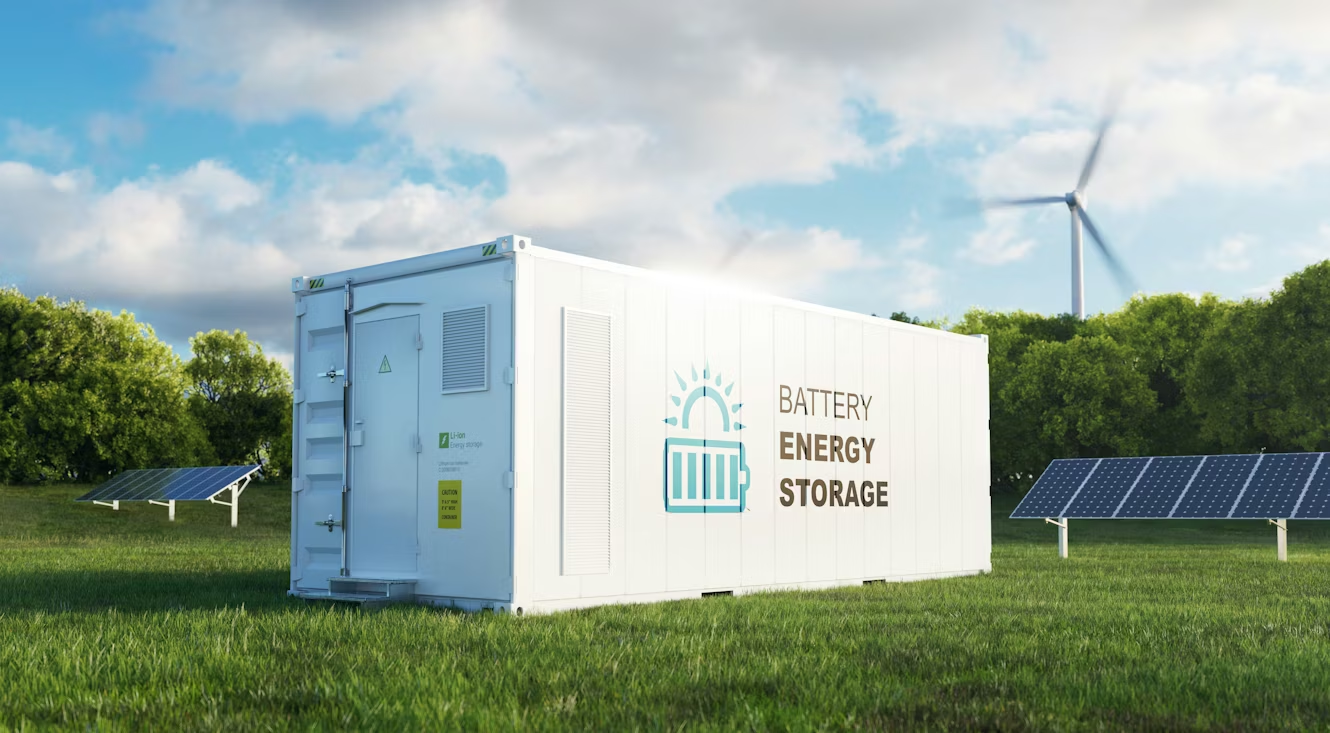
Battery Storage Statistics 2026
Battery storage is the fastest-growing power technology on Earth right now. In 2025, global deployments increased 40% year over year. In 2026, they are forecast to grow another 41%. The numbers are everywhere — but they contradict each other constantly, because different organizations measure different things and rarely explain what they’re counting.
This article compiles the most important battery storage statistics for 2026 from primary sources — the International Energy Agency, BloombergNEF, the U.S. Energy Information Administration, and others — and explains exactly what each figure means, why the numbers appear to conflict, and what they tell us about where this market is going.
Table of Contents
Why the numbers conflict: a guide to reading battery storage statistics
Before the data, the context that makes it usable. Battery storage statistics fail readers in three consistent ways.
Confusion 1 — GW vs. GWh. Gigawatts (GW) measure power — the rate at which a battery can charge or discharge. Gigawatt-hours (GWh) measure energy — the total amount of electricity stored. A battery rated at 1 GW/4 GWh can discharge at 1 GW continuously for 4 hours. IEA typically reports in GW (power capacity); InfoLink and BloombergNEF increasingly report in GWh (energy capacity). A figure that looks 3–4x larger than another may simply be reporting in GWh rather than GW.
Confusion 2 — Pumped hydro is sometimes included, sometimes not. Pumped hydro represents the majority of historical energy storage by capacity. When it is included in a “total energy storage” figure, numbers balloon dramatically. Most current statistics for battery storage growth exclude pumped hydro because the question being answered is specifically about electrochemical batteries. When you see “total energy storage installed base of 0.54 TW” (Mordor Intelligence), that includes all storage types.
Confusion 3 — Market value vs. installed capacity. A “$32 billion BESS market in 2025” describes revenue and capital deployed. “275 GWh deployed in 2025” describes physical capacity added. These are different questions. Market value is affected by pricing dynamics (falling cost per kWh actually reduces market value even as capacity grows); deployment figures tell you more about actual energy transition progress.
Global deployment statistics: 2025 actuals and 2026 projections
2025 by the numbers
| Metric | Figure | Source |
|---|---|---|
| New battery storage capacity deployed globally, 2025 | 108 GW (power) / 275.3 GWh (energy) | IEA Global Energy Review 2026 / InfoLink Consulting |
| Year-over-year growth, 2025 | +40% (IEA power-based) / +61.3% (InfoLink energy-based) | IEA / InfoLink |
| BNEF independent count, 2025 | 112 GW / 307 GWh | BloombergNEF H1 2026 Outlook |
| Global cumulative capacity relative to 2021 | 11× higher | IEA Global Energy Review 2026 |
| Utility-scale share of 2025 new deployments | ~80% | IEA |
| LFP share of 2025 new deployments | ~90% | IEA |
| Long-duration storage (4h+) share of 2025 installs | 6% | Wood Mackenzie |
| China production of stationary storage cells, 2025 | ~557 GWh | BloombergNEF (estimated) |
| Global BESS shipments (cells + systems), 2025 | 421.2 GWh | InfoLink Consulting |
Note: The IEA and BNEF figures for 2025 differ (108 vs. 112 GW; 275 vs. 307 GWh) due to different data collection methodologies, geographic coverage, and whether certain behind-the-meter commercial installations are included. Both are credible; BNEF’s figure is considered more inclusive of smaller-scale commercial deployments.
2026 forecasts
| Region | 2025 actual (GWh) | 2026 projected (GWh) | YoY change |
|---|---|---|---|
| Global total | 275.3 | 353.4 | +28% |
| China | 167.0 | 203.5 | +22% |
| United States | ~54.6 | ~49.0–72.0 | Variable (see note) |
| European Union | 27.1 | 35.1 | +30% |
| Australia | 11.4 | 12.9 | +13% |
| India | ~2.7 | ~5.4 | +100% |
| Sub-Saharan Africa | ~8.8 | Not yet published | — |
Sources: InfoLink Consulting (global/regional); BNEF H1 2026 Energy Storage Outlook (India, Sub-Saharan Africa); EIA Preliminary Monthly Electric Generator Inventory (US utility-scale). US figure varies: EIA’s Feb 2026 report shows 24 GW utility-scale planned for 2026; BNEF’s more conservative figure accounts for policy risk and supply chain delays.
US note: The U.S. faces unusual uncertainty in 2026 due to the Foreign Entity of Concern (FEOC) rules that took effect January 2026, which disqualify battery storage projects with significant ties to Chinese entities from claiming the federal Investment Tax Credit. A 23% utility-scale system price increase from 2024 to 2025 (Wood Mackenzie) reflects early supply chain restructuring. BNEF initially forecast a 2026 contraction but withdrew that forecast after the Q4 2025 construction surge; the market is likely to retain 2024–2025 momentum, though growth will slow compared to non-US markets.
BNEF’s alternative count for 2026: Using their power-capacity metric, BloombergNEF forecasts 158 GW / 459 GWh of new global non-pumped-hydro storage in 2026 — a 41% increase in GW terms over 2025, representing the largest single-year addition on record.
Regional breakdown: where storage is growing fastest
United States
U.S. battery storage accounts for 28% of all planned new utility-scale capacity additions in 2026 — second only to solar at 51%. Battery storage set a record in 2025 with 18.9 GW installed — a 58% increase from 2024’s ~12 GW, which was itself the first year to reach double-digit GW deployment.
| US battery storage statistic | Figure | Source |
|---|---|---|
| Total new capacity installed, 2025 | 18.9 GW | IndexBox / Wood Mackenzie |
| Of which: utility-scale | ~15 GW | EIA |
| Of which: residential | 2.7 GW (+92% YoY) | Wood Mackenzie |
| Of which: commercial & industrial | 95.6 MW | Wood Mackenzie |
| Utility-scale planned for 2026 | 24 GW | EIA (Feb 2026) |
| Share of 2026 US new capacity additions | 28% | EIA |
| Texas share of 2026 US planned storage | 53% (12.9 GW) | EIA |
| California share | 14% (3.4 GW) | EIA |
| Arizona share | 13% (3.2 GW) | EIA |
| US cumulative installed (5-year total, 2021–2025) | 40+ GW | EIA |
| Wood Mackenzie US storage forecast, 2026–2031 | ~500 GWh cumulative | Wood Mackenzie |
| US cumulative projection by 2036 (BNEF) | 334 GW / 1.3 TWh | BloombergNEF |
China
China added 167 GWh of new battery storage in 2025 — more than the rest of the world combined. Its cell production capacity now stands at approximately 557 GWh per year for stationary storage applications alone, more than double global deployment, creating intense price pressure that flows to every other market.
| China statistic | Figure | Source |
|---|---|---|
| New BESS installed, 2025 | 167 GWh | InfoLink Consulting |
| 2026 projection | 203.5 GWh | InfoLink Consulting |
| China’s share of global new deployments, 2025 | ~61% | BitsFromBytes calculation from InfoLink data |
| LFP share of domestic power battery installs, 2025 | 81.2% | China Automotive Power Battery Industry Innovation Alliance |
| Domestic power battery installed capacity, Jan–Dec 2025 | 769.7 GWh (+40.4% YoY) | China Automotive Alliance / Tianyancha |
| CATL global EV battery market share, Q1 2026 | 40.7% | CnEVPost |
European Union
EU installed battery capacity stood at 77.3 GWh by end of 2025, up from less than 8 GWh at the end of 2021 — a tenfold increase in four years. For the first time in 2025, large grid-connected batteries accounted for the majority of new EU capacity (55%), displacing residential as the dominant application.
| EU statistic | Figure | Source |
|---|---|---|
| New capacity installed, 2025 | 27.1 GWh (+45% YoY) | SolarPower Europe (Jan 2026) |
| EU cumulative capacity, end of 2025 | 77.3 GWh | SolarPower Europe |
| Grid-connected share of 2025 additions | 55% (first time majority) | SolarPower Europe |
| Germany total 2025 | 3.8 GW / 7.6 GWh | BloombergNEF |
| Germany residential share | 76% (2.9 GW / 5.8 GWh) | BloombergNEF |
| France installed capacity, early 2026 | ~1,600 MW | RTE (Feb 2026) |
| France installed capacity, 2019 | ~50 MW | RTE |
| EU projected additions, 2026 | 35.1 GWh | InfoLink Consulting |
The cost ladder: what battery storage actually costs at each tier
The most misunderstood dimension of battery storage data. A “$70/kWh battery” and a “$334/kWh battery” can both be accurate simultaneously — they just refer to different points on the cost chain. The table below maps every tier from raw cell to fully installed residential system.
This is an original synthesis compiled by BitsFromBytes from BloombergNEF, Ember Energy, NREL, and Lazard primary data as of Q4 2025 / Q1 2026.
| Cost tier | $/kWh | Geography / scope | Source |
|---|---|---|---|
| 1. LFP cell (Chinese domestic market) | $36–$40/kWh | China domestic, Nov 2025 | Ember / BNEF 2025 survey |
| 2. LFP pack — lowest observed | $50/kWh | China, LFP stationary | BNEF 2025 survey |
| 3. Global average stationary storage pack | $70/kWh | Global average | BNEF 2025 battery price survey (Dec) |
| 4. Global average lithium-ion pack (all uses) | $108/kWh | Global average | BNEF 2025 survey |
| 5. Core equipment (BESS enclosure + PCS + EMS, ex-US/ex-China) | ~$75/kWh | Competitive global markets | Ember (Oct 2025) |
| 6. Turnkey BESS project capex (global average, 4-hour) | $110–$117/kWh | Global average | BNEF Energy Storage Systems Cost Survey 2025 |
| 6a. Turnkey BESS (competitive markets, ex-US/ex-China) | ~$125/kWh | Global markets, low import duties | Ember (Oct 2025) |
| 6b. Turnkey BESS (US utility-scale, 4-hour, NREL benchmark) | ~$334/kWh | United States | NREL 2025 Benchmark |
| 7. Residential battery storage (fully installed) | $700–$1,300/kWh | United States | EnergySage / NREL |
The $264/kWh gap between the global turnkey average ($110/kWh) and the US utility-scale NREL benchmark ($334/kWh) reflects: FEOC-compliant supply chains (which exclude the lowest-cost Chinese suppliers), US labor and soft costs, domestic content requirements under the IRA, and Section 301 tariffs on components sourced from China. NREL’s figure represents a US-built system with compliant components; the global average reflects Chinese-built systems deployed in markets without equivalent trade barriers.
Levelized Cost of Storage (LCOS): Ember’s October 2025 analysis puts utility-scale LCOS at $65/MWh for optimal global markets. Lazard’s 2025 analysis pegs the US LCOS range at $50–$150/MWh for utility-scale, and $200–$400/MWh for residential systems.
The 10-year decline in context:
| Year | Approximate global average pack price | Source |
|---|---|---|
| 2010 | ~$1,200/kWh | Multiple historical analyses |
| 2015 | ~$450/kWh | BNEF / BloombergNEF retrospective |
| 2020 | ~$135/kWh | BNEF |
| 2023 | ~$150/kWh (temporary rise) | BNEF |
| 2024 | ~$120/kWh ($165/kWh system; revised to $169/kWh) | BNEF |
| 2025 | $108/kWh pack / $117/kWh system (global) | BNEF Dec 2025 survey |
Total decline 2010–2025: -91% for pack prices. The 19% learning rate — meaning costs fall approximately 19% for every doubling of cumulative production — has held remarkably consistent across this period.
2035 BNEF forecast:
- China turnkey 4-hour BESS: $41/kWh
- Europe: $101/kWh
- United States: $108/kWh
Market value statistics: reconciling conflicting figures
Battery storage market value figures range from $14.9 billion to $161 billion depending on the source. The conflict is definitional, not factual.
| Market size figure | What it measures | 2025 | 2026 | Source |
|---|---|---|---|---|
| BESS market only (battery energy storage systems, equipment) | Hardware + software revenue | $32.62B | $40.45B | Fortune Business Insights |
| BESS market (installed capacity × average system price) | Capital deployed | ~$32B | ~$41B | Fortune Business Insights |
| Total energy storage market (incl. pumped hydro, thermal, hydrogen) | All storage technologies | Not published as $B | 0.54 TW installed base | Mordor Intelligence |
| Cell shipments × price (BNEF methodology) | Physical market volume | ~$29.5B (421 GWh × $70/kWh average) | ~$42B (600 GWh × $70/kWh est.) | BitsFromBytes calculation from BNEF data |
| BESS market (longer forecast, broader scope) | Multiple revenue lines | $32.62B (2025) | $40.45B | Fortune Business Insights |
| Forecast to 2034 | BESS equipment + services | — | — | $161.12B by 2034 (Fortune, 18.86% CAGR) |
When comparing two market size figures, always check: does the source include pumped hydro? Does it include behind-the-meter residential? Does it include services/O&M revenue in addition to hardware? The $14.9B figure from some reports reflects hardware-only BESS revenue for a narrower product scope.
What the falling cost paradox means for market value: Cell prices dropped 45% in stationary storage from 2024 to 2025, yet deployment grew 61%. Market value in dollar terms grew modestly. This is the characteristic of a market where volume is growing faster than prices fall — but it also means that dollar-denominated market size figures chronically understate how much of the physical energy transition is actually happening.
Chemistry statistics: LFP dominance and the sodium-ion emergence
LFP’s near-total dominance
Lithium iron phosphate (LFP) batteries now account for around 90% of battery storage deployments globally. Five years ago, their market share was well below 50%. The shift from NMC (nickel manganese cobalt) to LFP reflects cost, safety, and cycle-life advantages: LFP cells tolerate more charge-discharge cycles without significant degradation and carry no cobalt, the most ethically and supply-chain-problematic of battery materials.
China’s LFP production dominance is nearly absolute. Chinese manufacturers supply close to all global LFP demand, which is why the 44–56% price premium for cells in North America and Europe persists — local manufacturing at comparable cost does not yet exist at scale.
| Chemistry statistic | Figure | Source |
|---|---|---|
| LFP share of global storage deployments, 2025 | ~90% | IEA |
| LFP share five years ago | <50% | IEA |
| Lowest LFP cell price observed, 2025 | $36/kWh | BNEF 2025 survey |
| LFP cycle life (leading suppliers) | 6,000–10,000 cycles | Industry standard specs |
| NMC share declining due to | Cobalt export quotas from DRC (2025), cost | DRC government; BNEF |
| Flow battery (vanadium redox) share, 2025 | 2.1% of capacity | Mordor Intelligence |
| Vanadium price change 2024–mid 2025 | $8/kg → $11.2/kg (+40%) | Metal Bulletin (cited in Mordor) |
| Flow battery CAPEX impact from vanadium spike | +25% | Mordor Intelligence |
Sodium-ion: the 2026 commercial inflection
Sodium-ion batteries use sodium ions rather than lithium ions for charge transfer. They offer several structural advantages for stationary storage: no lithium, no cobalt, no nickel in common formulations; sodium is the sixth most abundant element on Earth; LFP-comparable safety; and performance stability at extreme temperatures (functional at -40°C).
The technology crossed a critical threshold in April 2026.
| Sodium-ion statistic | Figure | Source |
|---|---|---|
| CATL sodium-ion BESS cell launched (ESIE 2026, April 1) | 300+ Ah, 160 Wh/kg, 97% round-trip efficiency | CATL / ESS News (April 2026) |
| CATL sodium-ion cell cycle life | 15,000+ cycles at 80% capacity retention | CATL |
| CATL sodium-ion cell temperature range | -40°C to +70°C | CATL |
| CATL + HyperStrong sodium-ion BESS deal (April 2026) | 60 GWh multi-year | CATL / Electrek (April 2026) |
| CATL planned sodium-ion capacity expansion | 40 GWh (¥5B / $735M investment) | CnEVPost (May 2026) |
| Peak Energy (US) GS-1.1 deployment | 3.5 MWh at SolarTAC, Colorado | Peak Energy |
| Peak Energy + Jupiter Power agreement | 4.75 GWh, 2027–2030 | Peak Energy |
| Sodium-ion price expectation vs. LFP | ~30% lower | CATL / industry analysts |
| World’s first mass-produced sodium-ion passenger EV | Changan Nevo A06 (CATL cells) | Changan / CATL, Feb 2026 |
| BNEF sodium-ion share of energy capacity, 2026 | ~3% (growing to 13% by end of forecast) | BloombergNEF H1 2026 |
The CATL 60 GWh deal with HyperStrong is the largest sodium-ion energy storage agreement ever signed. It represents a commercial-scale commitment to sodium-ion for grid storage that would have been unthinkable 18 months ago. The technology is not replacing LFP — CATL explicitly frames this as a “dual-star” strategy where both chemistries coexist for different applications. For multi-hour and long-duration grid storage where energy density is less critical than cost and cycle life, sodium-ion will be competitive by 2027.
Applications: what battery storage is actually doing
| Application | Share of 2025 deployments | Trend |
|---|---|---|
| Utility-scale grid (arbitrage, frequency regulation, peaking) | ~80% | Growing; displacing gas peakers |
| Behind-the-meter commercial & industrial | ~12% | Slow growth (US: only 95.6 MW in 2025) |
| Residential | ~8% | Fast growth in US (+92%); dominant in Germany |
| Data center co-located storage (on-site) | Emerging — 12.9 GW/51.5 GWh announced/in development | New category |
| EV charging station storage | ~1 GWh installed globally | Early stage |
Source: IEA (utility/residential split); BNEF (data center and EV charging); Wood Mackenzie (C&I).
Data center storage: the fastest emerging demand driver. BNEF has tracked 12.9 GW/51.5 GWh of announced, operational or under-construction on-site energy storage at data center complexes, although a significant share does not have a confirmed commissioning date. AI infrastructure growth is the primary driver — data centers need sub-second power quality that batteries can provide, and as grid reliability becomes a competitive concern for hyperscalers, co-located storage is shifting from UPS backup to active grid participation.
Gas peaker displacement. The arithmetic on battery-vs-peaker has flipped in most markets. At $65/MWh LCOS (Ember, utility-scale) versus $150–$250/MWh for new gas peaker capacity, battery storage is now cheaper to build and operate for 4–8 hour durations in competitive markets. In Texas — which accounts for 53% of 2026 US planned battery storage additions — this substitution is explicit in utility procurement decisions.
Supply chain and policy variables for 2026
| Variable | Status | Impact |
|---|---|---|
| US FEOC rules (effective Jan 2026) | Projects with significant Chinese entity ties disqualified from ITC | 23% US utility-scale price increase from 2024 to 2025; long-term restructuring toward US/allied manufacturing |
| IRA standalone storage ITC (30%) | In effect; projects starting construction before mid-2026 secure full credit | Drove Q4 2025 construction surge; continues to support demand |
| China removed mandatory storage-with-renewables rule | 2025 | Slight headwind for Chinese domestic demand; reinforces export pressure |
| Cobalt export quotas (DRC, 2025) | Ongoing | Accelerated LFP adoption; flow battery costs up 25% |
| US tariffs on Chinese components | Section 301 + general duties (~34–37% effective) | $264/kWh gap between US and global average system cost |
| Sodium-ion commercial scale | CATL commercial deployment 2026 | 20–30% cost reduction vs. LFP at scale; first major market impact expected 2027 |
| 300Ah+ cell form factor adoption | Dominant in 2025 new projects | Systems using large cells are 50% cheaper than smaller-cell systems (BNEF) |
Long-duration storage statistics
Long-duration storage (LDES) — systems with 8+ hours of discharge duration — accounts for just 6% of global 2025 deployments (Wood Mackenzie), despite extensive policy support. This is the most important gap between the grid storage the energy transition needs and the grid storage currently being built.
| LDES statistic | Figure | Source |
|---|---|---|
| LDES share of global 2025 installs | 6% | Wood Mackenzie |
| Dominant duration in 2025 new builds | 2–4 hours (lithium-ion) | BNEF / Wood Mackenzie |
| IEA stated need for deep decarbonization | “Hundreds of TWh of LDES by 2050” | IEA Net Zero by 2050 |
| Flow battery share of total capacity, 2025 | 2.1% | Mordor Intelligence |
| Vanadium redox flow battery CAPEX hit (2025) | +25% from vanadium price spike | Metal Bulletin / Mordor |
| Compressed air, gravity, iron-air | <1% of deployed capacity | Wood Mackenzie |
| Largest LDES barrier | Economics vs. 2–4 hour Li-ion; intermittency duration mismatch | Multiple |
The long-duration gap matters because 2–4 hour batteries are optimized for daily arbitrage (store cheap daytime solar, sell expensive evening power). They cannot handle multi-day weather events or seasonal mismatches. Closing the gap requires either significantly cheaper long-duration chemistries or policy mandates — and neither has arrived at scale.
Key statistics at a glance: the reference table
For researchers and journalists who need verified, sourceable figures:
| Statistic | Value | Source | Date |
|---|---|---|---|
| Global new battery storage deployed, 2025 | 108 GW / 275.3 GWh | IEA / InfoLink | 2026 |
| Global deployments growth, 2025 vs 2024 | +40% (GW) / +61.3% (GWh) | IEA / InfoLink | 2026 |
| Global deployment forecast, 2026 | 158 GW / 353–459 GWh | BNEF / InfoLink | 2026 |
| Global stationary pack price, 2025 | $70/kWh (global average) | BNEF Dec 2025 | Dec 2025 |
| Global average pack price, all segments, 2025 | $108/kWh | BNEF Dec 2025 | Dec 2025 |
| Global turnkey BESS system cost, 2025 | $117/kWh (4-hour systems: $110/kWh) | BNEF ESS Cost Survey 2025 | Dec 2025 |
| US utility-scale BESS benchmark, 2025 | ~$334/kWh | NREL 2025 | 2025 |
| Utility-scale LCOS (global competitive markets) | $65/MWh | Ember | Oct 2025 |
| 10-year battery pack price decline | -91% | BNEF historical | Dec 2025 |
| LFP share of 2025 deployments | ~90% | IEA | 2026 |
| US new battery storage installed, 2025 | 18.9 GW | IndexBox / Wood Mackenzie | 2026 |
| US planned battery storage, 2026 | 24 GW (utility) | EIA | Feb 2026 |
| China new storage installed, 2025 | 167 GWh | InfoLink | 2026 |
| EU new storage installed, 2025 | 27.1 GWh (+45%) | SolarPower Europe | Jan 2026 |
| EU cumulative storage, end 2025 | 77.3 GWh | SolarPower Europe | Jan 2026 |
| CATL sodium-ion BESS deal (April 2026) | 60 GWh with HyperStrong | CATL / Electrek | Apr 2026 |
| Global BESS market value, 2026 (BESS hardware) | ~$40.45B | Fortune Business Insights | 2025 |
| Total energy storage installed base, 2026 | 0.54 TW (all types) | Mordor Intelligence | Jan 2026 |
| Global cumulative projection by 2031 | 1.52 TW at 23.05% CAGR | Mordor Intelligence | Jan 2026 |
Frequently asked questions
How much battery storage capacity was added globally in 2025?
The IEA’s Global Energy Review 2026 reports 108 GW of new battery storage capacity in 2025 — a 40% increase from 2024. Using the energy-capacity metric, InfoLink Consulting counts 275.3 GWh of new additions, up 61.3% year over year. BloombergNEF’s independent count is 112 GW / 307 GWh. The differences reflect methodology and geographic scope; all three are primary sources cited in research.
What is the current cost of battery storage per kWh?
This depends entirely on which tier of the cost chain you’re asking about. As of late 2025: LFP cells in China cost approximately $40/kWh. Global average stationary storage packs cost $70/kWh (BNEF, December 2025). A complete turnkey BESS project outside the US and China costs roughly $125/kWh (Ember, October 2025). US utility-scale projects benchmark at approximately $334/kWh due to tariffs, FEOC-compliant supply chains, and domestic content requirements. Residential systems in the US cost $700–$1,300/kWh fully installed.
Which country installs the most battery storage?
China by a large margin. China installed approximately 167 GWh of new battery storage in 2025 — roughly 61% of global additions — and is projected to add another 203.5 GWh in 2026. The United States is the second-largest market at 18.9 GW in 2025, followed by Europe (27.1 GWh in the EU).
What is the fastest-growing battery storage market?
In relative terms, Sub-Saharan Africa quadrupled installations year over year in 2025 (from approximately 2 GW/1 GWh to 4.3 GW/8.8 GWh per BNEF). India is projected to more than double installations in 2026 as government auction projects come online. In absolute terms, China and the United States continue to add the most capacity.
Why is the US battery storage market growing more slowly than the global trend in 2026?
Two factors. First, the FEOC (Foreign Entity of Concern) rules effective January 2026 disqualify projects with Chinese component ties from the federal Investment Tax Credit, removing the cheapest source of supply from the qualifying supply chain. Second, this caused a 23% price increase in US utility-scale BESS from 2024 to 2025 as developers shifted to FEOC-compliant suppliers. The underlying demand is strong — 24 GW is planned for 2026, more than any previous year — but supply chain restructuring is compressing margins and slowing some projects.
What is sodium-ion’s role in battery storage in 2026?
Sodium-ion is moving from early commercialization to scaled deployment in 2026, primarily in China. CATL signed a 60 GWh multi-year agreement with HyperStrong in April 2026 — the largest sodium-ion energy storage deal on record — and announced a $735 million capacity expansion to build 40 GWh of sodium-ion production. Sodium-ion cells from CATL’s new BESS-specific line offer 300+ Ah capacity, 15,000-cycle life, and operation down to -40°C. Prices are expected to run approximately 30% below comparable LFP. Commercial impact on global statistics will be visible in 2027 data.
What is the levelized cost of storage (LCOS) for battery storage in 2026?
Ember’s October 2025 analysis puts utility-scale LCOS at $65/MWh for optimal global markets — making battery storage directly competitive with new natural gas peaker plants in most geographies. Lazard’s 2025 analysis shows a wider range of $50–$150/MWh for US utility-scale, depending on project configuration and location. Residential LCOS remains $200–$400/MWh — cost-effective for backup and solar self-consumption in high-tariff electricity markets, but not for standalone economic arbitrage.
Methodology and data sources
All figures in this article are sourced from primary research institutions, official government data, or named primary research firms with published methodology. No figures are estimated or extrapolated by BitsFromBytes unless specifically labeled as a BitsFromBytes calculation.
Primary sources used:
- IEA Global Energy Review 2026 — deployment data
- BloombergNEF 2025 Lithium-Ion Battery Price Survey — cost data (published Dec 9, 2025)
- BloombergNEF H1 2026 Energy Storage Outlook — 2026 deployment projections
- U.S. Energy Information Administration — US market data (updated March 17, 2026)
- EIA Preliminary Monthly Electric Generator Inventory — US 2026 capacity additions (Feb 2026)
- Ember Energy — How Cheap is Battery Storage? — cost analysis (Oct 2025)
- NREL Cost Projections for Utility-Scale Battery Storage — US benchmark costs
- SolarPower Europe EU Battery Storage Market Report — EU deployment data (Jan 2026)
- InfoLink Consulting — Global BESS deployment and shipment data (2026)
- CATL / ESS News — Sodium-ion BESS launch at ESIE 2026
Where figures from different sources conflict, all figures are reported with source attribution, and the methodology difference is explained. BitsFromBytes does not adjudicate which source is “correct” — both figures may be accurate under different definitions.