

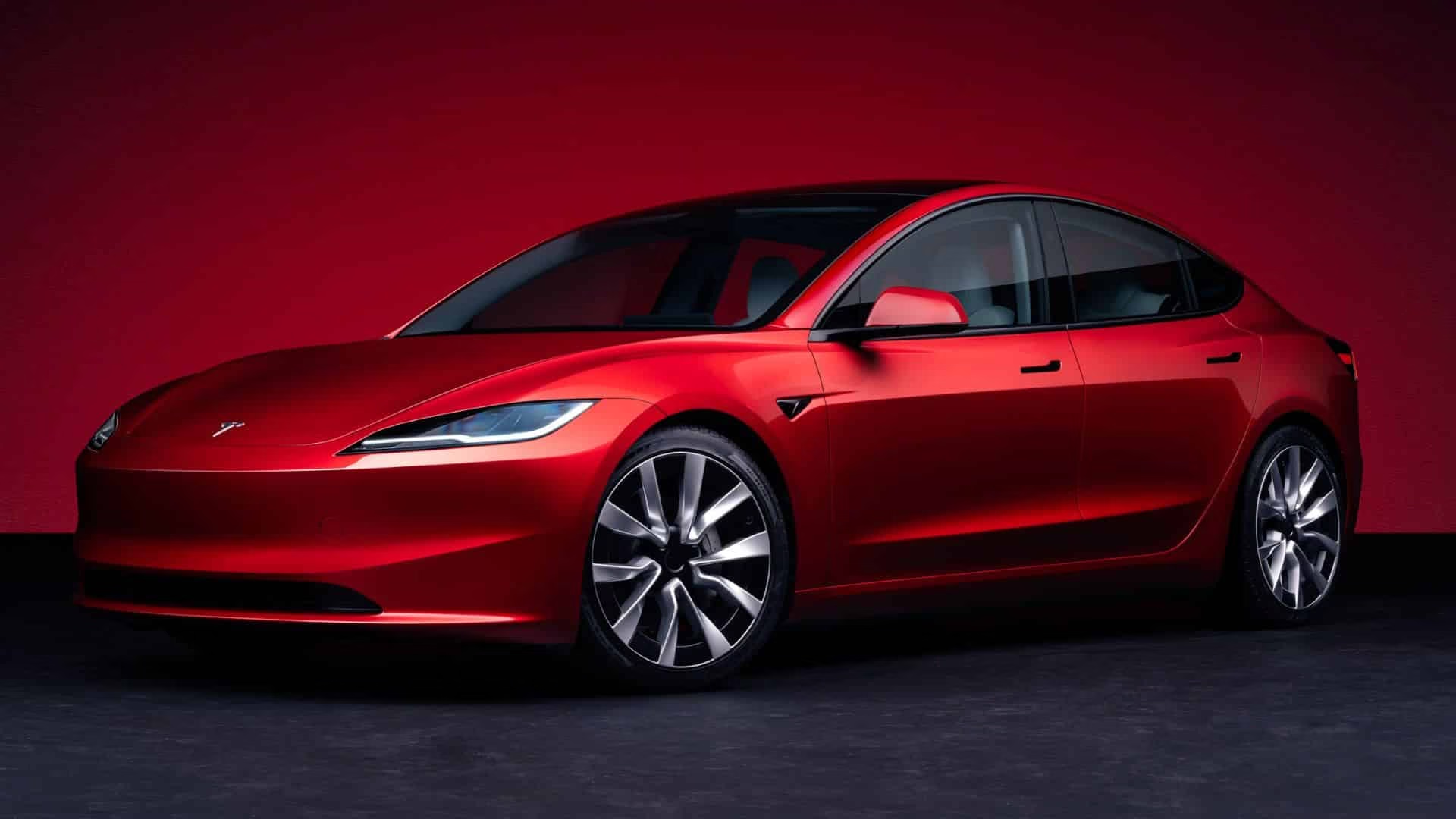
Tesla Model 3 Insurance Cost 2026
Tesla Model 3 insurance costs somewhere between $1,545 and $5,292 per year for full coverage, depending on which source you read. That $3,747 gap isn’t a data error — it’s the result of different sources using different driver profiles, model years, and coverage structures. Before you budget for a Model 3, you need to know which number actually applies to you.
This article does three things: reconciles the conflicting estimates you’ll find across the web, breaks down every ownership cost alongside insurance so you can see its true weight in your budget, and explains the two variables that will determine your actual number more than any other factor.
Table of Contents
Why the insurance estimates contradict each other
If you’ve already searched “Tesla Model 3 insurance cost,” you’ve seen numbers ranging from under $170 a month to over $440. All of them are technically accurate. Here’s why they diverge.
| Source | Annual estimate | Driver profile used | Model year | Coverage |
|---|---|---|---|---|
| insurance.com (Apr 2026) | $3,466/yr ($289/mo) | 40-year-old male, clean record | 2025 Model 3 | Full coverage, 100/300/100, $500 deductible |
| Insure.com (Apr 2026) | $3,871/yr ($322/mo) | 40-year-old male, 12,000 mi/yr | 2025 | Full coverage, 100/300/100, $500 deductible |
| Insurify (May 2026) | $5,292/yr ($441/mo) | Average across all driver ages | 2025 | Full coverage |
| MoneyGeek (2026) | $2,028/yr ($169/mo) | 40-year-old, no violations | Mixed 2012–2022 | Full coverage |
| The Zebra (2026) | $3,650/yr ($304/mo) | 30-year-old male, no violations | 2025 | Full coverage |
| State Farm (best carrier) | $1,545/yr ($129/mo) | Standard good-driver profile | 2025 | Full coverage |
| NerdWallet (Oct 2025) | $2,459/yr ($205/mo) | 35-year-old, good credit | Base 2025 | Full coverage, $1,000 deductible |
Sources: insurance.com, Insure.com, Insurify, MoneyGeek, The Zebra, NerdWallet — all cited in full in external links below.
What the reconciliation tells you:
The most reliable baseline for a typical buyer — 35–45 years old, clean record, full coverage with a $500–$1,000 deductible on a 2024–2026 Model 3 — is $3,200–$3,871 per year ($267–$322/month). Insurify’s higher figure reflects the broader driver pool, including younger and riskier profiles. MoneyGeek’s lower estimate reflects older model years with lower replacement values.
If you’re under 25, add 40–80% to any of these figures. If you’re in Louisiana, the most expensive state, the average hits $8,671/year. Hawaii, the cheapest, averages $2,201. The single most important variable in your insurance cost isn’t which carrier you pick — it’s your ZIP code.
Insurance rates by carrier: what you’ll actually be quoted
These are confirmed 2026 averages for a 2025 Tesla Model 3, full coverage, from a 40-year-old driver with a clean record. All figures from Insure.com and The Zebra’s April 2026 data.
| Carrier | Annual (full coverage) | Monthly | Notes |
|---|---|---|---|
| State Farm | $1,545 | $129 | Cheapest major carrier; best for most Model 3 trims |
| Nationwide | $1,780 | $148 | Cheapest for Long Range trim |
| Travelers | $2,505 | $209 | Cheapest for Long Range; strong OEM parts policy |
| GEICO | $2,612 | $218 | Strong rates for clean-record drivers; limited Tesla repair network |
| USAA | $2,244 | $187 | Military/veteran families only; consistently lowest for eligible drivers |
| Progressive | $3,100 | $258 | Mid-range; snapshot program can lower rates |
| Tesla Insurance | Varies by Safety Score | $80–$300+ | 13 states only; more below |
| Insurify average | $4,062 | $338 | Reflects full driver population including younger drivers |
Military-affiliated? USAA is almost always the cheapest option by $50–$100/month. Non-military: State Farm and Nationwide are consistently the best starting points.
The Tesla Insurance program: compelling offer, serious caveats
Tesla sells its own car insurance in 13 states: Arizona, California, Colorado, Florida, Illinois, Maryland, Minnesota, Nevada, Ohio, Oregon, Texas, Utah, and Virginia. Everything is managed through the Tesla app; there’s no agent, no call center, and no option to buy the policy without the app.
The pricing model is fundamentally different from traditional insurers. Rather than weighting your age, credit score, and marital status heavily, Tesla uses a Safety Score (0–100) based on real-time driving data: hard braking frequency, aggressive turning, unsafe following distance, and forward collision warnings. Higher scores lower your premium. Lower scores raise it.
Tesla’s own claims: average drivers save 20–40% compared to traditional insurers. Safe drivers can save up to 60%.
What changed in April 2026: Tesla released Safety Score v3.0, which assigns a perfect 100/100 score to every mile driven with Full Self-Driving (Supervised) engaged. In select states (currently Arizona, Indiana, Illinois, Tennessee, Texas, Virginia), this means FSD users can maintain a near-perfect average Safety Score without changing how they drive manually. The practical effect: FSD-heavy drivers in eligible states can access Tesla Insurance’s lowest premium tier, which some owners report as low as $80–$120/month.
What Tesla doesn’t advertise: Three facts about Tesla Insurance that belong in any honest comparison:
- Complaint rate. Tesla Insurance’s 2024 NAIC Complaint Index is 10.20 — meaning it generates roughly 10 times more complaints than average for a company of its size. By comparison, State Farm’s NAIC index is below 1.0. The Better Business Bureau gives Tesla Insurance 1 out of 5 stars.
- California enforcement actions. The California Department of Insurance issued enforcement actions against Tesla Insurance in 2025 for repeated failures to comply with claims handling laws. California drivers can buy Tesla Insurance, but the real-time Safety Score cannot be used to set premiums there (state law), and rates increased 12.4% in August 2025.
- No OEM parts guarantee. Tesla Insurance does not guarantee the use of original Tesla parts in repairs. For a car where recalibrating a camera after a minor collision requires Tesla-specific tooling, this is a meaningful gap.
Bottom line on Tesla Insurance: It can be significantly cheaper for safe drivers in eligible states, especially those using FSD. The tradeoff is customer service quality that is among the worst in the industry by complaint metrics. Get a Tesla Insurance quote alongside two or three traditional carrier quotes, and compare the actual dollar difference before deciding whether the potential savings justify the service risk.
The total cost breakdown: what a Model 3 actually costs to own
Insurance is one line item. To budget accurately, you need all of them. The table below shows estimated annual costs for three buyer scenarios at 12,000 miles per year, in an average-cost U.S. state.
| Cost category | New 2026 Model 3 | Used 2022 Model 3 | Used 2019 Model 3 |
|---|---|---|---|
| Purchase price (est.) | $38,000 | $26,000 | $18,000 |
| Depreciation (annual) | $4,200–$5,000 | $2,200–$2,800 | $1,200–$1,800 |
| Insurance — full coverage | $3,200–$3,871 | $2,500–$3,200 | $1,800–$2,600 |
| Electricity (home charging) | $530–$660 | $530–$660 | $530–$660 |
| Maintenance | $233 | $300–$450 | $400–$700 |
| Tires (annualized) | $300–$450 | $300–$450 | $300–$450 |
| Registration/fees | $200–$600 | $150–$400 | $100–$250 |
| Financing interest (est.) | $1,800–$2,400 | $900–$1,400 | $500–$900 |
| Total annual cost (excl. purchase) | $10,463–$13,581 | $6,880–$9,360 | $4,830–$7,360 |
| Insurance as % of annual cost | 31–33% | 32–36% | 30–37% |
Electricity estimate based on 15 kWh/100 mi efficiency, $0.15/kWh home rate, 12,000 mi/yr = $270. SuperCharger network average ~$0.25/kWh would raise this to ~$450. Depreciation for used models reflects 2026 market pricing. Maintenance from CarEdge 10-year data. Financing assumes 10% down, 72-month loan at 6.5%.
The most important row: Insurance is consistently 30–37% of annual running costs — making it the second-largest ongoing expense after depreciation. For a used 2022 Model 3, a buyer who cuts their insurance bill by $800/year (by shopping carriers aggressively) saves as much as switching from home charging to Supercharging would cost. Insurance shopping has outsized impact on the actual ownership experience.
The five factors that determine your specific rate
Averages are starting points. These five variables will move your actual premium significantly in either direction.
1. Your state and ZIP code
As shown above, the gap between the cheapest state (Hawaii, ~$2,201/yr) and the most expensive (Louisiana, ~$8,671/yr) is $6,470/yr on the same car with the same driver profile. Within a state, moving from a dense urban ZIP to a suburb can lower premiums by $500–$1,200/yr. NAIC state insurance department pages let you check your state’s insurer complaint history before committing.
2. Model year
A 2025 Model 3 costs an average of $284/month to insure. A 2017 Model 3 costs roughly $217/month for a 35-to-55-year-old driver (MoneyGeek data). Older cars have lower replacement values; lower replacement values mean lower comprehensive and collision premiums. If you’re buying a used Model 3 specifically for cost reasons, the insurance savings are real and compound.
3. Trim level
The Performance trim costs $54–$82/month more to insure than the Standard Long Range on average — in line with the trim’s performance and price premium. If you’re cross-shopping Standard and Performance, add $648–$984/yr to the Performance’s insurance column when comparing true costs.
4. Your driving record
A single at-fault accident typically raises a Model 3 premium by $800–$1,800/yr for three to five years depending on the carrier and state. A DUI raises it by $3,000–$5,000+/yr. A clean record is worth more than any discount program.
5. Coverage structure
Full coverage (comprehensive + collision + liability at 100/300/100 limits with a $500 deductible) is what most of these averages represent. Dropping to a $1,000 deductible saves $200–$400/yr but means paying more out-of-pocket after a claim. Liability-only — which makes sense only if the car’s actual cash value is low enough that comprehensive/collision premiums exceed the benefit — averages $1,127/yr for the Model 3 nationally.
What insurance doesn’t cover: the Tesla repair problem
Every Model 3 insurance analysis understates one cost: the gap between what your insurer covers and what Tesla repairs actually cost after a claim.
Tesla repairs require Tesla-certified shops, specialized tooling, and recalibration of cameras and sensors after any impact to panels near them. A rear bumper replacement that costs $1,200 on a Honda Accord can run $3,500–$4,500 on a Model 3, partly because recalibrating the Autopilot camera system after the repair adds $400–$800 in labor. Windshield replacement, which covers the cabin-facing camera, costs $900–$1,000 for the glass plus $200–$400 for ADAS recalibration — totaling roughly $1,100–$1,400 for what is otherwise a $300 repair on a non-ADAS vehicle.
Whether your insurer pays full cost or depreciates parts affects the real-world value of your policy. Asking specifically about OEM parts coverage and ADAS recalibration inclusion before signing is worth ten minutes of your time.
How to actually lower your Model 3 insurance bill
Ranked by impact, not by how commonly they’re mentioned:
1. Get quotes from at least five carriers. The gap between the cheapest (State Farm at $1,545/yr) and the most expensive major carrier for a clean-record Model 3 driver can exceed $2,500/yr. Shopping is the highest-leverage action available to you. The Zebra and Insurify run multi-carrier comparisons against your specific profile.
2. Increase your deductible from $500 to $1,000. Saves $200–$400/yr. Requires that you can cover the higher out-of-pocket cost if you file a claim.
3. Bundle with renters or homeowners insurance. Multi-policy discounts range from 5–15% depending on the carrier.
4. Consider Tesla Insurance if you’re in an eligible state and drive carefully. Request a Safety Score preview before committing; Tesla can provide an initial estimate. If your score runs consistently above 90 and you drive FSD in an eligible state, Tesla Insurance can be $600–$1,200/yr cheaper than the best traditional carrier.
5. Buy a used Model 3 instead of new. A 2022 Model 3 insures for roughly $700–$1,000/yr less than a 2026 model on equivalent coverage. The combined savings on insurance and depreciation often justify the used purchase decisively.
6. Avoid the Performance trim if insurance cost matters to you. You get 60% more horsepower and pay 30–40% more in annual premiums. If you’re buying for commuting efficiency, the base Long Range RWD ($36,990 in 2026) is the right call.
Frequently asked questions
How much does it cost to insure a Tesla Model 3 per month?
For a 35–45-year-old driver with a clean record and full coverage on a 2024–2026 Model 3, the realistic national range is $267–$322/month ($3,200–$3,871/year). State Farm at $129/month and USAA at $187/month (military only) represent the achievable floor for well-qualified drivers. Younger drivers (under 25) can expect $400–$700+/month.
Is Tesla Insurance worth it?
For safe drivers in eligible states, Tesla Insurance can save $600–$1,800/year versus traditional carriers. The caveat is a NAIC complaint index of 10.20 — roughly 10 times the industry average — and enforcement actions in California over claims handling. Get a quote, compare it dollar-for-dollar with State Farm and Travelers, and weigh the savings against the service track record.
How does the Model 3 compare to average car insurance costs?
The national average for full-coverage car insurance is $3,037/year ($253/month). A Tesla Model 3 runs $3,200–$3,871/year — roughly 5–28% more. For context, a Honda Accord LX averages $2,513/year; the Model 3 is meaningfully more expensive to insure despite being in a similar price bracket.
Does driving Full Self-Driving (FSD) lower my insurance?
Through Tesla Insurance specifically: yes, as of Safety Score v3.0 (April 2026). Every FSD mile earns a perfect Safety Score of 100/100, which over time raises your monthly average and lowers your premium. This discount applies in select states (currently AZ, IN, IL, TN, TX, VA) and only to Tesla Insurance policyholders. Third-party carriers do not offer FSD discounts.
Why is Tesla insurance so expensive?
Three structural reasons. First, the car’s replacement value is higher than average for a sedan ($36,990 base in 2026). Second, Tesla repairs require certified shops, specialized tooling, and sensor recalibration — average repair costs run higher than equivalent non-EV repairs. Third, Tesla’s limited repair network means longer repair times, which compounds rental car costs that insurers also absorb. Safety features (Autopilot, forward collision warning) partially offset this by reducing accident frequency, but the repair cost factor wins in the actuarial tables.
What is the cheapest way to insure a Tesla Model 3?
State Farm consistently offers the lowest rates among major carriers — averaging $1,545/year ($129/month) for a good-driver profile. USAA is cheaper for military members and their families. Tesla Insurance can beat both for drivers with Safety Scores consistently above 90 in eligible states. The biggest single cost lever remains the state you live and garage the vehicle in: a Hawaii resident pays $2,201/year versus $8,671/year in Louisiana for the same car and driver.
Methodology and data sources
Insurance rate data in this article is sourced from: insurance.com (April 2026), Insure.com (April 2026), MoneyGeek (April 2026), NerdWallet (October 2025, re-confirmed April 2026), Insurify (May 2026), and The Zebra (2026). All third-party insurance rate studies use stated driver profiles with full coverage policies; assumptions vary by source, which explains the range of estimates. The reconciliation table and synthesized “True Annual Cost” breakdowns are original analyses compiled by BitsFromBytes. No compensation was received from any insurance carrier, Tesla, or automotive marketplace referenced in this article.
NAIC complaint data sourced from the National Association of Insurance Commissioners complaint database. California enforcement action sourced from the California Department of Insurance. Tesla Safety Score v3.0 information from Tesla’s April 2026 announcement and Tesla’s official insurance support documentation.