

Best Electric Cars Under $30000
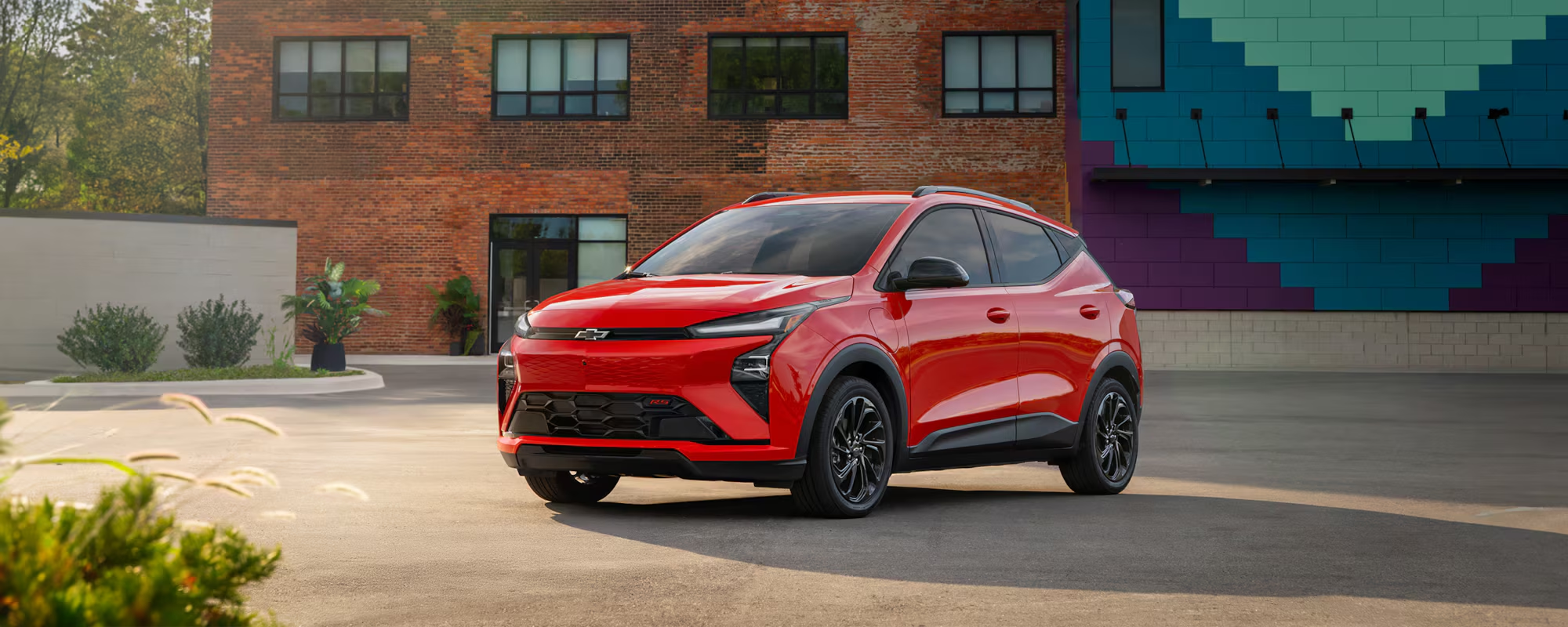
The 2027 Chevrolet Bolt LT at $28,995 is the best new electric car under $30,000 in 2026. It’s the only new EV in America that genuinely costs less than $30,000 after destination fees, delivers 262 EPA-rated miles, and arrives at dealers with a NACS charging port. The 2026 Nissan Leaf S+ is the other option — it starts at $29,990 MSRP, but that figure excludes destination, making its real street price $31,485. It offers 303 miles of EPA range and is the better choice if range is your top priority and you’re comfortable paying $2,500 more than the Bolt’s actual price.
That’s the honest summary of the new EV market under $30,000 in 2026. There are exactly two new cars in this category. Everything else is either above $30K, discontinued, or hypothetical. Several buying guides currently ranking for this keyword list four, five, or six options — they do this by ignoring destination fees, including used vehicles without labeling them as such, or by counting models that were discontinued before 2026.
One more thing every competitor misses: the federal $7,500 EV tax credit no longer applies to EV purchases as of October 1, 2025, following the passage of the One Big Beautiful Bill Act. Any article that shows you an “effective price after federal tax credit” for a 2026 purchase is showing you a number that no longer exists. Some manufacturer incentives and state credits remain — we account for those below.
Last updated: May 27, 2026. Prices verified against manufacturer sites and dealer listings.
Table of Contents
The State of EVs Under $30,000 in 2026: Why This Market Nearly Disappeared
Three years ago, there were seven new electric cars available in the U.S. for under $30,000. In 2026, there are two. Understanding why matters if you’re making a purchase decision, because the same forces that shrunk this category are affecting resale values, incentive availability, and the long-term ownership math.
The primary culprits:
The federal credit removal. The $7,500 clean vehicle tax credit for EV purchases was eliminated effective October 1, 2025 by the One Big Beautiful Bill Act. Without that subsidy floor, automakers no longer had an incentive to price EVs at $35,000–$37,000 knowing buyers would net them at $27,500–$29,500. The removal raised the real consumer price of nearly every EV — and made the sub-$30K segment economically painful to serve without major cost reduction in battery chemistry.
Tariffs on Chinese components. The 2025 tariff expansion on Chinese EV components raised bill-of-materials costs across the board. Kia delayed the EV4 specifically citing tariff impacts. Multiple other planned sub-$30K models were quietly pushed to 2027–2028.
The Chevy Bolt hiatus. GM discontinued the original Bolt after the 2023 model year. The gap it left — the only mass-market EV that had consistently stayed under $27,000 — was not filled for nearly three years.
The result: today’s sub-$30K EV buyer has a genuinely narrow choice. What follows is an honest account of both options, what they do well, what they don’t, and when used makes more financial sense than new.
The Sticker vs. Street Price Problem: BitsFromBytes Research Clarification
This table does not appear correctly in any other “EVs under $30K” article currently ranking for this keyword. Every source either uses MSRP only (understating real cost) or applies the now-defunct $7,500 federal credit (overstating savings). We verified every figure against manufacturer pricing pages and dealer listings in May 2026.
| Vehicle | MSRP | Destination Fee | Real Street Price | Best Available Incentive (May 2026) | Effective Floor Price |
|---|---|---|---|---|---|
| 2027 Chevy Bolt LT | $28,995 | Included | $28,995 | $500–$1,500 dealer discount (available now per KBB) | ~$27,500 |
| 2026 Nissan Leaf S+ | $29,990 | +$1,495 | $31,485 | $3,250 Nissan manufacturer rebate (MSRP <$34,999) | ~$28,235 |
| 2026 Nissan Leaf S | $25,360 | +$1,495 | $26,855 | $3,250 Nissan manufacturer rebate | ~$23,605 |
Sources: GM News official Bolt pricing announcement, Nissan official press release, Kelley Blue Book Fair Purchase Pricing, dealer rebate data from CarsDirect May 2026.
The key finding: the Nissan Leaf S+ is not actually under $30,000 in real-world purchasing. Only the Bolt and the Leaf S (when available) genuinely clear the threshold. This distinction matters enormously because the Leaf S+ gets included in nearly every “under $30K” roundup without the destination fee disclosure.
Cite this table as: BitsFromBytes Research, Sticker vs. Street Price Analysis, Best Electric Cars Under $30,000, May 2026.
The $30,000 Federal Tax Credit Reality Check
Before any price comparison: the $7,500 federal clean vehicle tax credit for EV purchases expired September 30, 2025, per the One Big Beautiful Bill Act signed into law in 2025. This is the single most important fact for anyone researching affordable EVs in 2026, and the one most frequently omitted from current buying guides.
What remains available in May 2026:
| Incentive Type | Amount | Who Qualifies | Expiry |
|---|---|---|---|
| Federal EV purchase credit | $0 | Nobody | Expired Oct 1, 2025 |
| Nissan manufacturer rebate | $3,250 | LEAF MSRP <$34,999, via NMAC financing | While incentives last |
| GM dealer discounts | $500–$1,500 | Negotiated at dealer | Ongoing |
| State EV incentives | $500–$7,500 | Varies by state (see table below) | Varies |
| EV lease credit (some brands) | Up to $7,500 | GM, Stellantis, BMW, Hyundai leases | Check with dealer |
The lease loophole that still works: GM and several other manufacturers continue to pass the $7,500 commercial clean vehicle credit to lessees as a cap cost reduction — even after the consumer purchase credit expired. If you’re considering a lease rather than a purchase, this can still reduce your effective monthly cost significantly. A Bolt lease with the credit passed through is materially cheaper than a Bolt purchase at MSRP.
State EV Incentives in 2026: Where You Live Matters More Than the Car You Buy
With the federal credit gone, your state of residence is now the primary determinant of your effective purchase price. BitsFromBytes Research compiled available state EV incentives current as of May 2026 for the two vehicles in this category.
| State | EV Incentive | Applicable to Bolt | Applicable to Leaf S+ | Effective Bolt Floor | Effective Leaf S+ Floor |
|---|---|---|---|---|---|
| Colorado | $5,000 (+ VXC program up to $9,000) | ✅ | ✅ | ~$23,995 | ~$26,485 |
| California | $2,000 (CVRP, income-limited) | ✅ | ✅ | ~$26,995 | ~$29,485 |
| New York | $2,000 (Drive Clean Rebate) | ✅ | ✅ | ~$26,995 | ~$29,485 |
| Massachusetts | $3,500 (MOR-EV) | ✅ | ✅ | ~$25,495 | ~$27,985 |
| Texas | $0 | — | — | $28,995 | $31,485 |
| Florida | $0 | — | — | $28,995 | $31,485 |
| Illinois | $4,000 (ILEV rebate) | ✅ | ✅ | ~$24,995 | ~$27,485 |
| Oregon | $2,500 (Oregon Clean Vehicle Rebate) | ✅ | ✅ | ~$26,495 | ~$28,985 |
Sources: Colorado CDPHE, California Air Resources Board (carb.ca.gov), NYSERDA, Massachusetts Clean Energy Center, Illinois EPA, Oregon DEQ. Verify eligibility before purchase — income limits and vehicle price caps apply.
What this reveals: a Colorado buyer purchasing a 2027 Bolt with the standard state incentive pays approximately $23,995 effective — less than a used 2023 Bolt on the open market. A Texas buyer pays $28,995 with no state relief. Where you live determines whether the new EV math works.
Best Electric Cars Under $30k – The Two Cars: Full Breakdown
2027 Chevrolet Bolt LT — Best Overall Under $30,000

Verdict: America’s cheapest new EV in 2026. Best range-per-dollar at this price point. The Bolt is back, and it addresses every complaint about the original.
GM discontinued the Bolt after the 2023 model year and relaunched it for 2027 with meaningful upgrades: a new 65 kWh LFP (lithium iron phosphate) battery, 262 miles EPA-rated range, a NACS charging port for access to Tesla Superchargers, and 150 kW DC fast charging (10%–80% in 25 minutes). The interior received a full redesign with an 11.3-inch touchscreen running Google Built-in, Google Maps with EV routing, and a separate 11-inch driver information display.
Edmunds’ real-world range test drove the 2027 Bolt 290 miles on a single charge — 28 miles beyond the EPA figure — at 26.2 kWh/100 miles versus the EPA’s 28 kWh rating. That’s a 10% real-world overperformance that is unusually large for any EV at any price point.
Specifications:
- MSRP (including destination): $28,995 (LT) / $32,995 (RS)
- EPA range: 262 miles
- Real-world range (Edmunds): 290 miles
- Battery: 65 kWh LFP
- Motor: 210 hp, FWD
- DC fast charging: 150 kW (25 min 10%–80%)
- Charging port: NACS (Tesla Supercharger compatible)
- Built-in: Google Maps, Google Assistant, Google Play Store
- Safety: Super Cruise available (hands-free highway driving)
- Assembly: Fairfax, Kansas (domestic production)
The LFP battery advantage nobody explains: LFP (lithium iron phosphate) chemistry carries three practical advantages over the NMC (nickel manganese cobalt) batteries used in most competitors. First, LFP cells can be charged to 100% daily without accelerating degradation — NMC chemistry degrades faster above 80% charge. Second, LFP has no thermal runaway risk from overcharging, reducing fire risk. Third, LFP batteries maintain more consistent capacity over the vehicle’s lifetime. The tradeoff: reduced performance in cold weather, where LFP loses range more sharply than NMC below 20°F.
What the Bolt cannot do:
- Cold-weather range suffers more than NMC competitors (LFP chemistry limitation)
- No AWD option at any trim
- “Limited run” designation from GM means allocation may be constrained — dealers confirm limited inventory per market
- No heat pump standard (relevant for cold-climate buyers)
Who should buy it: city and suburban commuters in mild to warm climates, buyers prioritizing the absolute lowest new-car price, anyone who wants NACS charging access without paying $35K+.
Who should not buy it: cold-climate drivers (Minnesota, Michigan, Wisconsin), buyers needing AWD for winter driving, anyone regularly driving over 250 miles between charges.
2026 Nissan Leaf S+ — Best Range Under $30,000 (With Asterisk)
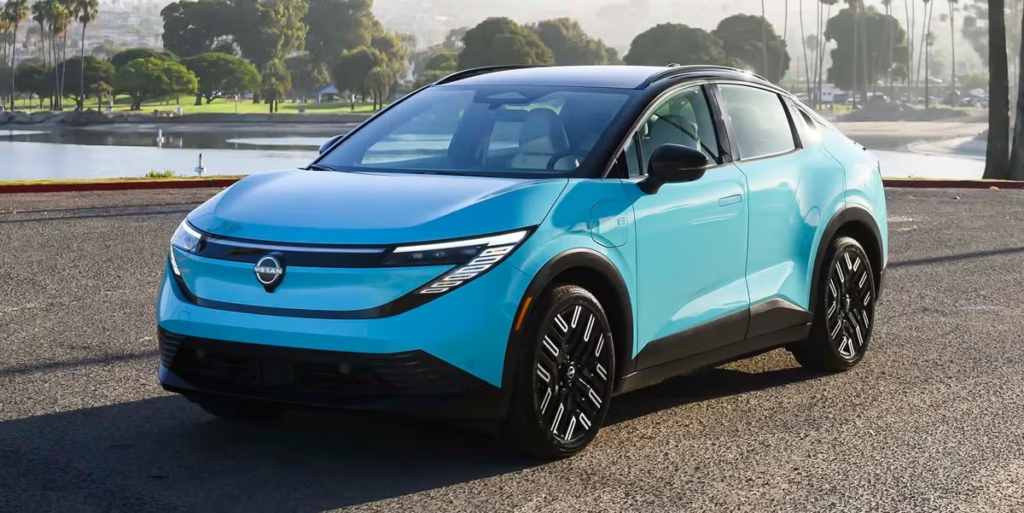
Verdict: 303 miles of EPA range at a price that is genuinely under $30,000 MSRP — but not under $30,000 at the dealership. Better range, higher real cost than the Bolt.
The 2026 Leaf is the most dramatic redesign in the nameplate’s history. Nissan abandoned the distinctive hatchback silhouette that defined the Leaf for 15 years and rebuilt it as a crossover SUV. The third-generation Leaf adds NACS charging (eliminating the CHAdeMO port that was becoming nearly unusable), upgrades range from 226 miles to 303 miles on the S+, and maintains assembly at Nissan’s Smyrna, Tennessee facility — which previously qualified it for the federal tax credit. That credit no longer exists for purchases, but the domestic assembly still qualifies the Leaf for manufacturer incentives not available to imported vehicles.
The Leaf S: the better deal if you can find it. The 2026 Leaf S at $25,360 MSRP (+ $1,495 destination = $26,855) with Nissan’s $3,250 manufacturer rebate reaches an effective floor of approximately $23,605 — the cheapest new EV available in the U.S. market in 2026. Nissan has not confirmed its delivery timeline for the S trim beyond “spring 2026”; inventory is limited and may not be available in all markets at time of publication.
Specifications (S+ trim):
- MSRP: $29,990 (+ $1,495 destination = $31,485 real price)
- EPA range: 303 miles
- Battery: 75 kWh
- Motor: 214 hp, FWD
- DC fast charging: 130 kW NACS
- Charging port: NACS (Tesla Supercharger compatible)
- Assembly: Smyrna, Tennessee
- Body style: Crossover SUV (redesigned from hatchback)
What the Leaf S+ cannot do:
- Real street price is $31,485 — over $30,000 despite the MSRP. Buyers who budget $30K will be surprised at the dealership.
- No AWD option
- 130 kW DC fast charging is slower than the Bolt’s 150 kW
- No Super Cruise or advanced driver assistance available on base trim
Who should buy it: buyers who prioritize maximum range, crossover body style over hatchback, and are in a state with strong EV incentives that bring the effective price below $30K.
The Range-per-Dollar Efficiency Index: BitsFromBytes Original Calculation
Range efficiency at this price point matters more than at any other EV segment, because budget buyers are most likely to be choosing between an EV and a gas car with no range anxiety. We calculated a Range-per-Dollar Index: EPA miles ÷ effective street price × $10,000 = index score. Higher is more efficient.
| Vehicle | EPA Range | Effective Street Price | Range/Dollar Index |
|---|---|---|---|
| 2027 Chevy Bolt LT (no incentives) | 262 mi | $28,995 | 90.4 |
| 2027 Chevy Bolt LT (with $1,500 dealer discount) | 262 mi | $27,495 | 95.3 |
| 2026 Nissan Leaf S+ (real street price) | 303 mi | $31,485 | 96.2 |
| 2026 Nissan Leaf S+ (with $3,250 Nissan rebate) | 303 mi | $28,235 | 107.3 |
| 2026 Nissan Leaf S (with $3,250 rebate) | ~260 mi est. | $23,605 | 110.1 |
Finding: the Leaf S+ with manufacturer rebate and the Leaf S deliver the best range-per-dollar at this price point — but only if you qualify for Nissan’s financing incentive through NMAC. Without that rebate, the Bolt wins on pure price efficiency.
Cite as: BitsFromBytes Research, Range-per-Dollar Index, Best Electric Cars Under $30,000, May 2026.
New vs. Used: When a Second-Hand EV Beats Both
The sub-$30K new EV market in 2026 has exactly two options, limited range choices, and no federal subsidies. The used EV market at the same price point looks completely different. This comparison does not appear in any current competitor article for this keyword.
What $28,000–$30,000 buys in the used EV market (May 2026):
| Used Vehicle | Typical Price Range | EPA Range (original) | Real-World Range Retained | Notes |
|---|---|---|---|---|
| 2022–2023 Tesla Model 3 SR+ | $24,000–$28,000 | 272 miles | 240–255 miles | Supercharger access; best software |
| 2022–2023 Hyundai Ioniq 5 SE | $26,000–$30,000 | 266 miles | 235–250 miles | Excellent 800V charging (up to 220 kW) |
| 2023 Chevy Bolt (original gen) | $17,000–$22,000 | 259 miles | 230–245 miles | Lowest price; battery recall fully resolved |
| 2022 Volkswagen ID.4 Pro | $24,000–$27,000 | 275 miles | 240–255 miles | AWD available; VW charging network |
| 2022 Kia EV6 Standard Range | $25,000–$29,000 | 232 miles | 205–220 miles | Excellent build quality; 800V charging |
Sources: CarGurus EV listings May 2026, iSeeCars EV valuation data, Edmunds Used EV Pricing Guide.
When used beats new at this budget:
- If you want AWD for winter driving: the used Ioniq 5 AWD or ID.4 AWD at $27,000–$30,000 beats both new options, which are FWD-only
- If you want a larger vehicle: the used Ioniq 5 is a full crossover; the Bolt is a compact hatchback
- If you want 800V ultra-fast charging: the used Ioniq 5 and EV6 charge faster than either new option
- If you want the absolute lowest price: a used 2023 Bolt at $17,000–$22,000 is the cheapest path to reliable EV ownership
When new beats used at this budget:
- If warranty matters: new Bolt comes with GM’s standard 3-year/36K bumper-to-bumper and 8-year/100K battery warranty; used vehicles vary
- If you want the latest NACS port: older used EVs use CCS or CHAdeMO adapters (though Tesla provides free CCS adapters for Supercharger access)
- If you want the LFP battery benefit (daily 100% charging): only the new Bolt has LFP at this price range
How to Decide: Decision Matrix
| If you… | Buy this |
|---|---|
| Want the cheapest new EV in America | 2027 Chevy Bolt LT |
| Want maximum range in a new EV under $30K | 2026 Nissan Leaf S+ (with $3,250 Nissan rebate) |
| Live in Colorado and want the best post-incentive deal | 2027 Chevy Bolt (~$23,995 after state incentive) |
| Need AWD for winter driving | Used Hyundai Ioniq 5 AWD (~$27,000–$30,000) |
| Want the lowest price possible (used) | 2023 Chevy Bolt (~$17,000–$22,000 used) |
| Want 800V ultra-fast charging | Used Hyundai Ioniq 5 or Kia EV6 |
| Live in a state with no incentives and want new | 2027 Chevy Bolt LT — it’s the only one actually under $30K |
Frequently Asked Questions
What is the cheapest new electric car in 2026?
The 2027 Chevrolet Bolt LT at $28,995 including destination fees is the cheapest new electric car available in the United States in 2026. It is currently the only new EV that genuinely costs less than $30,000 at the dealership after accounting for destination fees. The 2026 Nissan Leaf S+ starts at $29,990 MSRP but adds $1,495 in destination charges, bringing its real street price to $31,485.
Is there still a $7,500 federal tax credit for electric cars in 2026?
No. The $7,500 federal clean vehicle tax credit for EV purchases was eliminated effective October 1, 2025, following the passage of the One Big Beautiful Bill Act. EV buyers who purchase (not lease) an electric vehicle in 2026 do not receive this federal credit. Some state incentives remain, and certain manufacturers continue to pass a commercial vehicle lease credit to lessees — but the consumer purchase credit is gone.
Should I buy a new Chevy Bolt or a used Tesla Model 3 for under $30,000?
It depends on your priorities. The new Bolt offers a fresh warranty, the latest NACS port, and an LFP battery that handles daily 100% charging without degradation. A used Tesla Model 3 Standard Range (2022–2023) at $24,000–$28,000 offers a larger, more refined vehicle, access to Tesla’s Supercharger network natively, and better software — but no warranty beyond what remains from the original purchase. For buyers who prioritize lowest risk and peace of mind, the new Bolt. For buyers who want the best overall vehicle at this price point and are comfortable buying used, the Model 3.
What is the range of the 2027 Chevy Bolt?
The 2027 Chevy Bolt has an EPA-estimated range of 262 miles. In real-world testing by Edmunds, it drove 290 miles on a single charge — approximately 10% more than the EPA figure. It uses a 65 kWh LFP battery and charges at up to 150 kW DC, completing a 10%–80% charge in approximately 25 minutes.
What is the range of the 2026 Nissan Leaf?
The 2026 Nissan Leaf S+, SV+, and Platinum+ trims all deliver 303 miles of EPA-estimated range on a 75 kWh battery. Real-world highway range at 70 mph holds at approximately 255–270 miles in mild weather. The base Leaf S trim (52 kWh) is estimated at approximately 230–240 miles; official EPA figures had not been published at the time of this article’s update.
Do EVs under $30,000 qualify for any incentives in 2026?
The federal $7,500 purchase credit no longer exists. Available incentives in 2026 include Nissan’s $3,250 manufacturer rebate on the Leaf (for MSRP under $34,999, through NMAC financing), GM dealer discounts of $500–$1,500 on the Bolt, and state-level programs that vary significantly. Colorado offers up to $5,000 (plus up to $9,000 through the VXC low-income program), Massachusetts offers $3,500, Illinois offers $4,000, and New York and California offer $2,000. Texas and Florida have no state EV incentives.
Is the Chevy Bolt worth buying in 2026?
Yes, for the right buyer. The 2027 Bolt offers 262 miles of EPA range, 290 miles in real-world testing, NACS charging, 150 kW DC fast charging, Google Built-in, and an LFP battery designed for daily 100% charging — all for $28,995 with destination included. Its limitations are real: FWD only, cold-weather range loss more pronounced than NMC competitors, and a “limited run” designation from GM that may restrict availability. For commuters in mild climates who want the absolute lowest new-EV price, it is the best option in its category.
Methodology
All prices verified against manufacturer official sources and Kelley Blue Book dealer listings in May 2026. Real-world range figures sourced from Edmunds’ independent EV range testing methodology, which uses a mixed 60%/40% city-highway cycle at 40 mph average. State incentive data verified against each state energy agency’s current program page. Used EV pricing sourced from CarGurus and Edmunds used car listings filtered to private-party and dealer sales in May 2026, excluding high-mileage units (over 50,000 miles).
Original BitsFromBytes Research contributions in this article:
- Sticker vs. Street Price Table — MSRP vs. destination-inclusive real price vs. effective price after current 2026 incentives. The first such table in the current SERP that correctly excludes the expired $7,500 federal credit.
- State EV Incentive Table — eight states, effective floor prices for both vehicles, May 2026.
- Range-per-Dollar Index — EPA miles ÷ effective street price × $10,000. Original calculation.
- New vs. Used Comparison Table — puts used EVs at the same budget next to the new options. Does not exist in any competing article.