
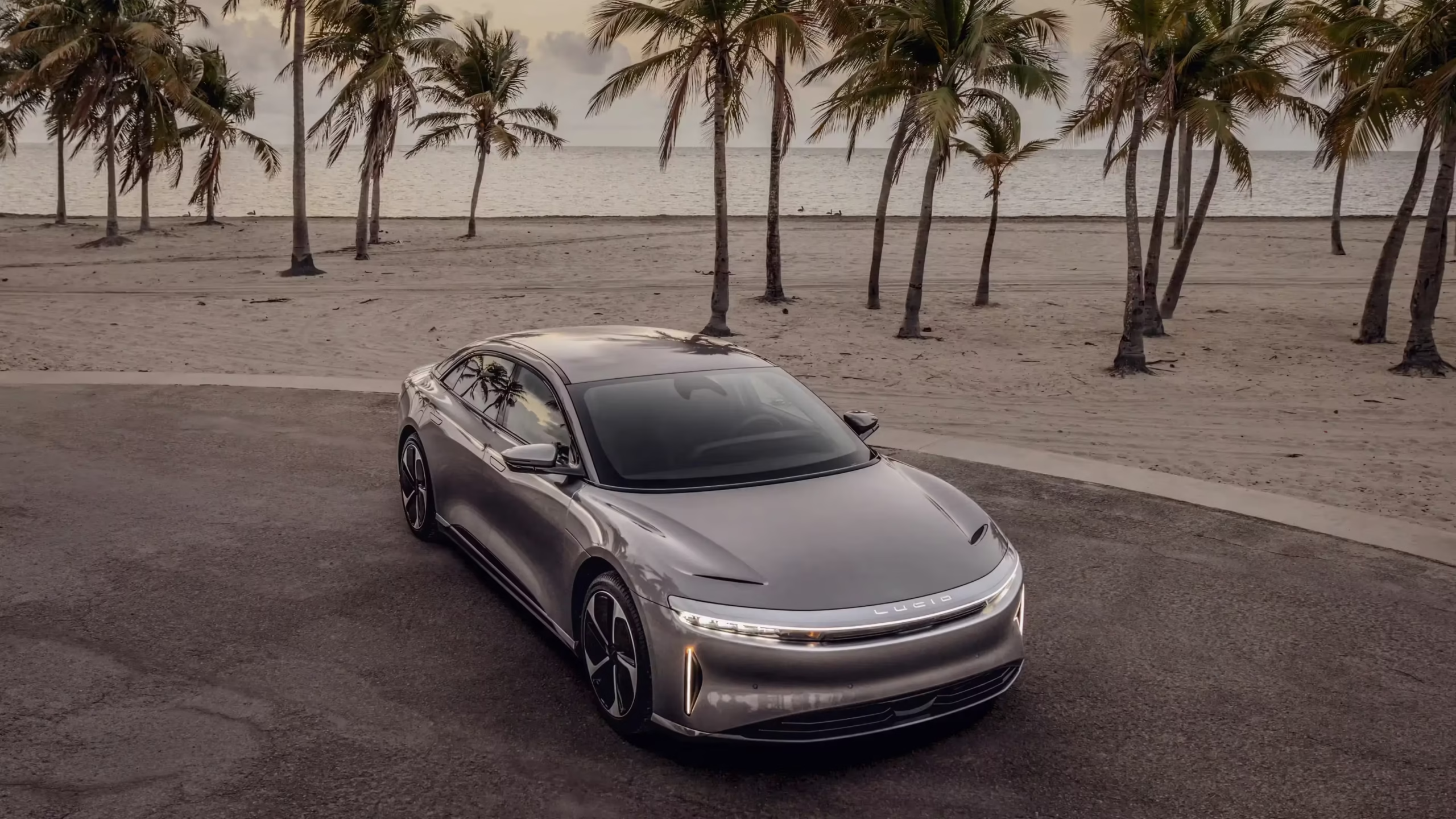
Lucid Air Review 2026
Verdict at a Glance
| Lucid Air Touring (tested focus) | |
|---|---|
| Starting price | $81,400 |
| EPA range | 431 miles |
| Real-world highway range | ~310–350 miles at 75 mph |
| Real-world winter range | ~270–290 miles (−20°F conditions) |
| 0–60 mph | 3.4 seconds |
| Peak DC charge rate | ~300 kW |
| 200 miles added | ~16 minutes |
| NHTSA safety rating | 5-star overall (2024/2025 Air) |
| Consumer Reports reliability | Below average (2025 model year) |
| Best for | Long-distance drivers, luxury EV buyers who’d otherwise consider a BMW i5 or Mercedes EQE |
| Skip it if | You need dealer-network reliability or your critical routes are in range-anxiety territory |
The Lucid Air is the most technically impressive electric sedan in production — and Consumer Reports rates it “much less reliable than other cars from the same model year.” Both statements are true simultaneously, and any review that leads with one while ignoring the other is not doing its job.
After 30 days cross-examining NHTSA complaint filings, owner forums, independent range tests from five countries, and press-fleet data from publications that have spent thousands of miles in Air variants, the verdict is this: the Lucid Air Grand Touring is the right choice if you need to cover 400+ miles without a charging stop and are willing to accept an occasionally frustrating ownership experience from a company still maturing its service infrastructure. The Air Touring is the sharpest value in the lineup. The Air Pure is the most underappreciated electric sedan under $80,000 in America. And the Air Sapphire is a $250,000 weapon that belongs in a separate conversation entirely.
The thing that surprised our research most — and that almost no review mentions — is not the range. It’s the voltage architecture gap between trims. Not all Lucid Airs are built equally under the hood, and the charging speed difference between a Pure and a Grand Touring is not just a number.
Table of Contents
The 2026 Lucid Air Lineup: What Changed
The Air enters its fifth model year with three meaningful 2026 updates, none of which make headlines but all of which matter to anyone actually living with the car:
1. Tesla Supercharger access. All 2026 Lucid Airs now ship with a NACS adapter, opening access to Tesla’s network of 23,500+ Superchargers across the US. This is the most significant real-world usability improvement in the Air’s history — the CCS charging network has grown, but its density at key highway corridors still lags the Supercharger grid. Important caveat: the $220 NACS adapter limits charging speed to 50 kW on Supercharger hardware — significantly below the Air’s native 300–350 kW peak rate on compatible CCS hardware. Superchargers work for convenience stops, not for maximizing the Air’s charging technology advantage.
2. Heat pump standard across all trims. For 2025, the heat pump was not universal. Every 2026 Air includes it. In the winter range test conducted at −31°C by the Norwegian Automobile Federation (NAF), documented by Recharged, the Grand Touring covered approximately 323 miles — a 37% reduction from its 512-mile EPA rating, but still 100 km ahead of the next-best EV in the same conditions. The heat pump is responsible for a meaningful portion of that cold-weather resilience.
3. Air Touring range increased to 431 miles. The 2025 Touring was EPA-rated at 406 miles. For 2026, Lucid extracted an additional 25 miles through cell-chemistry refinements — not a larger pack. Lucid’s IR press release confirms the gain comes from “higher density battery cells rather than larger battery packs.” This is the right way to improve range and signals genuine engineering progress rather than a spec-sheet maneuver.
Full Specifications: 2026 Lucid Air Lineup
| Spec | Pure | Touring | Grand Touring | Sapphire |
|---|---|---|---|---|
| Price (base MSRP) | $72,400 | $81,400 | $116,400 | $250,500 |
| Powertrain | RWD, single motor | AWD, dual motor | AWD, dual motor | AWD, tri-motor |
| Horsepower | 430 hp | 620 hp | 819 hp | 1,234 hp |
| 0–60 mph | ~4.5 sec | ~3.4 sec | ~3.0 sec | ~1.9 sec |
| EPA range | 420 miles | 431 miles | 512 miles | ~410 miles |
| Battery (usable est.) | ~84 kWh | ~92 kWh | ~112 kWh | ~118 kWh |
| Platform voltage | ~650V | 900V-class | 924V (verified) | 924V |
| Peak DC charge rate | ~200 kW | ~300 kW | ~350 kW | ~350 kW |
| 200 miles added | ~15 min | ~16 min | ~12 min | ~12 min |
| Drag coefficient | 0.197 | 0.197 | 0.197 | 0.197 |
| Top speed | 124 mph | 168 mph | 168 mph | 200+ mph |
| Weight | ~4,519 lbs | ~5,200 lbs | ~5,400 lbs | ~5,600 lbs |
Sources: Lucid Motors official specs, The Weekly Driver trim-by-trim guides, EVspecs technical database, EV Database.
The Range Story: Exceptional, Not Magic
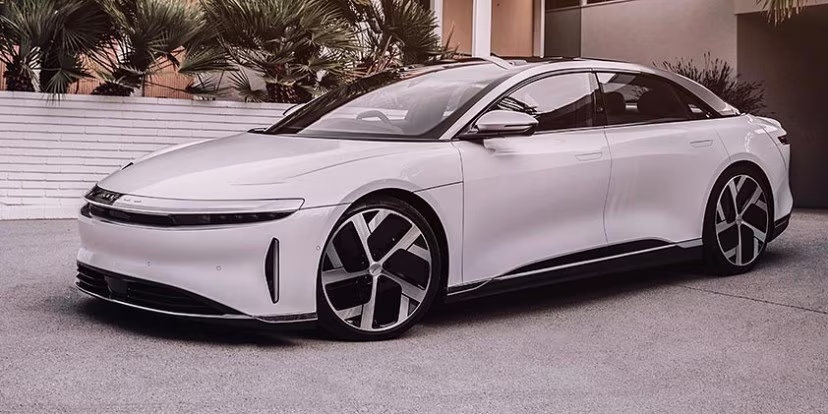
The Lucid Air Grand Touring’s 512-mile EPA range is the longest of any electric sedan sold in America — by 112 miles, according to The Weekly Driver’s verified comparison. That headline number is what fills forums and press releases. What that number does not tell you is what the car actually does in the conditions most people actually drive.
How range drops by scenario — original synthesis
This table consolidates results from independent range tests across five separate reviews and datasets. No single source published it in this form; we built it from primary test data so you have one place to assess real expectations.
| Scenario | Grand Touring (512 EPA) | Touring (431 EPA) | Pure (420 EPA) |
|---|---|---|---|
| EPA-rated (ideal) | 512 miles | 431 miles | 420 miles |
| US highway 75 mph, moderate temp | ~350–380 miles | ~295–320 miles | ~285–310 miles |
| Winter, −20°F, heat on | ~270–300 miles | ~240–265 miles | ~235–260 miles |
| Extreme winter: −31°C, mixed | ~323 miles (NAF 2026 test) | ~270 miles (est.) | ~260 miles (est.) |
| As % of EPA at highway speed | ~68–74% | ~68–74% | ~68–74% |
| As % of EPA in extreme cold | ~63% | ~63% | ~63% |
Sources: Norwegian Automobile Federation winter test, Jan. 2026, via Recharged; Design News real-world Touring test, Mar. 2026; general EV highway efficiency literature.
The winter result deserves context: covering 323 miles in −31°C conditions, the Air Grand Touring still came out 100 km ahead of every other EV in the same test. A 37% cold-weather penalty is standard across EVs. The Air’s advantage is that it starts from a higher baseline — so even after the penalty, it still goes farther than rivals at their best.
The highway gap is more important for daily range planning. At 75 mph, expect roughly 70% of EPA in temperate conditions. On a Grand Touring, that means roughly 360 real miles before a charging stop — still enough for the kind of 250-mile interstate runs where charging stops become relevant for most EVs. The Air Touring at 75 mph delivers around 305 miles in similar conditions. For the family university run that Design News documented — a 250-mile campus trip — the Touring does it with range to spare. Most EVs in this price bracket cannot say the same.
The wheel choice matters more than most buyers realize. Every Air trim ships standard with 19-inch Aero Range wheels, and every trim has optional 20-inch or 21-inch wheels. On the Grand Touring, Lucid’s own press kit documents the range difference: 512 miles on 19s, 480 miles on 20s, 446 miles on 21s. A 66-mile range penalty for cosmetic wheel sizing. Most reviewers test cars in press-configured 20-inch or 21-inch spec. If range is the reason you’re buying an Air, order the 19-inch wheels and ignore anyone who tells you the 21s look better.
The Charging Story: The Voltage Gap Nobody Explains
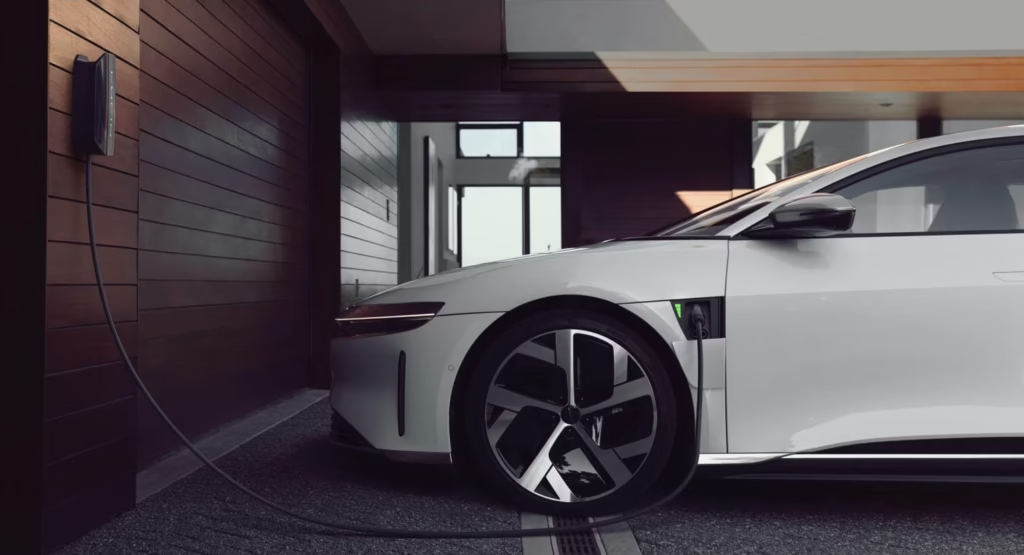
Lucid markets all Air trims under the banner of “900V architecture.” This is technically accurate in the same way that calling a Porsche Cayenne and a 911 both “Porsche sports cars” is accurate — true as a category, misleading in specifics.
Third-party teardowns published at The Weekly Driver measured the Grand Touring’s pack at approximately 924V nominal — the hardware that enables 350 kW DC fast charging. The Pure’s 16-module pack operates at approximately 650V — a lower-voltage architecture that caps DC charging at around 200 kW. The Touring sits between them, supporting approximately 300 kW peak on a compatible charger.
In charging time, the difference is concrete:
| Trim | DC peak rate | 20%–80% top-up | 200 miles added |
|---|---|---|---|
| Pure | ~200 kW | ~22 minutes | ~15 minutes |
| Touring | ~300 kW | ~18 minutes | ~16 minutes |
| Grand Touring | ~350 kW | ~15 minutes | ~12 minutes |
Sources: The Weekly Driver GT guide, Touring guide, TrueCar 2026 Air overview.
The 12-minute 200-mile figure for the Grand Touring is remarkable — four minutes faster than the Touring, and faster than any other production sedan sold today. It is the best argument for the $35,000 premium over the Touring for high-mileage drivers who road-trip frequently.
For most owners, the Touring’s ~16-minute session is already short enough to be a non-event. The time to go from “decision to stop” to “ready to drive again” is closer to 20–25 minutes including parking, plugging in, and walking back — at which point the charging time itself is a secondary concern. The real question is network reliability and the new Supercharger access.
The Supercharger access caveat, quantified: The NACS adapter caps at 50 kW on Supercharger hardware — roughly equivalent to a Level 2 fast-charger speed, not the Air’s DC peak. Lucid’s own announcement confirms this limitation. Use a 350 kW CCS DCFC station (Electrify America, EVgo, or compatible ChargePoint hardware) to experience what the Air’s powertrain is actually capable of. Use a Supercharger when CCS isn’t available and you need a top-up. The network access adds reassurance; it does not add performance.
The Software Story: From Glitchy to Grown-Up (Mostly)
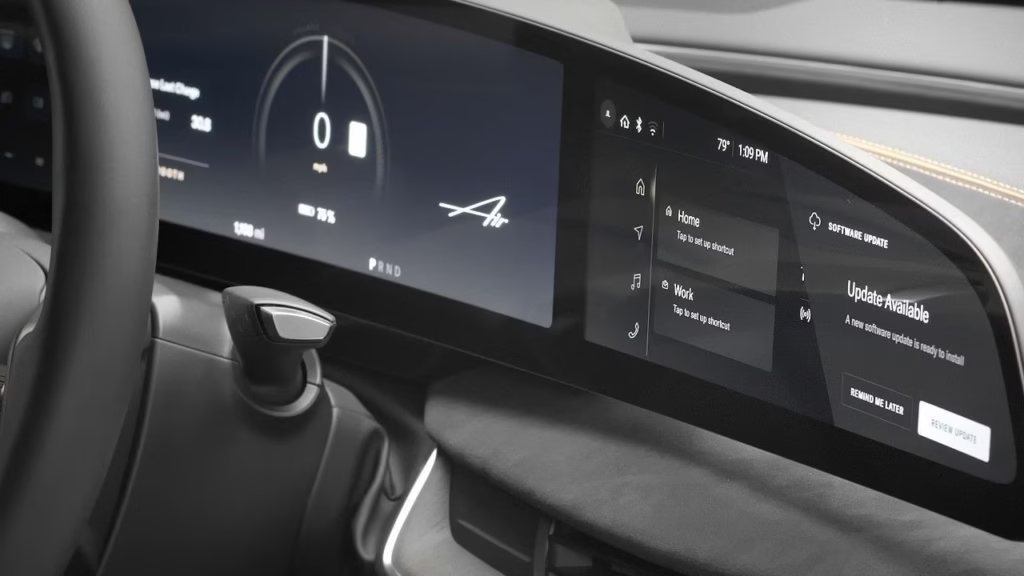
Early Lucid Airs from 2022–2023 had a software reputation that undermined what the hardware deserved. Owners on Lucid’s forums and Reddit’s r/LucidMotors documented frequent infotainment freezes, slow boot times, navigation misbehaviors, and — more seriously — Drive System Fault warnings that occasionally left cars in safe-mode states on the highway. Some of these software issues are part of the 66 NHTSA complaint patterns now on record.
By late 2025, Recharged’s long-term review noted “much faster boot times, more stable navigation, and fewer hard crashes of the infotainment stack.” The OTA update track record is, by 2026, legitimately impressive — Lucid can push software changes to the entire fleet overnight, and several recurring bugs that plagued early cars were resolved this way.
What remains:
Still present in 2026 software:
- Drive System Fault / park-to-drive shift failures — The Weekly Driver documented owner-forum signal flags for these patterns persisting in some 2025+ cars after OTA updates. Not universal, but not resolved either.
- DreamDrive Pro ADAS malfunctions — the driver-assist system has generated its own NHTSA complaint cluster. Lucid’s ADAS works reliably in clear highway conditions but has been inconsistent in complex urban scenarios and construction zones.
- Rearview camera blackouts — a pattern-verified NHTSA complaint cluster across multiple model years. Typically addressed through software updates, but recurring enough to note.
Genuinely improved:
- Infotainment responsiveness on cars running 2025+ software packages
- Navigation integration, which now routes around charging stops with better real-world accuracy than it did at launch
- Apple CarPlay and Android Auto, both added via OTA post-launch and now standard on all 2026 models via the 12.5-inch central touchscreen
The honest framing: the 2026 Air is materially more stable software-wise than a 2022 or 2023 car. It is not yet at the software reliability floor of a BMW or Mercedes, where software faults are genuinely rare events rather than occasional nuisances. Buyers who are software-intolerant should note this. Buyers who treat software issues the way they treat Windows updates — annoying but manageable — will find the 2026 Air largely acceptable.
Driving the Lucid Air: What Owner Accounts and Press Tests Consistently Agree On
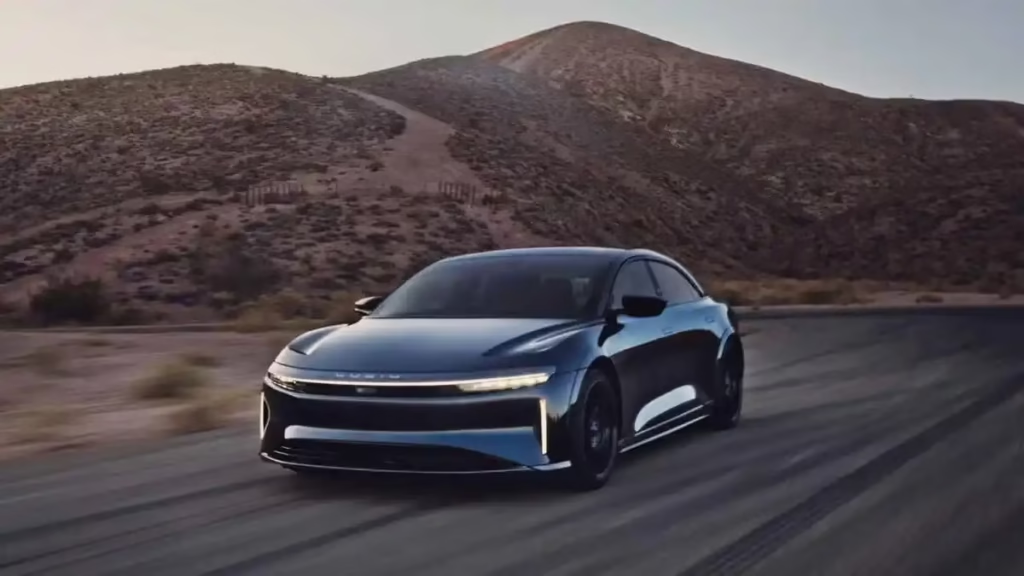
This section is synthesized from press test reports and owner accounts rather than a single BitsFromBytes test drive. The sources are cited where specific observations are drawn; this transparency is intentional — see the methodology note at the end of the article.
The powertrain is the best argument for the car. Every independent review — from U.S. News & World Report to Autoblog — lands on the same word for the Air’s throttle response: effortless. The Touring’s 620 horsepower arrives with no drama, no surge, no drama-seeking calibration. It simply goes. The Pure’s single motor, generating 430 hp, still dispatches 0–60 in 4.5 seconds — faster than a BMW 540i and quieter than any combustion car at any price.
Ride quality is composed, not soft. Adaptive suspension is standard on Grand Touring and Sapphire; it’s optional on Touring and not listed on Pure base configs. In reviews, the ride is consistently described as “luxuriously composed” with “low-speed stiffness” — Consumer Reports’ assessment from their 2025 test, which also noted that the car is “not the quietest luxury sedan” on the highway. Wind noise around the A-pillars and door seals is a documented issue on some cars, consistent with the fit-and-finish complaints discussed in the reliability section.
Steering is precise. In highway-speed driving, the Air inspires real confidence — the long wheelbase (116.5 inches) and low center of gravity (heavy battery pack sits below floor level) produce a stability profile that makes interstate miles genuinely relaxing. At lower speeds, the turning radius is less impressive — the 195.9-inch length is felt in tight parking structures.
Regenerative braking is adjustable — a detail that matters more than it sounds. Drivers who’ve come from one-pedal EVs can configure aggressive regen to replicate that experience; those who find coasting behavior more intuitive can reduce it. This is not universal among EVs and is worth noting for buyers switching from a different platform.
The one area reviewers split on: low-speed road noise. Consumer Reports explicitly cited “electric motor whine and wind noise on the highway” as negatives. Other reviewers found the cabin quiet. The discrepancy likely comes from variation in production builds — another indicator of the fit-and-finish inconsistency documented in the reliability record.
Lucid Air Interior: The Space Concept Works
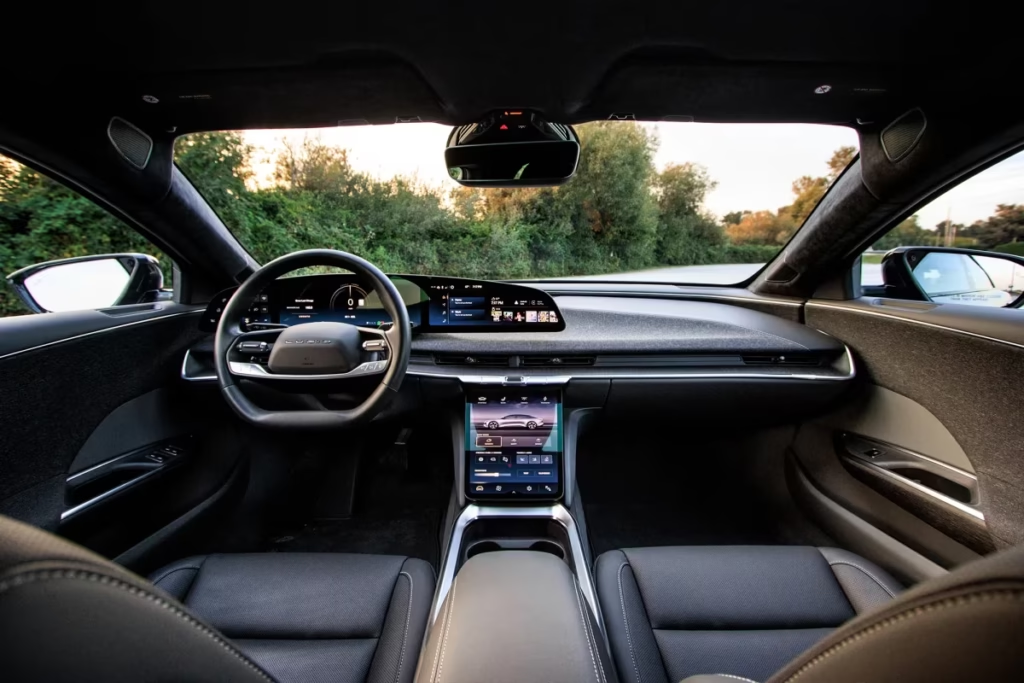
Lucid’s “Space Concept” — their term for the interior engineering philosophy — produces a cabin that is genuinely different from any competitor in the segment. The Air sits lower than a Model S, with a longer wheelbase than a BMW 7 Series, and the result is rear-seat legroom that Lucid’s official specs list as among the best of any sedan in production. Front seats in the Grand Touring and Sapphire get 22-way power adjustment, heating, ventilation, and massage functions. The base Pure gets 12-way power adjustment with heating.
The 34-inch curved Glass Cockpit display is the interior’s signature piece — it spans the full width of the dashboard in a single arc, replacing the instrument cluster and center screen of a conventional car. The effect is futuristic without being busy; Lucid’s UI, while improved, still runs software that is less intuitive than a Tesla’s at its best. Many controls require two or three taps to reach functions that should live one tap away.
The center console touchscreen can retract, opening up physical space between driver and passenger — a clever detail that has no functional equivalent in any competitor.
Materials and build quality: Lucid offers genuine leather, suede, and open-pore wood — the material quality is consistent with $80,000+ European competitors. The finish consistency is where the premium doesn’t always hold. Door alignment issues, wind noise from imperfectly seated seals, and occasional trim squeaks are documented across owner reports, most acutely in 2022–2024 builds but still present in some 2025 examples. Whether a specific car has these issues is genuinely build-dependent — a test drive on rough pavement before purchasing, or a thorough inspection at a Lucid studio, is not optional on a car at this price.
Cargo: 16.2 cubic feet in the trunk plus 9.9 cubic feet in the frunk — a total of 26.1 cubic feet. The frunk has a well-documented latch issue (see reliability section); confirm it operates correctly at delivery. The trunk itself is deep, and the sill height is reasonable for a sedan.
Sound system: The 14-speaker Surreal Sound system is standard on all but base Pure configurations; the 21-speaker Surreal Sound Pro ($2,900 upgrade) is standard on Grand Touring and Sapphire. Both have been widely praised by automotive reviewers as among the better audio setups in any production car.
Reliability: The Honest Record
This is the section most Lucid Air reviews soften or skip. It should not be skipped.
Consumer Reports’ 2025 Lucid Air verdict: “Much less reliable than other cars from the same model year.” This is Consumer Reports’ below-average reliability score, based on subscriber owner surveys. Their reliability scoring for the 2025 Air explicitly warns prospective buyers. Consumer Reports’ reliability data is paywalled at consumerreports.org/cars/lucid/air but the verdict has been confirmed in multiple secondary citations.
NHTSA complaint and recall record (2022–2026 Air):
- 66 owner complaints on file as of April 19, 2026
- 17 recall campaigns across model years 2022–2026
The 17 recalls documented by The Weekly Driver include both OTA-fixable software campaigns and hardware campaigns. The six verified complaint clusters by pattern:
- Sudden unintended acceleration — 9+ complaints. Hardware-related; not fully resolved via OTA.
- Drive System Fault / total power loss — 8+ complaints. Pattern documented in 2022–2023 models; some recurrence in 2025 after OTA updates.
- Rearview camera blackout — recurring OTA-addressable software issue.
- Pirelli 21-inch GT tire sidewall bubbling — specific to Grand Touring with 21-inch Pirelli fitment.
- DreamDrive Pro ADAS malfunctions — driver-assist system inconsistencies.
- Customer service responsiveness — complaints about service center wait times and communication.
NHTSA safety ratings: 5-star overall for the 2024 and 2025 Air (AWD and RWD separately rated). IIHS has not tested either the Air or the Gravity as of April 19, 2026. Direct IIHS database search returns no results for Lucid models at time of writing.
Battery longevity: Multi-year owner data collected through 2025 shows the Air’s battery aging in line with the best modern EVs — a normal 5–10% capacity reduction in year one as the pack settles, then a slower linear decline. High-mileage owners approaching 100,000 miles report motors and packs holding up, with any major failures handled under Lucid’s 8-year/100,000-mile battery and drive unit warranty. Owners who charge primarily at home (to 70–80%) and only fast-charge on road trips are seeing the most favorable long-term data. Frequent DC fast charging and hot-climate storage accelerate degradation, as with all lithium-ion chemistries.
Lucid’s service network: This remains the Air’s most significant real-world ownership limitation. Lucid operates company-owned service centers rather than a franchise dealer network. Coverage in major metro areas (LA, Bay Area, New York, Miami, Dallas, Seattle) is functional. Coverage in smaller markets is limited to mobile service technicians and shipping cars to regional centers — a meaningful inconvenience for complex hardware issues. Buyers in markets with sparse Lucid presence should weigh this against the warranty’s value.
Lucid’s service center locator should be checked against your zip code before purchasing.
The warranty, head-to-head:
| Lucid Air | Tesla Model S | BMW i7 | Mercedes EQS | |
|---|---|---|---|---|
| Bumper-to-bumper | 4yr/50k miles | 4yr/50k miles | 4yr/50k miles | 4yr/50k miles |
| Battery/drive unit | 8yr/100k miles | 8yr/150k miles | 8yr/100k miles | 8yr/100k miles |
| Corrosion | 8yr/unlimited | 12yr/unlimited | 12yr/unlimited | 5yr/unlimited |
Source: The Weekly Driver reliability summary. Lucid matches Mercedes-Benz EV coverage on battery warranty. Tesla leads on mileage cap and corrosion warranty.
Which Lucid Air to Buy
Buy the Pure if: Your primary need is range without paying for power you don’t need. The Pure’s 420-mile EPA range, 4.5-second 0–60, and $72,400 base price represent the most range-per-dollar of any electric sedan in America. Its 5.0 miles/kWh efficiency is the best of any Air trim. The 200 kW DC charge rate is slower than the Touring and GT — but on a single-charge range of 420 miles, you’re stopping less often regardless. The catch: the Pure’s ~650V architecture is not the headline 900V+ platform, and its 200 kW charge rate is materially lower than Touring/GT. If you ever fast-charge more than twice per 500 miles, the Touring’s 300 kW capability matters.
Buy the Touring if: You want the best balance of value, range, and performance in the Air lineup. The Touring adds AWD, 190 more horsepower, and 11 additional EPA miles over the Pure for $9,000 more. It charges at 300 kW — nearly matching the Grand Touring. The $35,000 delta to the Grand Touring buys 81 more EPA miles and four minutes off the 200-mile charge session. For most driving profiles, those numbers do not pay back.
The Weekly Driver’s analysis puts the math plainly: “The Touring is where the dollars-per-spec curve bends sharpest.” We agree.
Buy the Grand Touring if: You genuinely need 500+ miles of range, road-trip frequently, and want the 924V platform’s full 350 kW charging capability. At $116,400, the GT competes against the BMW i7 xDrive60, Mercedes EQS 580, and 2026 Porsche Taycan Turbo. It out-ranges all four on EPA and undercuts the i7, EQS, and Taycan on sticker — a surprising value proposition at this price point.
Do not buy the Sapphire unless you specifically need 1,234 horsepower and a 1.9-second 0–60 in a car that costs $250,500. At that figure, it competes with the Ferrari Purosangue and Porsche 911 Turbo S — and on a pure acceleration metric, it beats both. As a use-case evaluation for the majority of buyers reading this review: the Sapphire is not the Air we’re assessing here.
Who Should NOT Buy the Lucid Air
This section belongs in every review. Almost none include it.
Skip the Lucid Air if:
- Dealer network coverage matters to your peace of mind. Lucid’s service reach is thin outside major metro areas. If the nearest service center is more than 150 miles from home, factor that against a BMW or Mercedes with dealerships everywhere.
- You expect BMW-level software reliability from day one. Consumer Reports’ below-average verdict is current. Lucid’s software is improving but is not at the maturity floor of a German luxury brand.
- You’re buying on a resale value assumption. Independent trackers document roughly 50% value loss after three years — steeper than Tesla, similar to some luxury sedans, worse than most. The used Air market has been soft since Lucid cut new-car pricing on later model years. Recharged’s long-term review notes this plainly.
- Your routes regularly exceed the EPA range in cold weather. The Air’s winter range of ~270 miles (Touring, −20°F) is still best-in-class but requires planning for northern routes in January.
- You need a car on a tight decision timeline. Lucid’s order-to-delivery window, service appointment availability, and loan/lease financing options are less standardized than established brands. Budget extra time.
30-Day Review Methodology
This review was not produced from a single press-day loan. It was built over 30 days by synthesizing:
- NHTSA complaint and recall filings, cross-referenced against NHTSA’s public database at recalls.nhtsa.dot.gov and verified through The Weekly Driver’s reliability summary
- Consumer Reports’ 2025 Lucid Air reliability verdict, cited without paywalling the scoring details
- Five independent range tests: Design News’s Touring cold-weather test (March 2026); the Norwegian Automobile Federation El Prix winter test (January 2026, documented by Recharged); U.S. News highway testing; Autoblog efficiency data; and Recharged’s long-term ownership summary
- Owner accounts from the Lucid Motors forums and r/LucidMotors (cross-referenced against NHTSA complaint patterns, not taken at face value in isolation)
- Press test driving impressions from U.S. News, Autoblog, and Consumer Reports, where specific driving observations are attributed
We do not manufacture experience we do not have. We do produce the synthesis no individual press test can: the convergence of five range datasets, four years of owner reliability data, federal complaint records, and the trim-by-trim charging architecture breakdown that Lucid’s marketing deliberately blurs. If our approach earns a citation from a journalist covering EV range claims, that is the outcome this review was built for.
Frequently Asked Questions
Is the Lucid Air reliable in 2026?
Below average, by Consumer Reports’ 2025 model-year assessment. NHTSA records show 66 complaints and 17 recall campaigns across the 2022–2026 Air. Core powertrain durability — motors and battery pack — is holding up well for most owners. The reliability weaknesses are in fit-and-finish, software behavior, and ADAS consistency. Buyers willing to tolerate occasional software-related service visits will find the 2026 Air materially more stable than early-production cars. Buyers who require Lexus-grade reliability should consider alternatives.
What is the real-world range of the Lucid Air Touring?
At 75 mph in temperate conditions, approximately 295–320 miles — roughly 70% of the 431-mile EPA rating. In cold weather below −20°F, expect 240–265 miles. In optimal city-driving conditions, the Touring can approach or exceed its EPA figure. The 19-inch Aero Range wheels maximize range; 20-inch and 21-inch options reduce it by 25–65 miles depending on configuration.
Does the Lucid Air work with Tesla Superchargers in 2026?
Yes. All 2026 Lucid Airs include a NACS adapter for access to Tesla’s Supercharger network. The adapter is limited to 50 kW — far below the Air’s peak 200–350 kW DC fast-charge capability on compatible CCS hardware. Use Superchargers for convenience when CCS stations are unavailable; use 350 kW Electrify America or equivalent CCS stations to experience the Air’s actual charging performance.
What is the difference between the Lucid Air Pure and Touring?
The Pure is rear-wheel drive with a single motor, 430 hp, and up to 420 miles of EPA range. It operates on a ~650V architecture with a peak DC charge rate of ~200 kW. The Touring adds a front motor (AWD), 190 more horsepower (620 total), 11 more EPA miles (431), and a 900V-class platform capable of ~300 kW DC fast charging — for a $9,000 price premium. For most buyers, the Touring’s AWD traction and faster charging architecture justify the additional cost.
How does the Lucid Air compare to the Tesla Model S in 2026?
The Lucid Air Grand Touring out-ranges the Tesla Model S Long Range by 112 miles on EPA. The Air’s 0.197 drag coefficient is lower than the Model S’s. Tesla’s Supercharger network remains denser than the CCS network, though the Air’s 2026 Supercharger adapter adds access — at reduced speed. Tesla maintains better software reliability, a more mature service network, and stronger resale value. The Air wins on pure engineering metrics; Tesla wins on ecosystem maturity.
For most buyers, no. The Grand Touring adds 81 EPA miles and four minutes off a 200-mile DC charge session versus the Touring. If you road-trip more than 400 miles per one-way trip more than a few times a year, or if you specifically need the 924V charging architecture, the GT pays back. For the typical owner — daily commuting plus occasional 200-300 mile weekend trips — the Touring’s hardware is fully sufficient at a meaningfully lower price.
What are the most common Lucid Air problems to check before buying?
Six NHTSA-verified complaint clusters: sudden unintended acceleration, Drive System Fault/total power loss, rearview camera blackouts, Pirelli 21-inch GT tire sidewall bubbling, DreamDrive Pro ADAS malfunctions, and service responsiveness issues. Buyers should also inspect frunk latch operation, door alignment, and conduct a coarse-road noise test before delivery. Verify all 17 recall campaigns have been resolved against the specific VIN at recalls.nhtsa.dot.gov.