
SparkMaker SLA 3D Printer
Before 2017, stereolithography (SLA) 3D printing was a technology reserved for professionals with budgets exceeding $2,000. Desktop resin printers existed, but the cheapest options from Formlabs and Peopoly still required a significant financial commitment that most hobbyists and makers couldn’t justify. Then a Hong Kong-based team launched the SparkMaker on Kickstarter with early-bird pricing starting at $99, and the economics of resin printing shifted permanently.
The SparkMaker didn’t just offer a lower price point. It proposed a fundamentally different relationship between consumer and machine: one-button operation, no assembly required, and print quality that rivaled machines costing five to ten times more. The campaign raised over $600,000 from thousands of backers, establishing the SparkMaker as one of the first truly accessible desktop SLA printers.
This is the complete story of the SparkMaker — what it got right, where it struggled, and how it helped create the affordable resin printing market that now includes dozens of sub-$300 options from Anycubic, Elegoo, and Creality.
Table of Contents
What SLA Printing Is and Why It Matters
Most consumer 3D printing uses a process called FDM (Fused Deposition Modeling), where thermoplastic filament is melted and extruded through a nozzle, building objects layer by layer. FDM printers are affordable, reliable, and capable of producing functional parts. But they have an inherent limitation: the diameter of the extruded filament creates visible layer lines and limits the minimum feature size the printer can reproduce.
SLA printing works on an entirely different principle. Instead of melting plastic, SLA printers use ultraviolet light to selectively harden a liquid photopolymer resin. The UV light source — either a laser or LEDs masked by an LCD screen — traces each layer’s pattern into the resin, solidifying it with remarkable precision. The build platform lifts incrementally, and the process repeats.
The result is dramatically higher resolution and surface quality. Where FDM prints show visible stairstepping on curved surfaces, SLA prints can appear almost injection-molded. Minimum feature sizes of 25-100 micrometers are standard, producing sharp edges, smooth curves, and intricate details that FDM cannot match. This makes SLA the preferred technology for jewelry casting, dental models, miniature figurines, and any application where surface finish matters as much as geometry.
The trade-off is complexity. SLA printing requires handling liquid resin (which is toxic before curing), post-processing with isopropyl alcohol, and UV curing of finished parts. The build volumes are typically smaller than FDM printers, and the consumable cost per print is higher. These factors historically kept SLA printing in professional workshops — until the SparkMaker changed the equation.
SparkMaker: The Machine That Started at $99
The SparkMaker’s Kickstarter campaign launched in 2017 with a simple premise: SLA printing quality shouldn’t require SLA printing budgets. The machine was designed to minimize every possible cost without sacrificing the fundamental precision advantage of resin printing.
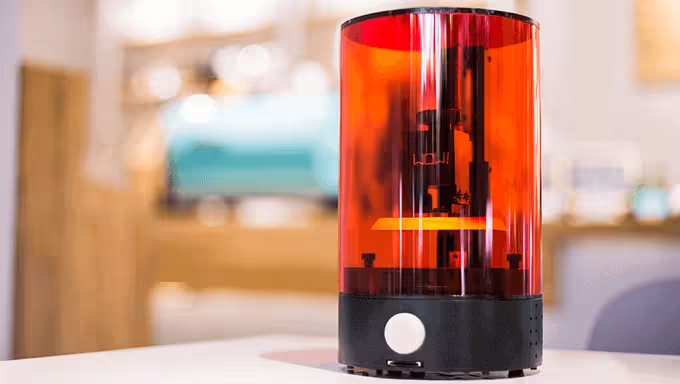
The hardware was minimal by design. The entire printer was roughly the size of a gallon jug, making it the most compact SLA printer available at the time. It shipped fully assembled — no build required, no calibration beyond a quick build plate leveling that took under a minute. The user interface consisted of a single rotary knob with an LED ring. There was no display screen, no Wi-Fi connectivity, no touchscreen. Files were loaded via SD card, and the print was initiated with a single button press.
Specifications of the SparkMaker Original:
- Printing technology: LCD-based SLA (UV photocuring)
- Light source: 24 uniformly distributed UV LEDs (405nm wavelength, 24W total)
- XY resolution: 100 micrometers
- Z-axis resolution: 25-100 micrometers (adjustable)
- Build volume: 98mm × 55mm × 125mm
- Single layer print time: 8-15 seconds
- Connectivity: SD card only
- Power: DC 24V, 48W
- Price: $99-$289 depending on configuration and purchase timing
The build volume was small — deliberately so. The SparkMaker was designed for miniatures, jewelry prototypes, dental models, and small mechanical parts, not for large-format printing. Within its intended use cases, the 100-micrometer XY resolution delivered results that competed with printers costing $1,500 or more.
What the SparkMaker Got Right
Price disruption was genuine. At $99-$289, the SparkMaker was 60-80% cheaper than its nearest SLA competitors. This wasn’t accomplished through inferior components — the UV LED array, the stepper motor with 128 microstep resolution, and the FEP film vat were all functional and capable of producing good results. The savings came from eliminating non-essential features: no screen, no Wi-Fi, no app, no auto-leveling. Everything that could be stripped without affecting print quality was stripped.
Print quality met or exceeded expectations. When properly calibrated and using compatible resin, the SparkMaker produced prints with sharp edges, smooth surfaces, and minimal visible layer lines. For hobbyists accustomed to FDM printing, the difference in surface quality was dramatic. Models created by the SparkMaker were suitable for jewelry casting, dental applications, miniature painting, and prototype fabrication.
The one-button operation lowered the barrier. While SLA printing still required resin handling and post-processing, the SparkMaker eliminated the setup complexity that characterized earlier resin printers. Pour resin, insert SD card, press button. The simplicity attracted users who had been intimidated by the perceived complexity of SLA printing.
Community support filled the documentation gaps. The SparkMaker Facebook group became an active community where users shared calibration tips, resin recommendations, and hardware modifications. This community-driven support model compensated for the manufacturer’s limited official documentation and became a resource that outlasted the printer’s market lifespan.
Where the SparkMaker Fell Short
Reviews from The Gadgeteer, Digital Trends, and Hackster were consistent in identifying the SparkMaker’s limitations alongside its strengths.
The lead screw was the Achilles’ heel. Multiple reviewers and community members reported that the stock lead screw — the component that raises and lowers the build platform — produced inconsistent results. The thread quality caused wobble that affected layer adhesion and dimensional accuracy. The community-developed workaround was to 3D print a replacement lead screw on a separate printer, which improved reliability significantly but required access to another printer.
Documentation was inadequate. The included manual was minimal, and the SparkStudio slicing software had a steep learning curve with limited official guidance. Users who weren’t comfortable with self-directed troubleshooting often struggled with initial setup.
Resin compatibility was narrow. The SparkMaker’s 24W UV LED array was lower-powered than competing printers, meaning it required resins specifically formulated for low-power UV sources. Standard resins designed for higher-powered printers didn’t cure properly, leading to failed prints. The Gadgeteer’s review noted that “only use resin designated for use with low-power UV printers” was critical advice that wasn’t adequately communicated in the official materials.
The SD card limitation was frustrating. The printer could only read a single file named “print.wow” from the SD card, requiring users to rename and replace files for each print. No USB or wireless connectivity was available.
Post-sale support was inconsistent. Several users reported difficulty reaching SparkMaker’s customer service for warranty claims, particularly regarding resin tank leaks. When contact was established, the support was described as helpful, but the initial response times were unreliable.
SparkMaker’s Legacy: Creating the Affordable Resin Printing Market
The SparkMaker’s most significant contribution wasn’t the printer itself — it was the market it created. By proving that consumers would buy sub-$300 SLA printers in volume, the SparkMaker demonstrated demand that attracted larger manufacturers.
Anycubic’s Photon (2018) improved on the SparkMaker’s concept with a built-in touchscreen, better documentation, and a more reliable mechanical platform at a similar price point. Elegoo’s Mars series (2019) further refined the formula with community-driven firmware updates and an aggressive pricing strategy. By 2021, multiple manufacturers were competing in the sub-$200 SLA printer category that the SparkMaker had effectively invented.
The evolution of affordable resin printing mirrors broader patterns in maker culture and consumer 3D printing. Technologies that start as professional-only tools become accessible through crowdfunded first-generation products, which attract mainstream manufacturers once the market is proven. The SparkMaker was the catalyst for SLA printing’s consumer transition, even though later products eventually surpassed it in every measurable specification.
For makers evaluating the current landscape of affordable 3D printers, our analysis of the best open-source 3D printers for the maker era provides updated comparisons across both FDM and SLA technologies.
Affordable SLA Printers in 2026: What the SparkMaker Started
The market the SparkMaker helped create has matured dramatically. In 2026, consumers can choose from dozens of resin printers under $300, with capabilities that would have seemed impossible at the SparkMaker’s launch:
Current-generation affordable SLA printers typically offer 4K or 8K LCD screens (versus the SparkMaker’s standard-resolution panel), build volumes 2-4 times larger, integrated air filtration systems, Wi-Fi connectivity with remote monitoring, and comprehensive slicing software with automatic support generation. Brands like Anycubic, Elegoo, Creality, and Phrozen have built entire product lines around the affordable SLA category.
The SparkMaker FHD (Full HD) attempted to keep pace with these developments, upgrading to a 1080p LCD panel and faster print times. But the company’s smaller scale and limited R&D budget made it difficult to compete with manufacturers who could iterate faster and achieve better economies of scale.
The lesson of the SparkMaker is both inspiring and cautionary. Being first to market in a new category generates attention, community, and brand equity. But sustaining that position requires ongoing investment in product development, customer support, and competitive positioning that early-stage crowdfunded companies often struggle to maintain.
Frequently Asked Questions
What is the SparkMaker 3D printer?
The SparkMaker is a compact desktop SLA (stereolithography) 3D printer that launched on Kickstarter in 2017. It was one of the first resin printers to break the $300 price barrier, with early-bird pricing starting at $99. It uses LCD-based UV photocuring technology to produce high-resolution prints from liquid photopolymer resin.
How much does the SparkMaker cost?
The SparkMaker Original was available at prices ranging from $99 (early-bird Kickstarter pricing) to $289 at retail. The SparkMaker FHD, an upgraded version with a 1080p LCD panel, was priced slightly higher.
Is the SparkMaker good for beginners?
The SparkMaker’s one-button operation simplifies the printing process, but SLA printing in general requires handling liquid resin, post-processing with isopropyl alcohol, and UV curing. Multiple reviewers noted that the SparkMaker’s limited documentation and occasional mechanical issues make it more suitable for users comfortable with troubleshooting than complete beginners.
What is the difference between SLA and FDM 3D printing?
FDM (Fused Deposition Modeling) melts and extrudes thermoplastic filament to build objects layer by layer. SLA (Stereolithography) uses UV light to selectively harden liquid photopolymer resin. SLA produces higher resolution prints with smoother surfaces, while FDM is generally faster, uses cheaper materials, and produces stronger functional parts. For a deeper comparison, see our FDM vs SLA vs SLS printing technology comparison.
What resin works with the SparkMaker?
The SparkMaker requires 405nm UV-curable resin specifically formulated for low-power UV printers. Standard resins designed for higher-powered SLA printers may not cure properly. SparkMaker’s own branded resins are compatible, and Monoprice resins have also been reported to work well by the community.
Is the SparkMaker still available?
The SparkMaker Original and FHD models have been largely superseded by newer affordable SLA printers from Anycubic, Elegoo, and Creality. However, the SparkMaker remains available through some retailers and can still produce quality prints when properly configured and used with compatible resin.