
Unihertz Titan
When BlackBerry officially exited the smartphone market in 2020, it left behind millions of users who had built their professional lives around physical keyboards. Touch-screen typing was faster for most people, but for email-heavy professionals, security-conscious executives, and anyone who valued tactile feedback over predictive text, nothing replaced the certainty of pressing an actual key.
Unihertz, a Shanghai-based manufacturer founded in 2006, saw the gap and filled it. The Unihertz Titan, launched through a Kickstarter campaign that raised over $1 million from more than 5,000 backers, was the company’s first serious attempt at building a rugged QWERTY smartphone that could serve as a daily driver. It wasn’t trying to be a BlackBerry clone — it was trying to be what BlackBerry should have become.
This is a comprehensive analysis of the Unihertz Titan lineup, from the original rugged model through the Titan 2 Elite unveiled at MWC 2026 to a standing ovation.
Table of Contents
Why the Unihertz Titan Exists: The Market BlackBerry Abandoned
The physical keyboard smartphone market didn’t disappear when BlackBerry stopped making phones. It went underground. Forums on Reddit, CrackBerry, and specialized Android communities continued to host thousands of active users searching for alternatives. TCL’s attempt to license the BlackBerry brand produced underwhelming hardware. OnwardMobility’s promised 5G BlackBerry never shipped. The demand was real, but no major manufacturer considered the market large enough to pursue.
Unihertz operated on a different calculus. As a smaller manufacturer with lower overhead and a direct-to-consumer model built on Kickstarter campaigns, the company could profitably serve niche markets that Samsung, Apple, and Google ignored. The Titan was designed for a specific user: someone who types extensively on their phone, works in environments where durability matters, and values functionality over fashion.
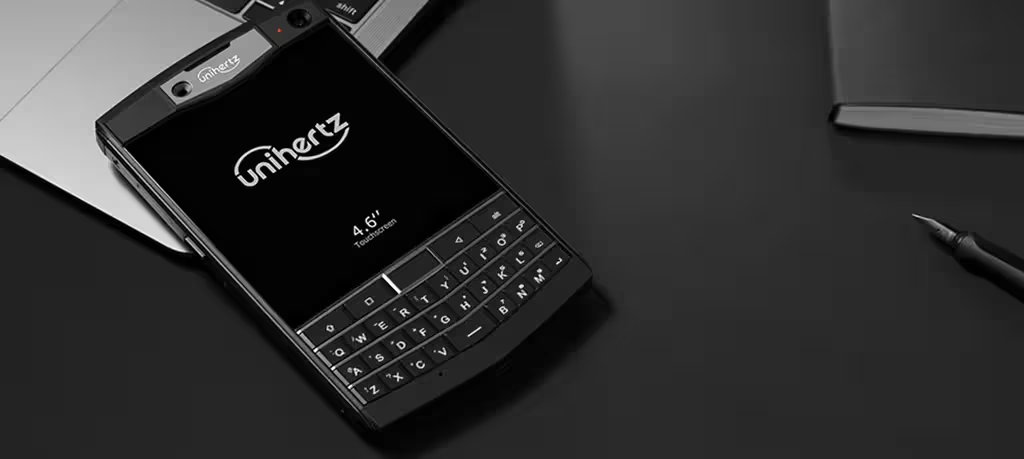
The original Titan launched with specs that reflected this philosophy. A 4.6-inch touchscreen sat above a full QWERTY keyboard with individually sculpted keys. The phone carried an IP67 rating for water and dust resistance, making it genuinely usable in construction sites, outdoor fieldwork, and industrial environments. A 6,000mAh battery — roughly twice the capacity of flagship phones — delivered two-day battery life under normal use. The combination of keyboard, ruggedness, and battery capacity created a product category that didn’t exist elsewhere in the Android ecosystem.
The Titan’s target audience overlapped significantly with the gadgets and mobile technology enthusiast communities that had been tracking BlackBerry alternatives since 2016.
Unihertz Titan Original: Specifications and Technical Analysis
The original Unihertz Titan positioned itself as a tool rather than a lifestyle device. Here’s what it delivered:
Display and Input: The 4.6-inch LCD touchscreen (1430 x 1438 pixels) worked in conjunction with the physical QWERTY keyboard. The keyboard doubled as a trackpad, allowing users to scroll through content by swiping across the key surface — a feature borrowed from BlackBerry’s later Passport and Priv models. Each key could be programmed with short-press and long-press shortcuts, effectively giving users 52 customizable quick-launch buttons.
Durability: IP67 certification meant the phone could survive submersion in one meter of water for 30 minutes and was completely sealed against dust infiltration. The body was reinforced at impact points, and the screen was protected by Corning Gorilla Glass. This wasn’t cosmetic ruggedness — field testers reported the phone surviving drops onto concrete from working height.
Battery: The 6,000mAh battery supported 18W fast charging and Qi wireless charging. In practical use, the phone consistently delivered 1.5 to 2 days of battery life with moderate use, and up to 3 days with conservative use. For field workers without reliable access to charging, this was a genuine differentiator.
Processing: A MediaTek Helio P60 octa-core processor paired with 6GB of RAM handled Android 10 competently. The Titan was never positioned as a performance device — it prioritized reliability and battery efficiency over benchmark scores.
Connectivity: Dual nano-SIM slots, global LTE band support, NFC for contactless payments, and a programmable PTT (push-to-talk) button. The PTT button could also be assigned to any application, making it a versatile hardware shortcut.
Camera: A 16MP rear camera and 8MP front camera delivered adequate results for documentation purposes but couldn’t compete with dedicated camera phones. This was a deliberate trade-off — the engineering budget went toward the keyboard mechanism and battery, not camera optics.
The Titan Lineup Evolution: From Rugged Pioneer to MWC Award Winner
Unihertz didn’t stop at the original Titan. The company iterated aggressively, producing multiple variants that addressed different segments of the keyboard phone market.
Titan Pocket (2021): A 30% smaller and lighter version with a 3.1-inch square screen, designed for one-handed operation. The Pocket traded the original’s ruggedness for portability, targeting users who wanted a compact secondary phone for messaging and email.
Titan Slim (2022): A slimmed-down model that prioritized pocket-friendly dimensions while retaining the full QWERTY keyboard. Users praised the typing experience but noted the absence of waterproofing — a feature the community consistently requested.
Titan 2 (2025): The first 5G model in the lineup, running Android 15 with a redesigned keyboard that included a scroll assistant and cursor control. The Titan 2 featured a 50MP rear camera, a 4.5-inch square display, and a rear screen for selfies. Priced at approximately $420, it represented a significant step toward mainstream smartphone specifications while retaining the keyboard-first design philosophy.
Titan 2 Elite (2026): Unveiled at MWC Barcelona in March 2026, the Elite earned multiple “Best of MWC 2026” awards. It features an aerospace-grade aluminum frame processed through 20+ precision steps, a 4-inch AMOLED display with 120Hz refresh rate and 1,600 nits peak brightness, and a Dimensity 7400 or 8400 chipset depending on the variant. The keyboard surface now functions as a full touchpad through the “Cursor Assistant” feature. At 163 grams, it’s the lightest Titan yet.
The Titan 2 Elite’s Kickstarter campaign raised over $2.2 million from nearly 5,000 backers. Shipping is scheduled for June 2026, with the Pro variant following in October 2026.
Who the Unihertz Titan Is Actually For
The Titan serves specific professional categories better than any other smartphone on the market:
Field professionals — construction managers, surveyors, environmental scientists, and military personnel who need a phone that survives physical abuse while enabling efficient text communication. The IP67 rating and reinforced chassis aren’t marketing features for these users; they’re operational requirements.
Enterprise communication — executives, lawyers, and financial professionals who manage high volumes of email and messaging. The physical keyboard enables faster and more accurate text input than any on-screen keyboard, particularly for users over 40 who built their typing muscle memory on physical keys.
Security-conscious users — the Titan supports hardware-level security features and programmable keys that can be configured for encrypted communication applications. Several organizations in regulated industries have adopted Titan phones as approved devices for sensitive communications.
International travelers — dual-SIM capability, global band support, and the massive battery capacity make the Titan practical for users who move between countries and may not have reliable access to charging infrastructure.
Nostalgia-driven professionals — a category Unihertz has been candid about serving. Former BlackBerry users who never adapted to touchscreen typing represent a meaningful market segment, and the Titan addresses their needs without pretending to compete with iPhone or Samsung on other dimensions.
Understanding how niche devices like the Titan find their audience connects to broader patterns in how technology trends emerge from underserved communities.
Unihertz Titan vs. The Competition: Where It Stands in 2026
The competitive landscape for physical keyboard smartphones is remarkably thin. After BlackBerry’s exit, TCL’s failed revival, and OnwardMobility’s collapse, Unihertz is essentially the only manufacturer producing QWERTY keyboard phones with current-generation Android software and global carrier support.
The closest alternatives are:
Astro Slide 5G (Planet Computers): A slider-format phone with a full keyboard that slides out from behind the screen. More expensive than the Titan, with a different form factor that appeals to users who want a full-size screen when the keyboard isn’t needed.
Fxtec Pro1-X: Another slider design with a landscape keyboard. Development has been inconsistent, and availability is limited.
Punkt MC02: A minimalist phone with a physical keyboard but intentionally limited smartphone features, designed for digital detox rather than productivity.
None of these competitors match the Titan’s combination of ruggedness, battery capacity, and ongoing manufacturer support. Unihertz’s track record of 11 successful Kickstarter campaigns and continuous iteration on the Titan platform gives it a credibility advantage that newer entrants can’t match.
For readers exploring the broader landscape of smartphones and mobile devices, our mobile technology coverage tracks emerging trends across the full spectrum of handset innovation.
The Unihertz Titan’s Place in Smartphone History
The Titan’s significance extends beyond its immediate market. It demonstrates that niche hardware categories remain viable when a manufacturer is willing to operate at a scale appropriate to the demand. The physical keyboard smartphone market isn’t big enough to justify Samsung or Apple’s attention, but it’s large enough to sustain a focused company like Unihertz with 11 successful product launches and growing brand recognition.
The Titan 2 Elite’s MWC 2026 awards represent a milestone in this trajectory. Being recognized alongside flagship devices from Samsung, Google, and Qualcomm signals that the industry is acknowledging Unihertz’s contribution to smartphone diversity.
As touchscreen fatigue grows and the limitations of on-screen typing become more apparent in an era of longer, more complex digital communications, the Titan’s thesis — that physical keyboards improve productivity for specific use cases — may prove more prescient than its current niche status suggests.
Frequently Asked Questions
What is the Unihertz Titan?
The Unihertz Titan is a rugged Android smartphone with a full physical QWERTY keyboard, manufactured by Shanghai-based Unihertz. Originally launched through Kickstarter, the Titan lineup has evolved through multiple generations, with the Titan 2 Elite (2026) being the latest and most advanced model.
Is the Unihertz Titan waterproof?
The original Unihertz Titan carries an IP67 rating, meaning it can withstand submersion in one meter of water for 30 minutes and is completely dust-sealed. Later models in the lineup vary — the Titan Slim does not include waterproofing, while the Titan 2 Elite’s IP rating depends on the specific variant.
How much does the Unihertz Titan cost?
Pricing varies by model. The original Titan launched at approximately $299 through Kickstarter. The Titan 2 retails for around $420. The Titan 2 Elite starts at approximately $389 through its Kickstarter campaign, with the Pro variant at a higher price point.
Can the Unihertz Titan work on AT&T and T-Mobile networks?
The Titan 2 and Titan 2 Elite are officially authorized to operate on AT&T and Cricket networks. Earlier models were affected by AT&T’s device whitelist policy implemented in 2022. T-Mobile compatibility varies by model and should be verified against the specific band support for your region.
What happened to BlackBerry phones?
BlackBerry stopped manufacturing smartphones in 2016, and TCL’s licensing agreement to produce BlackBerry-branded Android phones ended in 2020. OnwardMobility’s planned 5G BlackBerry was cancelled in 2022. Unihertz has emerged as the primary manufacturer of QWERTY keyboard smartphones.
What is the Unihertz Titan 2 Elite?
The Titan 2 Elite, unveiled at MWC 2026, is Unihertz’s latest QWERTY smartphone. It features an aerospace-grade aluminum frame, a 4-inch AMOLED display with 120Hz refresh rate, a Dimensity 7400 or 8400 chipset, and a keyboard surface that functions as a touchpad. It earned multiple “Best of MWC 2026” awards.