
Target Audience in 2026
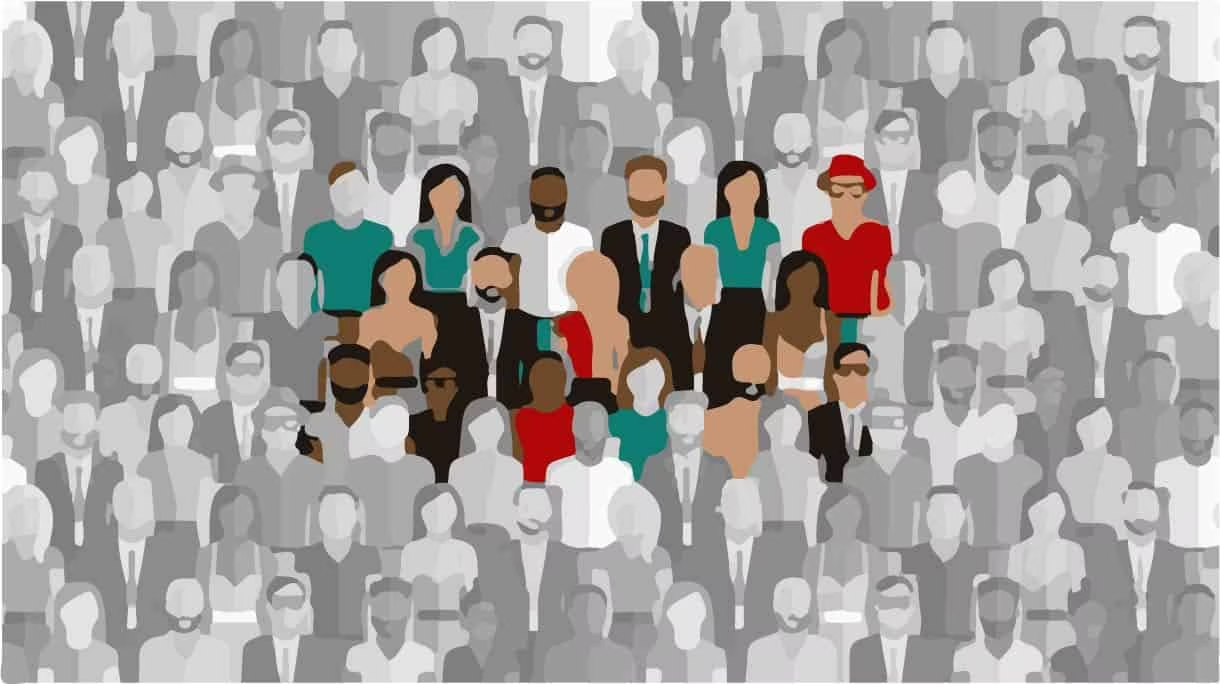
A target audience is the specific group of people most likely to buy your product or respond to your message — defined by shared characteristics like age, behavior, values, or job role. Every marketing decision you make should start with knowing who that group is. When you know your target audience precisely, you stop wasting budget on people who will never convert and start speaking directly to the people who will.
This guide explains what a target audience is, how it differs from a target market, the four main types of target audiences, and a practical step-by-step process for finding yours — including the free and paid tools marketers actually use in 2026.
Target Audience vs Target Market: What’s the Difference?
Most marketing guides use these terms interchangeably. They’re not the same thing, and conflating them is one of the most common reasons campaigns underperform.
Target market is the broad universe of consumers who could plausibly buy your product. A company selling running shoes has a target market of “people who run.” That’s a large, loosely defined category.
Target audience is the specific, campaign-level slice of that market you’re actually speaking to. The same running shoe company might define its target audience for a specific campaign as “women aged 25–40 in US metro areas who run 3+ times per week and follow fitness influencers on Instagram.”
The distinction matters because:
- Your target market tells you the size of the opportunity
- Your target audience tells you what to say, where to say it, and how to say it
A brand that markets to its target market in general terms produces generic messaging. A brand that markets to a defined target audience produces specific, resonant messaging. McKinsey’s research on personalization found that companies excelling at audience-specific targeting generate 40% more revenue than those using broad market messaging — and reduce customer acquisition costs by up to 50%.
| Target Market | Target Audience | |
|---|---|---|
| Scope | Broad — all potential buyers | Narrow — specific campaign segment |
| Defined by | Product category fit | Demographics + psychographics + behavior |
| Changes | Rarely | Per campaign or channel |
| Used for | Business strategy, sizing the opportunity | Creative direction, media buying, messaging |
| Example | “Pet owners in the US” | “Dog owners aged 25–44 who prioritize organic food and shop on Amazon” |
The 4 Types of Target Audience
Every target audience is built from a combination of four segmentation types. Understanding each type helps you build an audience definition that’s specific enough to be actionable.
1. Demographic Target Audience
Demographics are the most common starting point for target audience identification. They describe who your audience is in objective, measurable terms.
Core demographic variables:
- Age — generational differences drive significantly different purchasing behavior (Gen Z vs Millennials vs Gen X vs Boomers)
- Gender
- Income level — critical for pricing strategy and channel selection
- Education level
- Occupation / job title — especially important in B2B
- Location — city, region, country, urban vs rural
- Family structure — household composition, presence of children
- Ethnicity — when relevant to cultural messaging
Demographics are the skeleton of your target audience profile. They tell you who is in the room, but not why they’d buy from you. That’s where psychographics come in.
2. Psychographic Target Audience
Psychographics describe the internal characteristics that drive behavior: what your target audience believes, values, aspires to, and worries about. According to Salesforce’s 2025 State of the Connected Customer report, 73% of consumers now expect brands to understand their unique needs — a standard that demographic-only targeting cannot meet.
Psychographic variables:
- Values — what matters most to this person? (sustainability, status, family, independence, security)
- Lifestyle — daily routines, hobbies, social behaviors
- Personality traits — risk-taking vs cautious, social vs private
- Attitudes — toward technology, brands, competitors, institutions
- Motivations — why do they buy at all? status, convenience, fear, aspiration
- Pain points — what problem are they trying to solve?
A skincare brand with the same demographic target audience (women 25–40) will create completely different messaging depending on whether the psychographic profile centers on “clinical efficacy and ingredient research” or “natural, sustainable products that align with environmental values.” Both groups are the same age and gender. They are not the same target audience.
3. Behavioral Target Audience
Behavioral segmentation groups people by what they actually do, not who they are or what they believe. Behavioral data is often the most predictive of purchase intent.
Behavioral variables:
- Purchase history — what have they bought before? from you or from competitors?
- Brand loyalty level — first-time buyer, repeat customer, brand advocate
- Engagement patterns — how do they interact with content? video vs text vs search?
- Purchase readiness — awareness stage, consideration stage, decision stage
- Usage frequency — light, medium, heavy users
- Device behavior — mobile-first vs desktop, platform preferences
- Search behavior — what keywords do they use to find solutions?
Behavioral data is what makes tools like Google Analytics 4, Meta Ads Manager, and HubSpot CRM powerful for target audience work: they generate behavioral profiles from real interactions, not survey responses.
4. Geographic Target Audience
Geographic segmentation defines your target audience by where they are. This ranges from country and region down to ZIP code and neighborhood.
For digital businesses, geographic targeting affects:
- Language and cultural context — messaging that works in the US may not land in the UK or Australia
- Seasonal relevance — weather-dependent products, local holidays, regional trends
- Regulatory environment — GDPR in Europe, CCPA in California
- Platform usage patterns — TikTok usage skews younger globally but has different penetration rates by country
- Competitive landscape — your target audience faces different competitive alternatives depending on geography
Most real-world target audience definitions combine all four types. A B2B SaaS company’s target audience might be defined as: “Marketing managers (demographic: job role) at US companies with 50–500 employees (demographic: location + company size) who are currently using a competitor platform (behavioral: purchase history) and are frustrated with its reporting limitations (psychographic: pain point).”
That’s a target audience you can write messaging for, choose channels for, and buy media against. “Marketing professionals” is not.
Why Your Target Audience Definition Is the Most Important Marketing Decision You Make
Every downstream marketing decision depends on how well you’ve defined your target audience. Vague audience definitions produce vague campaigns that waste budget. Precise audience definitions produce precise campaigns that convert.
The data makes this concrete. Contentful’s 2025 personalization research found that fast-growing companies generate 40% more revenue from personalization efforts than slower-growing competitors. McKinsey’s personalization report found that personalized targeting can lift revenues by 5–15% and boost marketing ROI by 10–30%. Personalization is only possible when you know your target audience.
What a well-defined target audience enables:
- Messaging that resonates — you can speak directly to a specific person’s situation, not to an abstract demographic category
- Channel selection — you know where your target audience actually spends time, so you don’t guess
- Budget efficiency — you stop paying to reach people who can’t or won’t buy
- Product development — knowing your target audience’s unmet needs guides what to build next
- Content strategy — every piece of content is written for a specific reader, which improves both quality and performance
What a vague target audience produces:
- Generic messaging that doesn’t resonate with anyone in particular
- Wasted spend on channels your actual buyers don’t use
- Low conversion rates that can’t be diagnosed because the audience is undefined
- Content that performs inconsistently because it’s trying to serve everyone
Constant Contact’s 2025 Small Business Now report found that 48% of new small business owners cite customer acquisition as their top challenge. In most of these cases, the underlying problem isn’t the product or the budget — it’s that the target audience hasn’t been defined precisely enough to know who to acquire.
How to Find Your Target Audience: A 6-Step Process
Most businesses have a target audience already — they just haven’t articulated it clearly enough to be useful. The six steps below move you from gut instinct to a documented, data-backed audience definition.
Step 1: Analyze Your Existing Customers
If you have any customers at all, they are the single best source of target audience data. The people who already paid you are the proof of concept for who your target audience is.
What to extract from existing customer data:
- Demographics: Age, location, job title, industry (if B2B), household income (if visible). Your CRM, Shopify dashboard, or Stripe billing records contain most of this.
- Behavioral patterns: How did they find you? What did they search before buying? What pages did they visit? Google Analytics 4 shows user acquisition paths and on-site behavior.
- Psychographic signals: What language do they use in reviews? What problems did they describe before buying? Customer support tickets and product reviews are underused psychographic goldmines.
- Purchase patterns: What do your best customers (highest LTV, lowest churn) have in common? Segment your customer list by value and look for shared characteristics at the top.
If you’re a new business with no customers, go to Step 2 and use competitor intelligence to proxy this data.
Step 2: Research Your Competitors’ Target Audiences
Your direct competitors have likely done significant audience research already. You can learn from their results without paying for the research.
Tools and methods:
- Meta Ad Library (free) — search any brand’s active Facebook and Instagram ads. The creative, copy, and offer reveal who they’re targeting. A competitor running ads featuring middle-aged women in professional settings is signaling their target audience more clearly than any press release.
- Google’s Keyword Planner (free with Google Ads account) — shows what queries bring traffic to competitor pages, revealing search intent and audience vocabulary.
- Review mining — read your competitors’ product reviews on Amazon, G2, Capterra, Trustpilot, or App Store. Reviewers self-identify their situation (“As a freelance designer with 3 kids…”), their pain point, and what they were looking for. This is unfiltered psychographic data.
- SimilarWeb (free tier available) — shows competitor website demographics, traffic sources, and audience interests.
The goal of competitor research is not to copy their target audience — it’s to identify which segments they’re already serving well and which segments they’re ignoring. Underserved segments within a market are where new entrants build defensible positions.
Step 3: Build Your Initial Target Audience Profile
With data from Steps 1 and 2, build a written target audience profile. This is not a “buyer persona” with a stock photo and a name like “Marketing Mary” — those have been rightly criticized as fictional and impractical. A useful target audience profile is a factual, data-backed description.
Target audience profile template:
Primary Target Audience: [one clear sentence describing who this person is]

Demographics:
- Age range:
- Location:
- Job title / industry (B2B) OR household situation (B2C):
- Income range:

Psychographics:
- Primary motivation for buying in this category:
- Top 2-3 pain points this product addresses:
- Values that influence their purchase decisions:
- How they describe the problem in their own words (use actual quotes from reviews):

Behavioral signals:
- How they discover products like yours (search / social / referral / word of mouth):
- Platforms they use most:
- Purchase readiness stage:
- How long is their consideration period before buying?

What they are NOT:
- [Describe the adjacent audience that might seem relevant but isn't a good fit — this prevents scope creep in targeting]
The “What they are NOT” field is as important as the rest. A B2B project management tool for marketing agencies is not for solo freelancers, even though solo freelancers use project management tools. Including the exclusion prevents your campaigns from drifting toward easier-to-reach but harder-to-convert adjacent audiences.
Step 4: Validate with First-Party Data Tools
Once you have an initial target audience profile, validate it against actual platform data before committing budget.
Google Analytics 4
GA4’s audience reporting shows the actual demographics, interests, and device usage of people visiting your site. Navigate to: Reports → User → User attributes → Overview. If your assumed target audience is “professionals aged 30–45,” and GA4 shows your actual visitors skew 18–24, you have a mismatch to investigate.
To use GA4 for target audience validation:
- Set up demographic data collection (requires enabling Google Signals)
- Create audience segments by behavior (e.g., users who visited a pricing page or completed a purchase)
- Compare the demographics of high-intent vs low-intent visitors — your target audience is the high-intent profile, not the general visitor profile
Meta Audience Insights
Available in Meta Business Suite under Insights → Audience. Shows age, gender, location, and interest data for your existing followers and for “potential audiences” you can build by interest. Especially useful for consumer brands where the purchase decision has a social or identity component.
Google Ads Audience Insights
Within Google Ads Manager, the Audience Insights report shows which audience segments are converting for your campaigns, indexed against the general population. Segments with a high index score are over-represented in your conversions — those are characteristics of your actual target audience.
Practical validation test: Take your written target audience profile from Step 3 and build it as an audience in Meta Ads Manager or Google Ads. Check the estimated reach. If the reach is under 10,000, the definition is too narrow for paid media at most budget levels. If it’s over 10 million, it’s too broad to produce relevant messaging. The sweet spot depends on your market, but most effective target audiences for paid acquisition fall between 100,000 and 2 million.
Step 5: Segment Your Target Audience by Channel
Your target audience is not one monolithic group — it behaves differently on different platforms. A 32-year-old B2B software buyer researching solutions on Google is in a different mental state than the same person scrolling LinkedIn during lunch. Your messaging needs to match the context.
Channel-specific target audience adjustments:
| Channel | Audience Mindset | Messaging Approach |
|---|---|---|
| Google Search | Active problem-solving, high intent | Lead with the solution to their specific query |
| Google Display | Passive browsing, low intent | Brand awareness, retargeting of warm audiences |
| Professional context, B2B research | Lead with business outcomes and credibility | |
| Instagram/TikTok | Entertainment, discovery, identity | Lead with visual appeal, peer social proof |
| Email (subscribers) | Already opted in, moderate trust | Lead with value, personalized to their stage |
| Email (cold outreach) | No prior relationship | Lead with a specific, relevant insight about their situation |
Salesforce’s 2025 Connected Customer report found that 73% of consumers expect consistent experiences across every channel — which is only achievable when all channels are built around the same target audience definition, even as the execution adapts to each context.
Step 6: Refine Over Time with Real Performance Data
A target audience definition is a hypothesis. The job of campaigns is to test it. Set up the measurement to learn from every campaign:
- Track conversion segments: Which demographic and interest segments convert best? Update your target audience definition to emphasize these.
- Track negative signals: Which segments click but don’t convert? These are audiences adjacent to your target audience — they appear interested but don’t buy. Excluding them in paid media typically improves CPA immediately.
- Run audience experiments: Split-test two versions of a campaign targeting slightly different audience definitions. Over time, this produces an evidence-based audience profile that replaces the initial hypothesis.
- Listen to customer language: The words your target audience uses to describe their problem are the words your ads and landing pages should use. Mine reviews, support tickets, sales call recordings, and social listening tools quarterly.
Sprout Social’s Q2 2024 Pulse Survey found that more than 40% of consumers will unfollow brands whose values don’t align with their own. This means audience refinement isn’t just a performance marketing question — it’s a brand question. As your understanding of your target audience’s values deepens, your brand positioning should evolve with it.
The Best Tools to Find Your Target Audience in 2026
The tools below are divided by use case. You don’t need all of them — choose the tier that fits your budget and sophistication level.
Free Tools
Google Analytics 4 — behavioral and demographic data from your own website visitors. Best first tool for any business with an existing web presence. Free.
Google Trends — shows search interest over time for any topic, segmented by region, device, and related queries. Useful for identifying seasonal patterns in your target audience’s search behavior. Free.
Meta Business Suite Audience Insights — demographic and interest data for your Facebook/Instagram followers and custom audiences. Free with a Meta business account.
Reddit Search — searching your product category on Reddit surfaces real, unfiltered conversations from people in or adjacent to your target audience. The language, frustrations, and recommendations in these threads are primary psychographic research. Free.
AnswerThePublic — visualizes the questions people ask around any topic. Each question cluster represents a different target audience need state. Free tier available.
Google Keyword Planner — shows search volume and competition for queries your target audience types. Free with a Google Ads account.
Paid Tools
Semrush Audience Analysis — shows the demographics, interests, and behavioral data of any website’s audience. Particularly useful for competitor target audience research. Paid.
SparkToro — audience intelligence tool that shows where any defined audience spends time online, what they read, who they follow, and what podcasts they listen to. Built specifically for target audience research. Paid.
GWI (Global Web Index) — survey data from over 3 billion people across 53 markets. Best for understanding consumer attitudes, media habits, and purchasing behavior at scale. Paid, enterprise pricing.
Brandwatch Consumer Intelligence — social listening tool that tracks brand mentions and category conversations across 100+ million sources. Useful for psychographic research at scale. Custom pricing.
Audiense — audience segmentation and intelligence tool focused on social media audience profiles. Particularly strong for Twitter/X and brand community analysis. Paid.
When to Use Which Tool
| Situation | Recommended Tool |
|---|---|
| Starting from scratch, no budget | Google Analytics 4 + Reddit Search + AnswerThePublic |
| Validating a B2C audience hypothesis | Meta Audience Insights + Google Trends |
| B2B target audience research | LinkedIn Sales Navigator + Semrush + SparkToro |
| Understanding competitor target audiences | Meta Ad Library + SimilarWeb + Semrush |
| Scaling an established audience | GWI or Brandwatch for survey-level data |
Target Audience Examples: How Real Brands Define Theirs
These examples show the difference between a vague target audience description (the kind most internal brand documents contain) and a precise one (the kind that actually drives campaign decisions).
Example 1: B2C Fitness App
Vague: “Health-conscious people who want to get in shape”
Precise target audience: Adults aged 28–42 in US/UK metro areas, household income $60K+, who have tried and abandoned at least one gym membership in the past two years, identify as “wanting to be healthier” but struggle with consistency, use iOS, and follow at least three fitness or nutrition accounts on Instagram. They research products on YouTube before purchasing and respond to social proof from peers rather than expert endorsements.
Why the second version works: it tells the marketing team which platforms to use (Instagram, YouTube), what message will land (consistency problem, not motivation problem), what proof type converts (peer reviews, not expert authority), and what product experience they’ve already rejected (gym memberships requiring fixed schedules).
Example 2: B2B SaaS (Project Management Tool)
Vague: “Businesses that need better project management”
Precise target audience: Marketing directors and senior marketing managers at US agencies with 15–80 employees, currently using spreadsheets or Asana for project tracking, managing 10+ simultaneous client campaigns, frustrated specifically with client reporting and approval workflows. They evaluate software through G2 reviews and free trials, make purchase decisions with budget authority under $500/month, and respond to case studies from agencies in their vertical.
Why this works: the specific pain point (reporting and approvals, not general project management), the evaluation channel (G2 + free trial), the decision-making profile (budget authority at $500/month or less), and the proof format (vertical case studies) all follow directly from the target audience definition.
Example 3: Consumer Electronics (Wireless Headphones)
Vague: “People who listen to music”
Precise target audience: Two distinct segments requiring separate campaigns:
- Segment A (commuter): Urban professionals aged 25–38, commuting daily via public transit, primarily Android users, motivated by noise cancellation quality and battery life, price-sensitive at the $150–$250 range, discovered via YouTube tech review channels
- Segment B (audiophile): Age 30–55, work from home, willing to spend $300–$500, motivated by sound quality and build materials, discovered via dedicated audio forums and Reddit r/headphones
One product, two target audiences, two completely different campaigns. Running a single “people who listen to music” campaign serves neither segment effectively.
AI Era: What Changed in 2025–2026
The mechanics of target audience research haven’t changed. The tools have. Two developments in 2025–2026 are materially affecting how marketers find and reach their target audiences.
1. AI-Powered Audience Segmentation
Traditional audience segmentation drew hard lines: “women 25–34” or “users who visited the pricing page.” AI-based segmentation identifies patterns that demographic and behavioral buckets miss. It clusters users by shared affinity and interconnectedness, surfacing communities that a survey would never predict.
According to Future Market Insights, the audience intelligence platform market is valued at $8.2 billion in 2025 and is projected to reach $34 billion by 2035 — a 15.3% annual growth rate that reflects how quickly AI segmentation is becoming standard practice.
Practically, this means: if you’re using Google Performance Max campaigns, Meta’s Advantage+ audiences, or HubSpot’s AI-driven contact segmentation, the platform’s AI is actively refining your target audience for you based on conversion signals. This is useful, but it requires you to feed it quality first-party data and clear conversion definitions. An AI that optimizes for “add to cart” rather than “high-LTV purchase” will find you the wrong target audience efficiently.
Marketers surveyed by Contentful in January 2025 were allocating 40% of their marketing budgets to personalization — nearly double the 22% reported just a year earlier. That investment is only defensible when the underlying target audience definition is precise enough to personalize against.
2. Generational AI Search and Zero-Click Behavior
When your target audience searches on Google in 2026, an increasing percentage of them never click through to any website. Bain & Company’s 2026 research found that 60% of searches now end without a click. AI Overviews, Google’s AI Mode, and ChatGPT answer questions directly.
This changes target audience strategy in one specific way: understanding your target audience’s search behavior is no longer just about knowing what keywords they type. It’s about knowing what questions they ask AI systems. A target audience that previously typed “best CRM for small business” into Google and clicked through to comparison pages may now get a complete answer from an AI Overview without visiting any website.
The implication: content designed to reach your target audience through search must now be written to be cited inside AI systems, not just to rank above them. That means authoritative, specific, source-backed answers to the exact questions your target audience asks — which requires knowing those questions precisely. Back to the target audience definition.
The 5 Most Common Target Audience Mistakes
These are the errors that prevent an otherwise good marketing strategy from working.
Mistake 1: Defining the Target Audience Too Broadly
“Small businesses” is not a target audience. “Female homeowners aged 35–55” is not specific enough to write copy for. A target audience broad enough to describe millions of people with fundamentally different needs cannot be served by a single message.
The test: read your target audience definition aloud. Could you write the opening line of an email to this person? If not, the definition is still too broad.
Mistake 2: Assuming the Target Audience Is Like You
Founders and marketers default to assuming their target audience thinks the way they do, uses the language they use, and cares about what they care about. Pulsar Platform’s 2026 audience research guide documents this bias: “Two 25-year-olds in the same ZIP code can share zero cultural touchpoints.” Segmentation must follow behavior, not biography.
Mistake 3: Updating the Target Audience Definition Once (at Launch) and Never Again
A target audience definition is a hypothesis that should be tested and refined continuously. Markets shift. Products evolve. The first customers of a startup are often early adopters whose profile differs significantly from the mainstream buyers who follow. Treating the initial target audience definition as permanent means optimizing for customers who no longer represent the opportunity.
Mistake 4: Defining a B2B Target Audience as a Company Instead of a Person
“Companies with 100–500 employees in the technology sector” is a target market, not a target audience. The actual target audience for a B2B product is the specific person inside that company who feels the problem, evaluates solutions, and influences the purchase decision. In many B2B sales, that’s three different people: the end user (who feels the pain), the economic buyer (who controls the budget), and the champion (who advocates internally). Each requires different messaging.
Mistake 5: Confusing Audience Reach with Audience Quality
A campaign that reaches 10 million people in the wrong target audience underperforms one that reaches 100,000 in the right target audience. Meta’s own Advantage+ audience research consistently shows that tighter, better-defined audiences produce lower cost per acquisition than broad targeting, even with automated optimization. More reach is not the goal. More relevant reach is.
FAQ
What is a target audience in simple terms?
A target audience is the specific group of people you want to reach with your marketing message — the people most likely to buy your product or take the action you’re asking for. You define your target audience by shared characteristics: their age, job, values, behavior, or problems. The more precisely you define your target audience, the more relevant your marketing becomes and the less you waste on people who aren’t interested.
What is the difference between a target audience and a target market?
A target market is the broad category of all potential buyers for your product. A target audience is the specific segment of that market you’re actively marketing to with a particular campaign or message. Your target market rarely changes. Your target audience shifts by campaign, channel, and offer. For example, a fitness brand’s target market is “adults who exercise.” Its target audience for a January campaign might be specifically “women aged 28–40 who set fitness goals at the start of the year and have disposable income for premium products.”
How do I identify my target audience?
Start with your existing customers: look at who actually buys from you and what they have in common. Then use platform tools — Google Analytics 4 for website visitor demographics, Meta Audience Insights for social followers, Google Ads Audience Insights for search converters — to validate and refine your assumptions with real data. Build a written target audience profile that includes demographics, psychographics, behavioral signals, and an explicit description of who your target audience is not. Review and update the profile quarterly as campaign data accumulates.
What are the 4 types of target audience?
The four main types of target audience segmentation are: (1) demographic — who they are in measurable terms (age, gender, income, location); (2) psychographic — their values, motivations, and lifestyle; (3) behavioral — what they do, including purchase history, platform usage, and engagement patterns; and (4) geographic — where they are. Effective target audience definitions typically combine all four, using demographics as the starting frame and adding psychographic and behavioral layers to produce a profile specific enough to market to.
What is a target audience example?
A concrete target audience example for a B2C meal kit service: “Dual-income households without children, aged 28–40, living in US metro areas, with household income over $80K. They value cooking at home but have limited time on weekdays. They’ve ordered from a meal kit service before but churned due to portion size or variety issues. They discover new products via Instagram and read food content on YouTube. They’re willing to pay $12–$15 per serving if the quality justifies it.” This is a profile specific enough to write an ad, choose a platform, and set a price point.
Does my target audience matter for SEO?
Yes, directly. Your target audience’s search behavior — the exact words they use to describe their problem, the questions they ask, the keywords they type — determines which content you should create and how to structure it. Understanding your target audience’s vocabulary is how you identify which keywords to rank for. Understanding their intent (are they researching or ready to buy?) tells you what type of content to create at each stage. Google’s March 2026 core update explicitly rewards content that demonstrates deep understanding of the actual user behind the query — which is another way of saying: content written for a precisely defined target audience outranks content written for “anyone searching this topic.”
How is a target audience different from a buyer persona?
A buyer persona is a semi-fictional representation of your target audience — a named character (“Marketing Maria, 35, works at a mid-size agency”) built from audience research. The target audience is the actual, data-backed definition that underpins it. Personas are useful for aligning creative teams on voice and context. The underlying target audience definition is what drives media buying, segmentation, and performance measurement. Personas can become a liability if they substitute for real data — treating a fictional character as the source of truth rather than the customer data it was built from.