
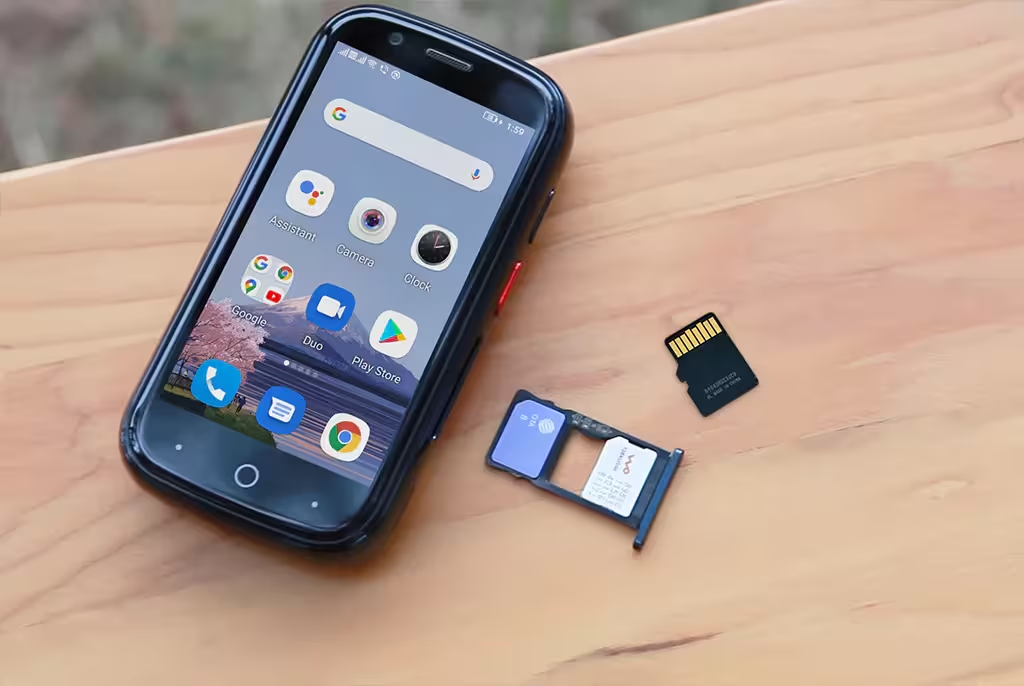
Unihertz Jelly 2
Smartphones have been getting bigger every year since 2010. The average flagship screen now exceeds 6.5 inches, and folding phones push that number even further. For most consumers, bigger screens mean better media consumption, easier typing, and more immersive gaming. But a persistent minority of users has been pushing back against this trend, arguing that phones should fit comfortably in a pocket, be operable with one hand, and prioritize portability over screen real estate.
Unihertz addressed this audience directly with the Jelly 2, a 3-inch Android smartphone that weighs 110 grams and fits in the coin pocket of a pair of jeans. Launched through Kickstarter in 2021, the Jelly 2 raised over $1.7 million and became one of the most successful ultra-compact phone campaigns in crowdfunding history. It wasn’t a toy, a feature phone, or a novelty item — it was a fully functional Android 11 smartphone with NFC, a fingerprint reader, and an IR blaster, compressed into a body smaller than most credit card cases.
Table of Contents
The Case for Tiny Phones: Why the Jelly 2 Exists
The Jelly 2’s value proposition isn’t for everyone, and Unihertz has never pretended otherwise. The phone serves specific use cases where small size is an advantage rather than a compromise.
Secondary phone users represent the largest segment of Jelly 2 buyers. Runners, cyclists, and gym-goers who want music, GPS, and emergency calling without carrying a full-size phone. Business travelers who want a backup device with a local SIM card. Security-conscious professionals who carry a separate phone for encrypted communications.
Minimalism and digital wellness advocates use the Jelly 2 as a deliberate constraint. The small screen discourages social media scrolling, video binging, and other attention-consuming behaviors while maintaining access to essential communication tools. Several digital detox communities have adopted the Jelly 2 as a recommended “dumb phone alternative” that retains smartphone functionality for maps, messaging, and emergencies.
Specialized professional applications include healthcare workers who need a pocketable phone that doesn’t interfere with PPE or sterile environments, and military personnel who need a compact communication device that fits into tactical gear without adding bulk.
The Jelly 2 also carved out an unexpected niche in the enthusiast and collector community. Small phone forums on Reddit, XDA Developers, and specialized Android communities treat compact phones as a category worth tracking and discussing, much like mechanical keyboard enthusiasts track niche keyboard manufacturers. This gadgets subculture has sustained demand for ultra-compact phones even as the mainstream market moves toward larger screens.
Unihertz Jelly 2: Technical Specifications
Despite its diminutive size, the Jelly 2 packed legitimate smartphone specifications into a 95mm × 49mm × 16.5mm body:
- Display: 3.0-inch IPS LCD, 480 × 854 pixels
- Processor: MediaTek Helio P60, octa-core up to 2.0GHz
- RAM/Storage: 6GB RAM, 128GB internal storage, microSD expansion
- Battery: 2,000mAh (adequate for the small screen, typically lasting a full day)
- Cameras: 16MP rear, 8MP front
- OS: Android 11 (Android 10 on the original Jelly)
- Connectivity: 4G LTE (global bands), Wi-Fi 802.11 a/b/g/n/ac, Bluetooth 5.0
- Security: Rear fingerprint sensor, face unlock
- Special features: NFC for contactless payments, IR blaster for remote control, programmable shortcut key
- Weight: 110 grams
- IP Rating: None (not waterproof)
The inclusion of NFC was a critical decision. Many compact and budget phones omit NFC to save costs, but its absence eliminates contactless payment — a feature many users consider essential for a daily-carry phone. The IR blaster was a bonus feature that allowed the Jelly 2 to function as a universal remote control, a capability that delighted users who discovered it.
The Jelly Series Evolution
The Jelly 2 was the second generation of Unihertz’s ultra-compact phone line:
Jelly (2017): The original Jelly was a 2.45-inch phone that ran Android 7.0 with 1GB of RAM. It was proof-of-concept more than a practical daily driver, but it established the product category and demonstrated market demand.
Jelly 2 (2021): A substantial upgrade with a larger 3-inch screen, modern processor, NFC, and fingerprint sensor. The Jelly 2 was the first model practical enough for daily use as either a primary or secondary phone.
Jelly Star (2023): Added a transparent back panel with an LED notification system, running Android 13 with a Helio G99 processor. The Star emphasized personality and customization while maintaining the compact form factor.
Jelly Max (2024): Expanded the screen to 5 inches — departing from the ultra-compact philosophy but retaining the “Jelly” branding for the expanded Unihertz lineup.
The original Jelly and Jelly 2 remain the purest expressions of the concept: smartphones designed around the constraint of minimum viable size. Every component selection, every feature inclusion or exclusion, was evaluated through the lens of “can this fit in a phone that disappears into a coin pocket?”
Real-World Usage: What Living With a 3-Inch Phone Is Actually Like
Community feedback from Jelly 2 owners reveals consistent patterns in how the phone integrates into daily life.
Typing is challenging but manageable. The on-screen keyboard works, but extended text composition is impractical. Most Jelly 2 users rely heavily on voice dictation, canned responses, and brief messages. The phone is better suited for receiving and triaging communications than composing lengthy replies.
Maps and navigation work surprisingly well. Google Maps and Waze function on the 3-inch screen, and the phone’s GPS accuracy is comparable to full-size smartphones. Runners and cyclists particularly value this — the phone mounts easily on armbands and handlebar mounts designed for much larger devices.
Battery life exceeds expectations. The 2,000mAh battery sounds small by 2026 standards, but the tiny, low-resolution screen draws minimal power. Users consistently report full-day battery life with moderate use, and the phone charges quickly via USB-C.
App compatibility is good but not universal. Most Android apps run on the Jelly 2, though some with fixed landscape layouts or minimum screen size requirements may not display correctly. Banking apps, messaging apps, email clients, and utility apps generally work well. Social media apps are functional but uncomfortable to browse for extended periods — which some users consider a feature rather than a bug.
The phone is genuinely pocketable. This is the Jelly 2’s defining characteristic in practice. Users who have experienced running without a phone bouncing in their pocket, or attending formal events without a rectangular bulge ruining their suit lines, consistently cite this as the primary reason they keep the phone in their rotation.
For those tracking developments in compact and specialized mobile technology, the Jelly line represents an ongoing experiment in how small a useful smartphone can be.
Frequently Asked Questions
What is the Unihertz Jelly 2?
The Unihertz Jelly 2 is a 3-inch Android smartphone designed to be the world’s smallest fully functional 4G phone. It features a Helio P60 processor, 6GB RAM, 128GB storage, NFC, a fingerprint sensor, and an IR blaster in a 110-gram body that fits in a coin pocket.
How much does the Unihertz Jelly 2 cost?
The Jelly 2 launched at approximately $129 through Kickstarter. Retail pricing varies but typically ranges from $129 to $169 depending on the retailer and market.
Can the Unihertz Jelly 2 be used as a primary phone?
The Jelly 2 can function as a primary phone for users whose smartphone needs center on calls, messaging, maps, and basic app usage. Extended text composition and media consumption are limited by the 3-inch screen, making it better suited as a secondary device for most users.
Does the Unihertz Jelly 2 support contactless payments?
Yes. The Jelly 2 includes NFC, enabling contactless payment through Google Pay and other NFC-based payment systems.
Is there a newer version of the Unihertz Jelly?
Unihertz has released several Jelly variants including the Jelly Star (2023) with LED notification lights and Android 13, and the Jelly Max (2024) with a larger 5-inch screen. The Jelly 2 remains available and popular among users who prioritize the smallest possible form factor.