
What Does NGL Mean?
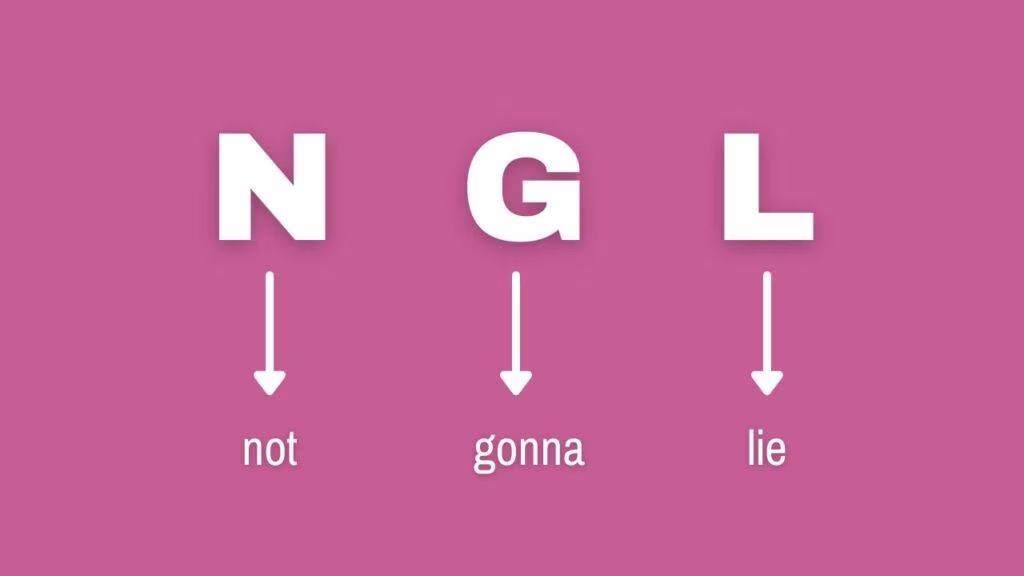
NGL stands for “Not Gonna Lie” — a texting abbreviation used to signal honesty or a candid opinion before saying something true, blunt, or mildly embarrassing. It reads in lowercase (ngl) almost as often as uppercase, and you’ll find it at the start of sentences across TikTok, Instagram, Snapchat, iMessage, and WhatsApp. There is also a separate app called NGL — built on the same abbreviation — and that app had a dramatic 2024 that most explainers skip entirely. Both meanings are covered here.
What does NGL mean in texting?
NGL = Not Gonna Lie. When someone types “ngl” before a statement, they’re flagging that what follows is their genuine, unfiltered take — no performance, no softening. It’s the digital equivalent of prefacing a sentence with “honestly” or “I have to be real with you.”
Three quick examples of NGL in real use:
- “Ngl, that concert was better than I expected.” (honest praise)
- “Ngl, I have no idea what I’m doing in this class.” (self-deprecating admission)
- “Ngl, the ending of that show was kind of awful.” (blunt opinion)
In all three cases, “ngl” does the same job: it sets the reader’s expectations for honesty. The phrase isn’t a literal promise to tell the truth. It’s more of a conversational warm-up that signals sincerity — a habit now so baked into digital communication that most people type it without thinking.
NGL is closely related to TBH (To Be Honest), IMO (In My Opinion), and FR (For Real). The difference is subtle: TBH is typically used when sharing an opinion someone didn’t ask for; IMO distances you from a claim; NGL specifically invokes the idea that you’re being candid rather than just opinionated.
Where did NGL come from?
The phrase “not gonna lie” predates the internet. Spoken English has used it for decades as an informal way to emphasize honesty before saying something unexpected or slightly uncomfortable. The abbreviation is newer.
According to submissions visible on Urban Dictionary, the first standalone entry for “NGL” appeared in January 2009 — slightly earlier than many similar text abbreviations. By 2010, it had accumulated enough entries to suggest it was already common in early social media and SMS culture.
The pattern follows the same arc as most internet abbreviations: a phrase that was too long to type on a physical keyboard got compressed into three letters, and those three letters spread through platforms that rewarded brevity. Twitter’s original 140-character limit accelerated this. TikTok’s comment culture — where response time and character count both matter — kept it alive through the 2020s.
NGL sits in what linguists and communications researchers call “hedged honesty markers” — short phrases that soften a direct statement while simultaneously amplifying its credibility. The phrase tells the receiver: I could have kept this polished, but I chose to be straight with you. That framing is useful in a social media environment where everything else is curated.
How NGL is actually used — platform by platform
The abbreviation doesn’t behave identically across platforms. Context shapes how NGL lands.
NGL on TikTok
On TikTok, NGL appears most often in comments and video captions. It’s used to validate a reaction (“ngl this made me cry”), to join a conversation honestly (“ngl I was also confused by this”), or to deliver a mild hot take in a way that reads as self-aware rather than aggressive. The platform’s fast comment culture makes three-letter openers like NGL particularly efficient.
NGL on Snapchat and Instagram
On Snapchat and Instagram DMs, NGL usually precedes a compliment or an admission. It’s warmer in this context — closer to “I have to tell you something real.” In Instagram Stories comments, it reads more like a public opinion flag.
NGL on WhatsApp and iMessage
In private message threads with friends or family, NGL is the most conversational version of itself. The stakes are lower, so it often precedes small honest observations: “ngl I’m kind of tired of this plan.” The formality drops entirely; lowercase is standard.
NGL in memes
Meme culture uses NGL to create a specific comedic setup: the confession that’s relatable because everyone shares it but nobody says. “Ngl, I re-read that text 14 times before sending” works as a meme caption because the NGL signals an uncomfortable truth that the audience recognizes.
Is NGL rude?
Not inherently. NGL is a neutral prefix — its tone depends entirely on what follows. “Ngl, you’re really talented at this” is a compliment. “Ngl, that was a weird thing to say” is a gentle criticism. “Ngl, I can’t stand this person” is harsher.
The abbreviation can be used to soften a blunt statement by framing it as honesty rather than attack. It can also be used sarcastically. And like any honesty signal, it occasionally precedes something the listener didn’t want to hear. Whether it’s rude depends on the context, not on the letters themselves.
One thing NGL is not: a formal or professional register. It does not belong in work emails, client messages, or any situation where the relationship requires more care. The same way you wouldn’t say “not gonna lie” to your boss in a performance review, you don’t type NGL there either.
NGL vs. TBH vs. IMO — what’s the actual difference?
These three abbreviations are often used interchangeably, but they carry slightly different implications.
| Abbreviation | Stands for | The implication |
|---|---|---|
| NGL | Not Gonna Lie | “I’m being unusually honest right now” |
| TBH | To Be Honest | “Here’s my real opinion, whether you asked or not” |
| IMO | In My Opinion | “This is a personal view, not a fact” |
| FR | For Real | “I’m being serious, not sarcastic” |
| ISTG | I Swear to God | “I’m emphasizing the truth of what I’m saying” |
The functional overlap between NGL and TBH is the highest. The main distinction: TBH is often used alone (“tbh” as a standalone prompt for anonymous compliments) or to precede a positive observation. NGL tilts slightly more toward admissions and blunt opinions, though both have been used in every direction.
What is the NGL app — and is it different from the slang?
Yes. The NGL app is a separate product that took its name from the abbreviation. Understanding the difference matters because people searching “what does NGL mean” are sometimes asking about the app — especially parents, teachers, and anyone who found the name in a teenager’s phone.
The NGL app (available at ngl.link) is an anonymous messaging service. Users generate a link, share it to their Instagram Story, TikTok bio, or other social profile, and invite followers to send them anonymous questions or comments. The sender’s identity is hidden from the recipient.
The app launched in November 2021, developed by NGL Labs in Venice Beach, California. It climbed the App Store charts quickly by piggybacking on Instagram Stories’ reach — a user could share their NGL link as a Story and get responses from anyone who saw it, without those people revealing who they were.
By March 2024, NGL Labs announced the app had reached 200 million users. As of the December 2025 acquisition by Mode Mobile (detailed below), the platform reported 125 million monthly active users across web and mobile.
What happened to the NGL app in 2024 and beyond?
The NGL app had significant regulatory and ownership changes that anyone using or researching the app should know.
The FTC enforcement action (July 2024)
In July 2024, the U.S. Federal Trade Commission and the Los Angeles District Attorney’s Office took action against NGL Labs and its two co-founders, Raj Vir and Joao Figueiredo. The complaint alleged multiple law violations:
- The app actively marketed itself to children and teens despite knowing the risks
- NGL sent users fake, AI-generated messages that appeared to come from real followers — not actual humans
- Users were encouraged to buy NGL Pro (a paid tier at $9.99 per week) to “reveal” who sent each message; the alleged reveals were misleading because the messages themselves were fake
- The company charged recurring weekly fees without clear user consent
- NGL violated COPPA (Children’s Online Privacy Protection Act) by collecting personal data from minors without parental consent and without any age verification
The settlement terms, published by the FTC on July 9, 2024:
- $5 million total financial remedy — $4.5 million for consumer redress, $500,000 civil penalty to the LA DA’s office
- Permanent ban on offering the app to anyone under 18
- Required implementation of an age gate
- Mandatory destruction of much of the user data previously collected
- This was the FTC’s first-ever ban on an online service from offering its product specifically to minors (rather than just children under 13, as COPPA usually defines)
The FTC launched a refund claims process in January 2026 for users who paid for NGL Pro between January 2022 and July 2024. The claims window closed April 6, 2026. Details at ftc.gov/enforcement/refunds/ngl-settlement.
The Mode Mobile acquisition (December 2025)
In December 2025, NGL was acquired by Mode Mobile, a Chicago-based smartphone company that operates what it calls an “EarnPhone” — a device that rewards users for engagement while displaying advertising. According to TechCrunch’s reporting on December 19, 2025, the original founders left the company following the acquisition. Three remaining employees joined Mode Mobile.
Mode Mobile stated that the acquisition brings 125 million monthly active users into its ecosystem. The company plans to integrate its EarnOS rewards infrastructure into NGL, allowing users to earn rewards for engagement while advertisers pay for their attention.
The terms of the sale were not disclosed publicly.
Should parents be concerned about the NGL app in 2026?
The short answer: the regulatory picture has changed significantly. The NGL app is now legally restricted to users 18 and older as a result of the 2024 FTC settlement. In practice, age gates on apps are imperfect enforcement mechanisms — they typically rely on users self-reporting their age. No third-party age verification is built into most app store downloads.
Here’s what actually changed after the FTC action:
- The app is required to bar users who indicate they are under 18
- NGL is prohibited from marketing to minors
- The founders who built the original product are no longer with the company
- Mode Mobile, the new owner, operates a different business model centered on ad monetization
The anonymous nature of the app remains. Anyone who shares an NGL link and receives messages still cannot verify who sent them — that is the core function of the product. The difference now is that the fake AI-generated messages that were the basis of the FTC complaint are no longer supposed to be part of the product.
The practical guidance for parents: if your child is under 18, the app is not legally intended for them. The FTC’s consumer page on the NGL settlement has the clearest summary of what the enforcement action covered.
A brief timeline of NGL — slang and app
Early 2000s — The phrase “not gonna lie” is in common spoken use in English-speaking countries. Early internet forums begin abbreviating it.
January 2009 — First standalone Urban Dictionary entry for “NGL” as an abbreviation, marking its entry into documented internet slang.
2010–2015 — NGL spreads through SMS, Twitter, and early Facebook use. The abbreviation becomes standard in Gen Z and millennial text communication.
2019–2021 — TikTok’s rise amplifies NGL across a new generation. The abbreviation appears regularly in captions, comment threads, and meme formats.
November 2021 — NGL Labs launches the NGL anonymous messaging app in Venice Beach, California.
Q1–Q2 2022 — The NGL app records over 12.5 million downloads in its first six months, according to AppMagic data cited by Statista.
March 2024 — NGL Labs announces the platform has reached 200 million total users.
July 9, 2024 — The FTC and Los Angeles DA settle against NGL Labs. The app pays $5 million, is permanently banned from serving users under 18, and is required to destroy collected minor user data.
December 2025 — Mode Mobile acquires NGL. The original founders depart. The platform has 125 million monthly active users.
January 2026 — FTC launches the refund claims process for NGL Pro subscribers.
Frequently asked questions about NGL
What does NGL mean in a text message?
NGL means “Not Gonna Lie.” It’s used at the start of a sentence to signal that what follows is a candid, honest opinion or admission. It’s informal and suited to casual digital communication — not professional or formal contexts.
What does NGL mean on TikTok?
The same as in texting: Not Gonna Lie. On TikTok, it appears in video captions and comments as a way to preface an honest reaction, a hot take, or a relatable confession. It’s particularly common in comment threads responding to viral content.
What does NGL mean on Snapchat?
Not Gonna Lie. On Snapchat, it often precedes a compliment or a candid admission in direct messages. Snapchat also became the main distribution channel for the NGL anonymous messaging app, which let users share NGL links in their Stories.
Is NGL the same as TBH?
They’re similar but not identical. Both signal honesty, but TBH (To Be Honest) tends to precede unprompted opinions or compliments, while NGL often introduces admissions and blunt takes. In practice, most native users treat them as interchangeable.
What is the NGL app?
The NGL app (ngl.link) is an anonymous messaging service that lets users receive messages from followers without knowing who sent them. It launched in November 2021, reached 200 million users by March 2024, was the subject of a major FTC enforcement action in July 2024 (resulting in a $5 million fine and a permanent ban on serving minors), and was acquired by Mode Mobile in December 2025.
Is the NGL app safe?
Since the July 2024 FTC settlement, the app is legally restricted to users 18 and older. The enforcement action found that the app had sent fake AI-generated messages to users, misled paid subscribers about identity reveals, and charged recurring fees without adequate consent. The app is now under new ownership (Mode Mobile). The anonymity of the product itself remains unchanged.
Can you find out who sent you an NGL message?
No. NGL’s anonymous messaging design means the sender’s identity is not revealed to the recipient. The paid NGL Pro subscription, which previously claimed to offer “hints” about senders, was specifically cited in the FTC’s complaint as deceptive — the hints were vague, and many of the messages themselves were AI-generated rather than from real followers.
Who is the new owner of NGL in 2026?
Mode Mobile, a Chicago-based company known for its “EarnPhone” device that rewards users for engagement with ads. The acquisition was announced in December 2025. NGL’s original founders, Raj Vir and Joao Figueiredo, left the company following the acquisition.
When did NGL the slang first appear?
The phrase “not gonna lie” predates the internet. As an abbreviation, “NGL” first appeared in documented form on Urban Dictionary in January 2009, roughly when early social media and SMS culture were compressing common phrases into shorthand.
Is NGL appropriate for work or formal writing?
No. NGL is informal slang suited to casual digital conversations with people you know. It doesn’t belong in professional email, client communication, or any context where register matters. In written contexts beyond casual chat, writing out “to be honest” or “honestly” reads better and avoids confusion.
Key takeaways
- NGL = Not Gonna Lie. It signals honesty or a candid take before a statement. Lowercase (ngl) is equally common.
- The phrase moved from spoken English into internet abbreviation around 2009 and became standard in Gen Z digital communication by the mid-2010s.
- NGL is similar to TBH, IMO, and FR, but carries a specific connotation of candor rather than just opinion.
- The NGL app is a separate anonymous messaging product. It launched in 2021, reached 200 million users, faced a major FTC enforcement action in 2024, and was acquired by Mode Mobile in December 2025.
- The app is now legally restricted to users 18 and older following the FTC settlement.
- The slang isn’t going anywhere. The app’s ownership has changed, but “ngl” as a texting abbreviation is embedded enough in digital communication that it will remain standard regardless of what happens to the platform that borrowed its name.