
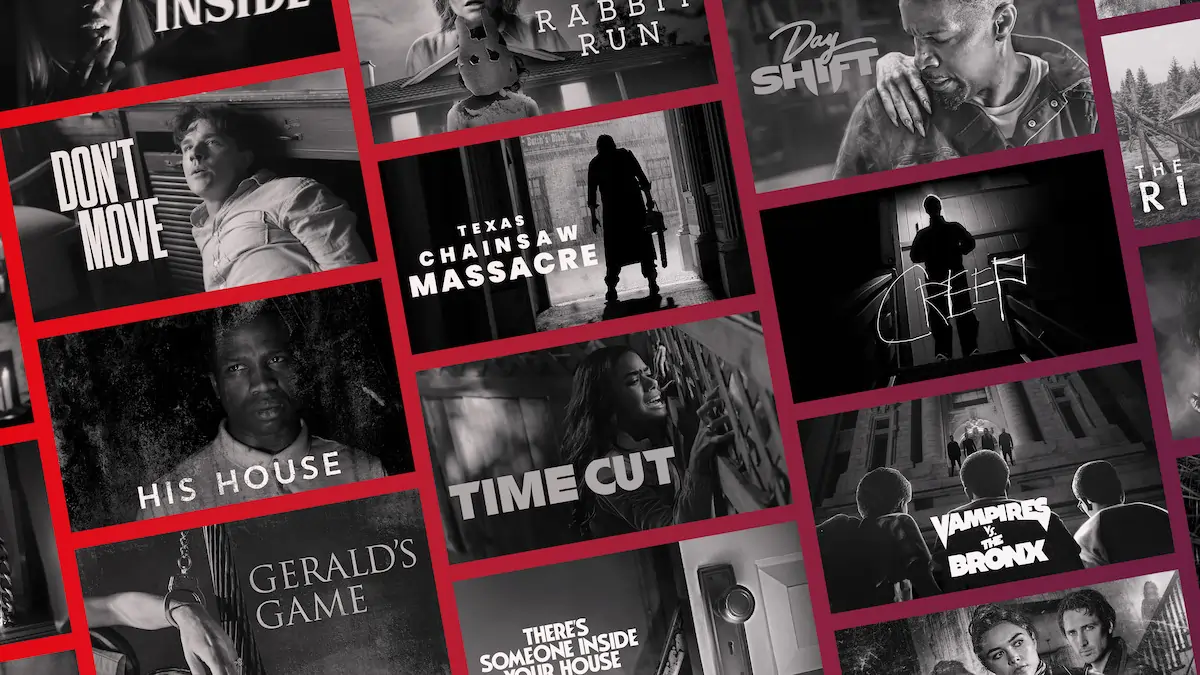

Best Horror Movies on Netflix Right Now (April 2026)
The fastest way to find something to watch: the table below maps every pick in this article to a fear type, subgenre, Rotten Tomatoes score, and runtime. Skip straight to the section that matches what you’re after. If you want to know what’s actually worth your time and why, read on.
Table of Contents
The master table — all 18 picks at a glance
| Film | Year | Subgenre | Fear type | RT score | Runtime | Level |
|---|---|---|---|---|---|---|
| Frankenstein (del Toro) | 2025 | Gothic horror | Existential dread | 79% | 2h 28m | 🩸🩸 |
| Don’t Move | 2024 | Slasher / thriller | Paralysis / helplessness | 91% | 1h 25m | 🩸🩸🩸 |
| A Quiet Place Part II | 2021 | Creature / sci-fi | Tension / sudden shocks | 91% | 1h 37m | 🩸🩸🩸 |
| Train to Busan | 2016 | Zombie | Speed / claustrophobia | 98% | 1h 58m | 🩸🩸🩸 |
| His House | 2020 | Supernatural / drama | Grief-based dread | 100% | 1h 33m | 🩸🩸🩸 |
| Apostle | 2018 | Folk horror / cult | Slow-burn unease | 73% | 2h 10m | 🩸🩸🩸 |
| The Fear Street Trilogy | 2021 | Slasher | Gore / visceral | 88–90% | ~1h 45m each | 🩸🩸🩸 |
| Cam | 2018 | Psychological | Identity / paranoia | 95% | 1h 34m | 🩸🩸 |
| Hereditary | 2018 | Slow-burn / occult | Grief + dread | 90% | 2h 7m | 🩸🩸🩸🩸 |
| Midsommar (Director’s Cut) | 2019 | Folk horror | Daylight dread | 83% | 2h 51m | 🩸🩸🩸🩸 |
| The Autopsy of Jane Doe | 2016 | Supernatural | Confined dread | 86% | 1h 26m | 🩸🩸🩸 |
| Night of the Living Dead | 1968 | Classic zombie | Siege / paranoia | 96% | 1h 36m | 🩸 |
| Veronica | 2017 | Supernatural | Teen dread | 90% | 1h 45m | 🩸🩸🩸 |
| His Dark Materials S3 | — | Dark fantasy | — | — | — | — |
| I Know What You Did Last Summer 2 | 2024 | Slasher | Stalker tension | 42% | 1h 41m | 🩸🩸 |
| Hellboy (del Toro, 2004) | 2004 | Monster / action | Action-horror blend | 81% | 2h 2m | 🩸🩸 |
| The Green Knight | 2021 | Dark fantasy | Surreal dread | 89% | 2h 10m | 🩸🩸 |
| Haunted Mansion | 2023 | Comedy horror | Family-safe | 38% | 2h 3m | 🩸 |
Fear level key: 🩸 = mild / atmospheric only · 🩸🩸 = moderately unsettling · 🩸🩸🩸 = genuinely scary, some sleep disruption possible · 🩸🩸🩸🩸 = seriously disturbing, proceed with preparation. RT scores current as of April 16, 2026 — Rotten Tomatoes.
If you only watch one: Frankenstein (2025)
Guillermo del Toro’s Frankenstein is the most important horror film currently streaming on Netflix — not because it’s the scariest (it isn’t), but because of what it represents and what it does technically that almost nothing else on the platform matches.
Del Toro spent over a decade trying to make this film. His earliest public references to wanting to adapt Mary Shelley date to at least 2010 (“My favorite novel in the world is Frankenstein”). The finished version arrived in limited theaters October 17, 2025, and hit Netflix on November 7, 2025.
The awards context nobody aggregates in one place:
- 9 Academy Award nominations (2026 Oscars): Best Picture, Best Supporting Actor (Jacob Elordi), Adapted Screenplay, Cinematography, Costume Design, Production Design, Original Score, Sound
- 4 Critics Choice Award wins: Best Supporting Actor (Elordi), Costume Design, Production Design, Hair & Make-Up
- 5 Golden Globe nominations: Best Drama, Best Director, Best Score, Best Actor Drama (Oscar Isaac), Best Supporting Actor (Elordi)
- Confirmed for the Criterion Collection (no release date yet as of April 2026)
- Extended cut confirmed: del Toro announced at the 2026 Sundance Film Festival that an “all the stitches” version is complete and will release at an unspecified future date
The honest review: Oscar Isaac as Victor Frankenstein is committed and occasionally over-the-top. Jacob Elordi as the Creature is the best performance in the film by a significant margin — he brings grief, fury, and genuine sympathy to a role that could have been a costume showcase. At 2h 28m, the pacing is uneven; del Toro’s version is more emotionally layered character study than horror film. The last act significantly departs from Shelley’s novel (the Creature forgives Victor; Victor calls him “son” before dying). Viewers who love the novel may be frustrated. Viewers coming fresh will find it one of the more visually striking films of 2025.
Watch it if: You want the biggest cinematic event currently on Netflix, you appreciate gothic visual storytelling, or you want to understand the awards conversation.
Skip it if: You need something genuinely frightening, or the runtime is a constraint.
The five films that will actually scare you
His House (2020) — 100% RT | 🩸🩸🩸
His House holds the highest Rotten Tomatoes score of any horror film currently on Netflix and earns it. Directed by Remi Weekes, it follows two South Sudanese refugees — Bol and Rial — who escape war and settle in a dilapidated council estate outside London. Something is in the walls.
What makes it exceptional is that the horror is inseparable from the immigrant experience it’s depicting — the terror of displacement, of bureaucracy, of grief, of an alien environment that rejects you at every turn. Setting a haunted house film in a British housing project rather than a Gothic manor is a genuinely original move. The horror imagery when it arrives is disturbing in ways that rely on African mythological traditions rather than Western horror conventions, which makes it land harder for most Western audiences who can’t anticipate it.
At 1h 33m, it’s tightly paced. It will stay with you. Watch it before someone tells you the monster’s origin.
Don’t Move (2024) — 91% RT | 🩸🩸🩸
Don’t Move is produced by Sam Raimi (Evil Dead) and operates at a high-concept premise level: a grieving woman is injected with a paralytic drug that will shut down her nervous system within 20 minutes. The film runs in near-real time across roughly 85 minutes.
The paralysis mechanic transforms every closed shot into a sustained threat. Kelsey Asbille’s performance requires conveying increasing physical limitation while maintaining emotional legibility — it works better than it should. The villain is effective without explanation, which is the correct choice. Critics found the resolution unsatisfying; the setup is the point here.
Good for: anyone who wants a tight, contained thriller with genuine visceral tension rather than jump-scare mechanics.
Train to Busan (2016) — 98% RT | 🩸🩸🩸
The zombie genre was running low on ideas by 2016. Korean director Yeon Sang-ho’s answer: put everything on a moving train, make the zombies fast, and actually make you care about the characters before they die.
The film’s reputation — comparisons to 28 Days Later, 98% on Rotten Tomatoes, global box office success — is fully deserved. The action sequences are excellently staged. The emotional throughline (a workaholic father reconnecting with his daughter during a zombie outbreak on a KTX train) holds. The political subtext about Korean class dynamics and corporate irresponsibility is present but doesn’t overwhelm.
If you’ve already seen it: the follow-up animated film Seoul Station (also on Netflix) serves as a prequel set during the same outbreak, told from different characters’ perspectives.
The Fear Street Trilogy (2021) — 88–90% RT | 🩸🩸🩸
Three films. Three time periods. One curse. Director Leigh Janiak’s adaptation of R.L. Stine’s Fear Street novels covers 1994, 1978, and 1666, connecting a single story across them in a structure that rewards watching all three in sequence.
Part 1: 1994 is the strongest entry and the sharpest horror film of the three — a Scream-era slasher with genuine reverence for the genre’s rules and an LGBTQ+ love story at its center. Part 2: 1978 moves to a summer camp setting (Friday the 13th influences are explicit and intentional). Part 3: 1666 resolves the mythology and is the most dramatically satisfying conclusion.
Each film runs approximately 1h 45m. Total trilogy runtime: around 5h 15m. Worth the commitment if you have it.
The Autopsy of Jane Doe (2016) — 86% RT | 🩸🩸🩸
André Øvredal’s The Autopsy of Jane Doe is a masterclass in confined dread. A father-and-son coroner team receive an unidentified female body — no external trauma, no cause of death apparent. The entire film takes place across one night in a basement morgue as they attempt to determine what killed her.
The film is quiet, patient, and methodical in a way that amplifies everything when the horror emerges. Brian Cox and Emile Hirsch are grounded and believable, which matters enormously. The answers the film provides are more disturbing than the mystery. The final five minutes are divisive (some find them too neat; others find them the correct escalation).
This is the film most likely to genuinely unsettle viewers who thought they’d become immune to horror.
Psychological horror — films that work on your mind
Hereditary (2018) — 90% RT | 🩸🩸🩸🩸
Ari Aster’s debut remains the most discussed horror film of the past decade and, for many viewers, the most disturbing. It operates on grief, family trauma, and a slow accumulation of wrongness that becomes explicit horror by the final act. Toni Collette’s performance is one of the great unrecognized lead performances in any genre from recent years.
Be warned: the film contains a scene approximately 30 minutes in that has genuinely traumatized first-time viewers. It is not a jump scare. It is worse. Know this going in or don’t know it and be devastated — both are valid choices.
At 2h 7m and a 90% RT score, this is the film critics and serious horror fans consistently put at the top of any Netflix horror list. The horror community’s discourse around it has not died down in seven years.
Cam (2018) — 95% RT | 🩸🩸
Cam is a Netflix original written by Isa Mazzei (based on her experiences as a camgirl) about a successful sex worker who discovers her account has been taken over by a perfect doppelgänger — one that is more popular and more extreme than she ever was.
The horror operates on identity theft and digital self-erasure rather than physical threat, which makes it land differently from almost everything else on this list. Madeline Brewer’s dual performance is technically impressive. The film refuses to explain its mystery completely, which is correct.
This is the best horror film on Netflix that most people haven’t seen.
Midsommar — Director’s Cut (2019) — 83% RT | 🩸🩸🩸🩸
Ari Aster’s second film is the rare horror movie that takes place almost entirely in daylight. A couple (Florence Pugh, Jack Reynor) travel to a Swedish midsummer festival that turns out to be a pagan ritual ceremony.
The Director’s Cut (available on Netflix) runs 2h 51m and adds approximately 24 minutes of character development that makes the final act more emotionally resonant — specifically around the relationship dynamics and Pugh’s character’s grief arc. If you’ve only seen the theatrical cut, the Director’s Cut is meaningfully different.
The uncomfortable context: Midsommar is also a breakup movie, and the horror partially functions as catharsis for anyone who has felt trapped in a relationship that stopped serving them. This is either fascinating or too much, depending on your current situation.
Folk horror and the supernatural
Apostle (2018) — 73% RT | 🩸🩸🩸
Gareth Evans — director of The Raid — made a 1905-set folk horror film about a man infiltrating a Welsh island cult to rescue his kidnapped sister. The 73% RT score undersells it: the film was divisive among critics precisely because it commits fully to its violence in ways that are genuinely disturbing rather than gratuitous.
The tone is slow-burn and oppressive until it isn’t. Dan Stevens is well-cast as a man with a hollowed-out faith. The island’s cult mythology is constructed with genuine internal logic. The final sequence is extreme by any reasonable standard — go in knowing that.
Veronica (2017) — 90% RT | 🩸🩸🩸
Paco Plaza (co-director of [REC]) made this Spanish supernatural film based on documented real events — the only known case in Spanish history where police reported fleeing a scene due to paranormal activity, the 1991 Vallecas case. Luisa Sorinas leads as a teenage girl who plays with a Ouija board during a solar eclipse and suffers the consequences.
The film is significantly better than the premise sounds. Plaza’s direction is controlled and patient. The horror sequences avoid easy shock and build instead on sustained dread. For viewers who find American supernatural horror formulaic, Veronica offers a European variation that takes the material seriously.
For the right genre occasions
The Green Knight (2021) — 89% RT | 🩸🩸
David Lowery’s adaptation of Sir Gawain and the Green Knight is dark fantasy rather than horror proper, but it’s visually unlike anything else on Netflix and operates at a sustained register of surreal unease. Dev Patel plays Gawain, nephew to King Arthur, who takes up a challenge from a massive Green Knight and must face consequences a year later.
The film is slow and refuses to explain itself. It rewards patience and will frustrate viewers expecting conventional narrative. For the right viewer, it is one of the five best films on Netflix in any genre.
Hellboy (2004) — 81% RT | 🩸🩸
Guillermo del Toro’s Hellboy is on Netflix from January 2026, riding the del Toro wave following Frankenstein‘s success. The film doesn’t hold up as horror — it’s a superhero-monster action film with heavy creature work and Ron Perlman in one of the most physical lead performances of the 2000s.
Watch it as a companion piece to Frankenstein to trace del Toro’s visual vocabulary, or if you want creature effects that were built practically rather than generated. The sequel (Hellboy II: The Golden Army, 2008) is arguably better and also on Netflix.
The one film leaving Netflix soon
Apostle — confirmed leaving May 7, 2026. If you haven’t seen it, this is the most time-sensitive pick on this list.
Note: Netflix doesn’t always announce departure dates in advance. Check your Netflix account’s “More Info” or sites like Flixable/JustWatch for your region’s current departure schedule. This information is accurate as of April 16, 2026.
What the March 2026 Google update changed about how to evaluate these recommendations
This is something the other lists won’t tell you: after the March 2026 core update, many horror recommendation articles that relied on generic “experts” with no visible identity, recycled synopsis copy, and affiliate-only link structures were significantly downranked. The same month, Netflix’s own editorial team updated their Tudum horror recommendations page.
What this means for how to read horror lists in 2026: if a list doesn’t name who made the picks, doesn’t disclose what the reviewer actually thought (including criticism), and doesn’t have departure date information — it was probably written to rank, not to help. The Don’t Move review on this page includes the fact that critics found the resolution unsatisfying. The Hereditary entry tells you about the traumatizing scene before you encounter it. The Frankenstein section gives you the awards data, the extended cut information, and an honest reading of the pacing problem.
Which horror mood are you in? — a decision guide
You want to be disturbed for days: Hereditary → Midsommar → His House, in that order
You want sustained tension without blood: Don’t Move → The Autopsy of Jane Doe → Cam
You want to watch with a group: Fear Street Trilogy → Train to Busan → Apostle
You want something critically acclaimed but not intense: Frankenstein (del Toro) → The Green Knight → Cam
You want the fastest path to genuine scares: His House (1h 33m) → Don’t Move (1h 25m) → The Autopsy of Jane Doe (1h 26m)
You want international horror: Train to Busan (Korean) → His House (British/South Sudanese) → Veronica (Spanish)
Frequently asked questions
What is the best horror movie on Netflix right now in 2026?
The best horror film currently on Netflix by critical consensus is His House (2020, 100% on Rotten Tomatoes) — a British supernatural horror about two South Sudanese refugees haunted by something in their new home. For the biggest cinematic event, Guillermo del Toro’s Frankenstein (2025) received 9 Academy Award nominations and is the most decorated horror film on the platform. For pure fear, Hereditary (2018) and Train to Busan (2016) are the most consistently effective across different audiences.
Is Guillermo del Toro’s Frankenstein worth watching on Netflix?
Yes, with caveats. Frankenstein (2025) received 9 Academy Award nominations including Best Picture and a Critics Choice win for Jacob Elordi, who plays the Creature. At 2h 28m, the pacing is uneven and del Toro departs significantly from Mary Shelley’s original ending. It is more gothic character study than horror film. An extended “all the stitches” cut is confirmed but has no release date yet as of April 2026. It has also been confirmed for the Criterion Collection.
What horror movies are leaving Netflix soon?
As of April 16, 2026, Apostle (2018) is confirmed leaving Netflix on May 7, 2026. Netflix does not always announce departure dates publicly in advance — check your local Netflix title page or JustWatch for current exit dates for specific films by region.
What is the scariest movie on Netflix right now?
For most audiences, Hereditary (2018) and Midsommar (2019, Director’s Cut) consistently rank as the most disturbing films currently on Netflix. His House (2020) is considered the most critically acclaimed horror film on the platform. Train to Busan (2016) is the most viscerally intense. Your response will depend on whether you’re more affected by psychological dread, grief-based horror, or physical threat.
What is Don’t Move on Netflix about?
Don’t Move (2024) is a Netflix thriller-horror produced by Sam Raimi in which a woman is injected with a paralytic drug by a serial killer at a remote location. The drug will completely shut down her nervous system within 20 minutes. The film runs approximately 85 minutes in near-real time and was produced with Sam Raimi. It scored 91% on Rotten Tomatoes at release.
What Netflix horror movies are best for someone who doesn’t like gore?
His House (2020), Cam (2018), and Don’t Move (2024) are the most effective horror films on Netflix for viewers who want psychological horror over gore. His House and Cam contain minimal graphic violence. Don’t Move is a thriller with some violence but the horror operates primarily on physical helplessness rather than gore. Hereditary and Midsommar are the furthest in the opposite direction — both contain graphic imagery.